
The Last Tree: A Story of Renewal
A Tale of Hope, Change, and the Power of Nature

In a small village nestled between rolling hills, there stood an ancient oak tree. This tree had seen generations come and go, its gnarled branches stretching wide as if embracing the entire village. Children played under its shade, couples carved their names into its bark, and elders often sat nearby, reminiscing about the past.
For as long as anyone could remember, the tree had been a symbol of life, strength, and continuity. It was more than just a tree; it was a part of the village’s soul. The villagers would gather each year to celebrate its presence, planting flowers around its roots and lighting candles beneath its canopy, singing songs of gratitude.
But as the years passed, something began to change. The village, once thriving with life and green fields, started to feel the strain of progress. Factories, roads, and large buildings crept closer, taking over the lands that had once been lush and full of life. The air grew heavier, and the once crystal-clear river began to darken with the waste of human activity.
The oak tree, too, began to show signs of distress. Its leaves turned brown earlier in the season, and the branches that once stretched proudly toward the sky seemed to sag. The villagers were heartbroken but powerless. The tree had stood the test of time, but it couldn't withstand the relentless march of pollution and deforestation.
One quiet autumn morning, an old woman named Lila, who had lived her entire life in the village, walked to the oak tree, leaning heavily on her cane. She had seen this tree grow from a sapling into the mighty oak it was, and she could feel its pain in her bones. She sat beneath its branches, her heart heavy with sorrow.
"How long, old friend?" she whispered, her voice trembling. "How long can we continue to take from you and not give anything back?"
As the wind whispered through the thinning leaves, Lila closed her eyes, remembering the way the village used to be. She thought of the laughter of children, the scent of wildflowers in the breeze, the sound of birds singing from the tree's highest branches. Her heart ached, not just for the tree, but for the world that seemed to be slipping away.
Days passed, and the tree's condition worsened. The village began to notice the change. People who had once ignored the land around them, focusing only on their own lives, now saw the quiet desperation in the tree’s fading leaves. Some said it was a sign, a warning from nature itself.
One evening, the villagers gathered around the oak. Lila stood at the front, her eyes moist with tears, and spoke in a voice both soft and strong. "We've watched this tree suffer, just as our earth suffers. It’s not too late to change, but we must act. We cannot wait for tomorrow, for tomorrow may be too late."
A tear slid down Lila’s cheek as she raised her hand, urging the crowd to listen. "Let us promise that we will restore this land, that we will plant new trees, protect the rivers, and nurture the earth that has always nourished us. Let this oak remind us of what we stand to lose, and let us fight to save it, for ourselves, and for future generations."
And so, the village changed. People planted new trees around the oak, started cleaning the river, and built systems to reduce waste. They began to live in harmony with the land, not taking more than it could give, but giving back more than they ever had before.
The oak tree didn’t recover immediately, but over the years, its branches grew stronger, its leaves greener. And as the tree flourished, so did the village. Lila, now an old woman, lived to see the transformation, and when the tree was finally strong again, she whispered, "We saved you, and in saving you, we saved ourselves."
The last tree had become a symbol of hope. It reminded the villagers that even when things seem lost, there is always a way to heal. The environment, much like the oak, could endure if given the chance. But it was up to humanity to choose to nurture, protect, and cherish it before it was too late.
About the Creator
Keep reading
More stories from Shiv Rabari and writers in Earth and other communities.
The Last Journey of Bala the Elephant
In the dense jungles of Assam, there lived a wise and gentle elephant named Bala. He was massive, with tusks that gleamed like polished ivory and a soulful gaze that seemed to hold the stories of a thousand years. Bala was the leader of his herd, a protector and guide through treacherous rivers and drought-ridden summers.
By Shiv Rabariabout a year ago in Poets
Workers Recover 15,000 Crabs After Lorry Crashes Into Field
An extraordinary scene unfolded when a lorry carrying an estimated 15,000 live crabs crashed into a field, spilling its cargo across farmland and prompting a large-scale recovery effort. The unusual accident quickly drew attention from local residents, emergency services, and animal welfare groups, as workers scrambled to rescue as many crabs as possible before they succumbed to exposure.
By Aarif Lashari3 days ago in Earth
US Balks as UK and France Pledge Troops to Postwar Ukraine
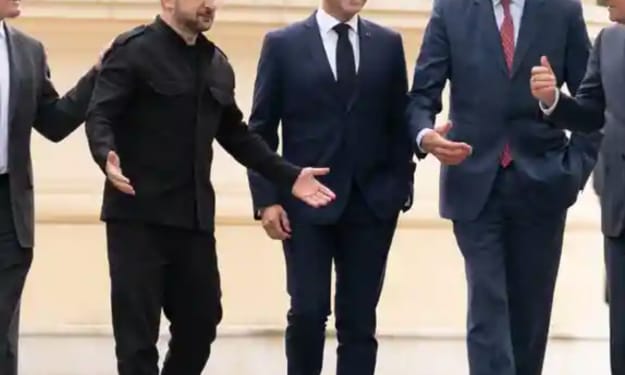
As the war in Ukraine grinds on with no clear end in sight, the debate over what comes after the fighting has taken a sharper turn. The United States has signalled reluctance about committing troops to Ukraine once the war ends, even as the United Kingdom and France openly pledge to consider deploying forces in a postwar security role. The divergence has exposed differing strategic priorities among Western allies and raised new questions about how Ukraine’s future security will be guaranteed. While all three nations remain united in their support for Kyiv during the war, the emerging split over postwar troop commitments highlights the complexity of planning for peace in a conflict that continues to reshape Europe’s security landscape. What the UK and France Are Proposing British and French leaders have increasingly spoken about the need for long-term security arrangements for Ukraine once active hostilities end. Their position reflects a growing concern that any ceasefire or peace agreement could be fragile, leaving Ukraine vulnerable to renewed aggression. The idea under discussion is not a combat deployment in an active war zone, but rather a stabilisation or reassurance force. Such troops could help train Ukrainian forces, protect critical infrastructure, and serve as a visible deterrent against future attacks. Supporters argue that a limited but credible international presence would help ensure that any peace settlement is respected. For London and Paris, this approach fits within a broader European push to take more responsibility for continental security. Both governments see Ukraine not only as a partner but as a frontline state whose stability directly affects Europe as a whole. Why Washington Is Hesitant The United States, while remaining Ukraine’s most significant military backer during the war, has taken a more cautious stance on postwar troop deployments. American officials have stressed that there are no plans to send US forces into Ukraine, even after a potential peace agreement. This hesitation is rooted in several factors. First, Washington remains wary of any move that could risk a direct confrontation with Russia. Even in a postwar scenario, the presence of US troops on Ukrainian soil could be portrayed by Moscow as a provocation, escalating tensions rather than reducing them. Second, domestic considerations play a major role. After years of overseas military engagements, there is limited appetite among the American public and political class for new long-term deployments abroad, particularly in a region where risks remain high and outcomes uncertain. Finally, US strategy has increasingly emphasised supporting allies through funding, training, and equipment rather than large-scale troop commitments. From Washington’s perspective, enabling Ukraine to defend itself may be preferable to stationing American forces on the ground. A Question of Deterrence At the heart of the debate lies a fundamental question: what will actually deter future aggression against Ukraine? The UK and France appear to believe that a physical presence, however limited, would send a powerful signal of commitment. Troops on the ground would demonstrate that Ukraine’s security is directly tied to that of major European powers, raising the cost of any future attack. The US, by contrast, seems to place greater faith in alternative mechanisms such as long-term military aid, security guarantees, and sanctions frameworks. American officials argue that deterrence does not necessarily require boots on the ground, especially if Ukraine emerges from the war better armed and more integrated with Western institutions. This difference reflects broader strategic cultures. European powers, facing the immediate proximity of the conflict, may feel a stronger need for visible reassurance measures, while the US assesses risks from a more global perspective. Implications for NATO Unity Although Ukraine is not a NATO member, the discussion has clear implications for the alliance. Any deployment of UK or French troops would be closely scrutinised for what it means for NATO’s role and credibility. NATO operates on consensus, and the absence of US support for a postwar troop presence could complicate coordination. Even if London and Paris act independently or as part of a smaller coalition, questions would remain about command structures, rules of engagement, and the political backing required for such a mission. At the same time, the situation underscores a broader shift within NATO, with European members increasingly expected to shoulder more responsibility. If the UK and France proceed with their plans, it could mark a significant step toward a more autonomous European security posture. Ukraine’s Perspective For Kyiv, the debate is both encouraging and frustrating. On one hand, the willingness of major European powers to consider troop deployments signals long-term commitment and recognition of Ukraine’s security concerns. On the other hand, uncertainty from the US—Ukraine’s most powerful ally—adds another layer of unpredictability. Ukrainian leaders have consistently argued that security guarantees must be concrete, not symbolic. From their perspective, any postwar arrangement must ensure that Russia cannot simply regroup and strike again. Whether this is achieved through foreign troops, binding treaties, or accelerated integration with Western institutions remains an open question. What is clear is that Ukraine wants assurances that go beyond promises and declarations. The Risk of Mixed Signals One potential danger of the current divergence is the message it sends to Moscow. Differing positions among Western allies could be interpreted as hesitation or lack of unity, potentially weakening deterrence rather than strengthening it. At the same time, open debate is not necessarily a sign of weakness. Allies often disagree on tactics while remaining aligned on broader goals. The challenge will be ensuring that these differences do not undermine the core objective of securing a stable and sovereign Ukraine. Diplomats on both sides of the Atlantic are likely to continue working behind the scenes to narrow the gap, even if public statements suggest a clear divide. Looking Ahead The question of postwar Ukraine remains largely theoretical while fighting continues. Yet the discussion itself reveals how seriously Western governments are taking the long-term consequences of the conflict. The UK and France’s willingness to pledge troops reflects a belief that peace must be actively protected. The US reluctance highlights concerns about escalation, sustainability, and domestic support. Reconciling these approaches will be one of the most important diplomatic challenges once the guns eventually fall silent. For now, the disagreement does not signal a breakdown in alliance unity, but it does expose the difficult choices ahead. As the war continues, planning for peace is proving almost as complex—and politically sensitive—as managing the conflict itself.
By Muhammad Hassan6 days ago in Earth



Comments
There are no comments for this story
Be the first to respond and start the conversation.