
The Last Message from Mars
: A stranded astronaut, a failing communication link, and a secret Earth was never supposed to know.
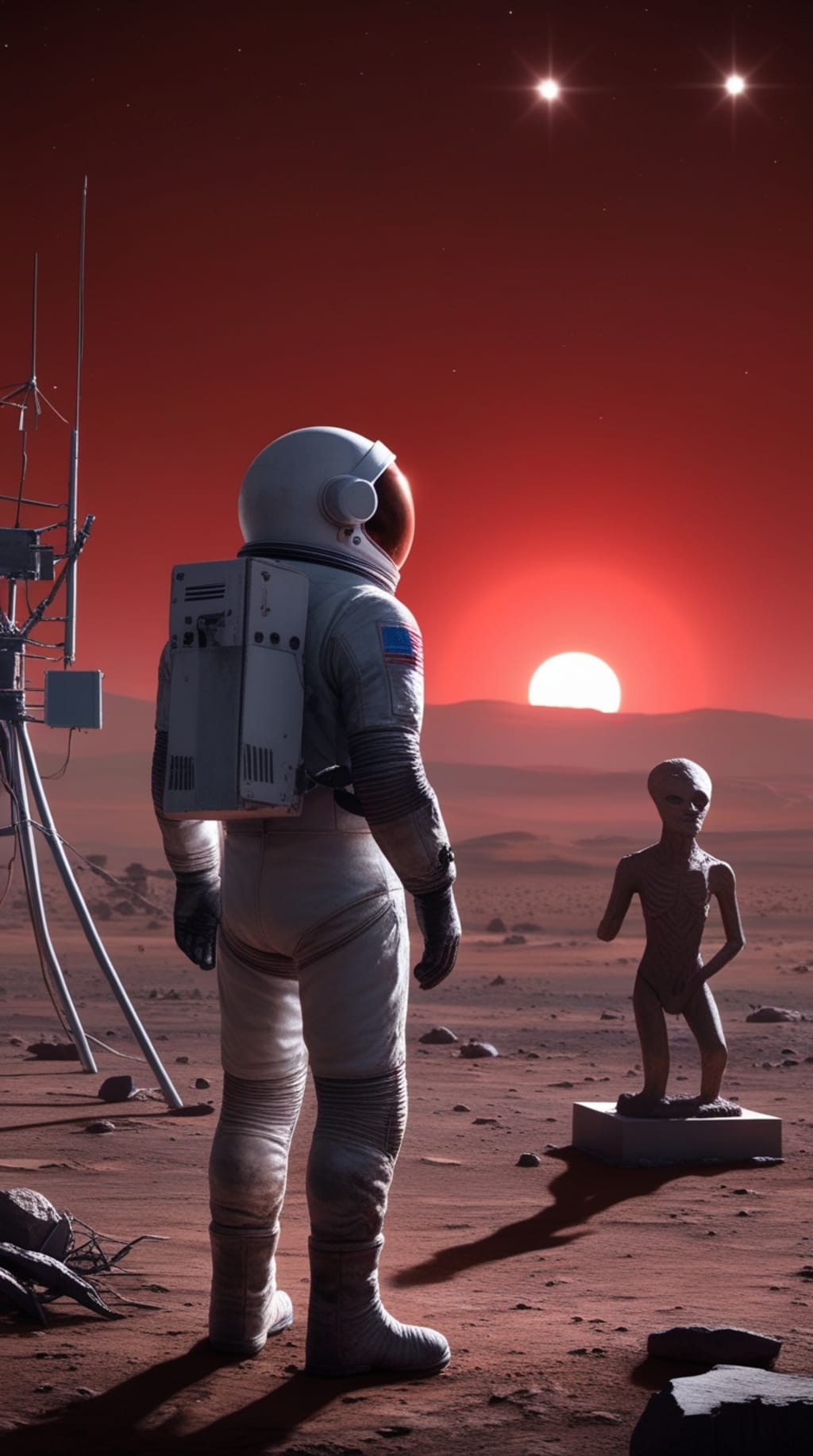
It was Sol 497 on Mars, and Commander Alex Raines had stopped counting the days. He stood alone outside the now-abandoned research station "Ares-7," staring at the dying sun through the red, dust-heavy sky. The landscape was eerily silent—just the hum of his suit systems and the distant whine of shifting sands. His oxygen levels were stable—for now—but his communication system was failing. His only companion was the empty horizon.
He was the last survivor.
The crew—six of the most elite minds from Earth—had been decimated after a freak storm disrupted the life support systems and caused a partial collapse of the base’s habitat modules. First it was Dr. Liang, then biologist Kara Mendez, and eventually Captain Rhodes himself. They died slowly, painfully, and Alex was left to bury them in the shallow red dirt, marking their graves with broken solar panels.
A rescue mission from Earth was out of the question—budget cuts, political gridlock, and global conflict had shut down all interplanetary efforts. NASA had gone dark six months ago. Private channels yielded no response. Alex knew this would be his last transmission. But he couldn’t die without telling the truth.
Inside the communication bay, he activated the emergency relay system. The old antennae crackled. A connection blinked green, weak but alive. The terminal screen glowed dimly.
"This is Commander Alex Raines of Ares-7," he began, his voice dry and cracked. "If anyone receives this, please know: I am alive. For now. But more importantly, I’ve discovered something."
He paused, choosing his words carefully.
"Thirty kilometers west of the original landing site, under a canyon ridge, I found structures—clearly artificial. Carvings in an unknown script. Fossils. Not just microbial, but vertebrate. Humanoid."
Alex took a breath, his voice shaking. "We were not the first intelligent life here. Mars had a civilization. Maybe they left. Maybe they died. But they were here. And the world must know."
He uploaded his findings: high-resolution photos of the stone archways buried under layers of dust, scans showing metal alloys unknown to Earth's periodic table, and skeletal remains shaped alarmingly like human ancestors.
Static swallowed part of his message. He punched the console.
"I'm uploading visuals, coordinates, and scans. These are the last acts of a dying man. Please… don’t let this be forgotten."
He ended the transmission.
Outside, the Martian night fell quickly. The sky turned a deep violet, the stars shockingly close. Alex returned to his pod, watching the constellations shift slowly. He thought of his daughter, who would be twelve now. He had promised her he’d return. That promise had become his curse.
He recorded a separate message for her, even if she never heard it.
"Hey kiddo... It's Dad. I saw you in my dream today, building a rocket out of Legos. Remember when you said you'd fly here one day? Maybe you still will. Maybe someone will. I love you more than all the stars."
Days passed. Then weeks. Rations dwindled. Power reserves fell into the red. The pod's heating systems failed. He wrapped himself in emergency foil, reading an old digital copy of Carl Sagan's Cosmos over and over. The words gave him comfort, but not warmth.
One morning, as Alex drifted into half-consciousness, a blinking light appeared on the comms panel. A message.
"Received. Data confirmed. Hold position. Rescue en route."
Alex blinked. Could it be real? Or just a hallucination, a dying mind’s final comfort?
He scrambled to the window, heart pounding. In the distance, over the Martian horizon, something flickered. Not a storm. Not static. Lights.
As the hours passed, the lights grew brighter. Then came the rumble—the unmistakable vibration of descending thrusters. A sleek, unfamiliar craft breached the sky, coated in a metallic sheen unlike anything he’d seen.
It wasn't Earth-made.
His mind reeled. Was this the original Martian civilization returning? A different species answering his call? Or a black-ops project Earth had buried?
The craft landed silently. A hatch opened. Silhouettes emerged—tall, humanoid, but not human. One raised a hand in greeting.
Alex stepped forward, trembling. He realized then: his message had reached someone. Not Earth—but someone.
And maybe, just maybe, Mars wasn’t done telling its story.
Part 1: Solitude
It was Sol 497. Commander Alex Raines had long stopped counting. Time on Mars felt different—slower, heavier. He stood outside the silent skeleton of the research station Ares-7, watching the dimming sun struggle through the thick red haze. The only sounds were the gentle hum of his suit and the whisper of Martian winds.
There had once been life here—laughter, arguments, science. Six of Earth’s finest minds. But that was before the storm. A rogue electrical event had ripped through the atmosphere, frying life support, collapsing part of the habitat. One by one, his crewmates succumbed. Dr. Liang. Biologist Kara Mendez. Even Captain Rhodes. Each death had carved a hollow into his soul.
He buried them in the dust, using broken solar panels as headstones. Now he was the last. No rescue would come. Earth was too broken—war-torn, disinterested. NASA had gone dark. Private channels returned static. The interplanetary dream had died with its dreamers.
Part 2: The Discovery
But Alex couldn’t let the truth die with him.
He returned to the comms bay and booted the emergency relay system one last time. The antenna groaned to life, flickering weakly. A faint green glow blinked on the screen. A thread of hope.
"This is Commander Alex Raines of Ares-7," he said, voice hoarse and dry. "If anyone receives this, know that I am alive. For now. But more importantly… I’ve discovered something."
He took a breath.
"Thirty kilometers west of the original landing site, beneath a canyon ridge, I found ruins. Structures that weren’t natural. Symbols etched into stone. Fossils—not microbial. Vertebrate. Humanoid."
His hands trembled as he uploaded the data: high-res images of stone archways half-buried in dust, spectral scans of alloys unknown to Earth’s periodic table, and skeletal remains eerily similar to early hominids.
"We were not the first. Something lived here. Intelligent. Advanced. Maybe they left. Maybe they died. But they were here. And the world deserves to know."
Part 3: The Final Days
Mars fell silent once again. Alex retreated to his pod, wrapped in thermal foil, surviving off ration crumbs and memory. He read Cosmos by Carl Sagan over and over, finding solace in the poetry of science.
He recorded one final message—for his daughter.
"Hey kiddo… it's Dad. I dreamed of you today. You were building a rocket out of Legos, remember? You said you’d come to Mars one day. Maybe you still will. Maybe someone will. I love you more than all the stars."
The days blurred. The power dipped into red. Heating failed. The pod grew colder than death.
And then—light.
Part 4: Contact
A blink on the console. A message:
"Received. Data confirmed. Hold position. Rescue en route."
Alex stared at the words, numb. Was it real? Or a hallucination, a dying mind’s farewell dream?
Then he saw it—on the horizon. A shimmer. Not a storm. Not static. Lights.
They grew brighter. A low hum filled the air. The ground vibrated. Something was descending—sleek, silent, and unlike any Earth-made craft.
The ship touched down, graceful as a dream. Metallic, dark, smooth. A hatch hissed open.
Silhouettes emerged. Tall. Humanoid. But… not human.
One figure raised its hand in a gesture of peace.
Alex stepped forward, heart pounding, breath shallow. His voice cracked:
“Who are you?”
And the answer came—not through ears, but inside his mind.
"We are those who left… and those who returned. You called. We answered. You have awakened a memory buried in red silence."
Tears welled in Alex’s eyes.
He wasn’t alone anymore.
Mars still had stories to tell.
About the Creator
Keep reading
More stories from Abdul Rahman and writers in Earth and other communities.
The Witness Tree: A Century of Humanity Through the Eyes of an Ancient Banyan
In the heart of an old village, or perhaps at the corner of a forgotten street in a growing city, stands a banyan tree — grand, unyielding, and timeless. For over a hundred years, this tree has watched the world change. It has no voice, but it remembers. It does not speak, but it listens. It is, in every sense, a witness — a silent observer of human triumphs, tragedies, and transformations.
By Abdul Rahman 8 months ago in Earth
Philippines Paper Bags Market: Packaging Shifts, Environmental Policy & Changing Consumption Patterns
Philippines Paper Bags Market Overview The Philippines paper bags market is undergoing a structural shift as environmental regulation, packaging reform and consumer awareness increasingly influence material choices across industries. According to IMARC Group, The Philippines paper bags market size was valued at USD 28.59 Million in 2025 and is projected to reach USD 46.95 Million by 2034, growing at a compound annual growth rate of 5.66% from 2026-2034. This expansion reflects gradual but consistent changes in packaging practices rather than a single disruptive trend.
By Manisha Dixitabout an hour ago in Earth



Comments
There are no comments for this story
Be the first to respond and start the conversation.