
The Witness Tree: A Century of Humanity Through the Eyes of an Ancient Banyan
How a 100-Year-Old Banyan Tree Silently Observed Generations, Revolutions, and the Changing Face of Humanity
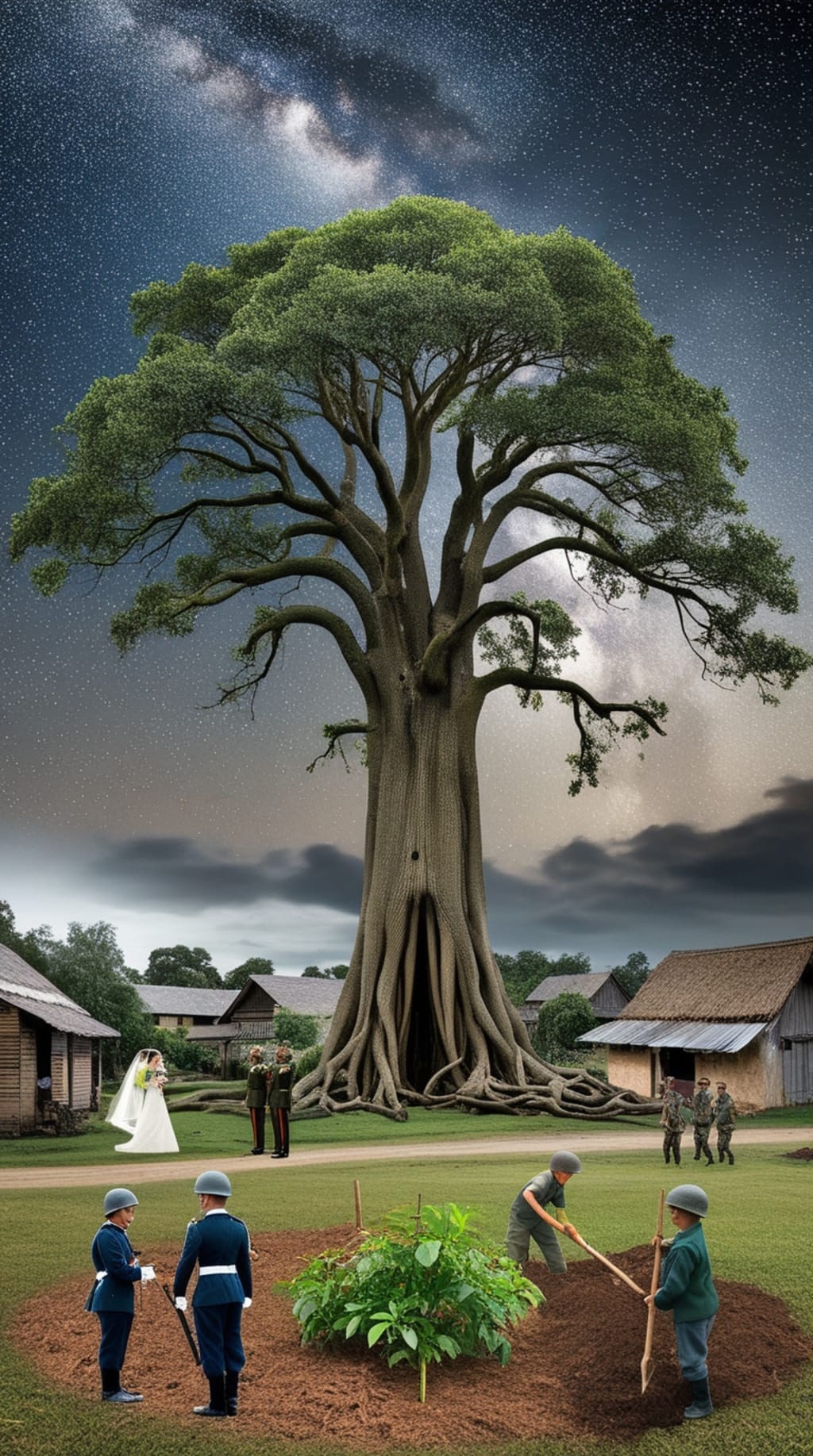
In the heart of an old village, or perhaps at the corner of a forgotten street in a growing city, stands a banyan tree — grand, unyielding, and timeless. For over a hundred years, this tree has watched the world change. It has no voice, but it remembers. It does not speak, but it listens. It is, in every sense, a witness — a silent observer of human triumphs, tragedies, and transformations.
Roots That Remember
Planted, perhaps by accident or ritual, this banyan once began as a fragile sapling. Yet, over the decades, its roots have crawled deep into the earth, anchoring it through storms and summers alike. These roots are not just biological veins — they are memory keepers. Underneath its shade, lives have begun, promises have been made, and even wars have been whispered into the dust.
This tree has watched children grow into parents and elders fade into memory. It has silently observed lovers etch initials into its bark, and rebels draw strength from its shadow before they march into history.
The Tree and Time
If time were a river, this banyan would be a stone, unmoved yet reshaped by the current. It saw the world change — from letters to smartphones, from ox-carts to electric cars, from community gatherings to virtual meetings. Each change did not pass unnoticed. The banyan noticed everything.
It witnessed colonizers leave and flags rise anew. It heard the slogans of freedom, tasted the tear gas of protest, and inhaled the smoke of celebrations. Under its vast canopy, newspapers turned yellow, transistor radios faded, and new generations brought their own songs and stories.
Witness to Human Emotion
More than history, this tree has been a witness to emotion. Joy, sorrow, hope, despair — all have lingered beneath its branches.
It remembers a wedding where laughter rang like temple bells. It remembers a mourning widow sitting in silence, her grief sinking into the soil. It has offered shade to farmers tired from the sun and solace to poets searching for verses. The banyan doesn't forget — it absorbs every emotion, every unspoken word carried on the wind.
For some, it was a meeting point. For others, a refuge. For a few, it became a temple, an altar of quiet reflection. To the homeless, it was shelter. To the storyteller, it was a muse. To the lost, it was a landmark.
A Mirror to Society
This tree, though silent, reflects us. Its growth is a metaphor for civilization — chaotic, sprawling, intertwined, and deeply rooted. It has been shaped by the same forces that shape us: time, environment, circumstance.
It saw caste boundaries being challenged under its shade. It witnessed women stepping out of centuries-old customs. It noticed children once denied education now reading schoolbooks aloud beneath its limbs. The banyan has seen society stretch and bend — sometimes gracefully, sometimes painfully.
And yet, despite all, it remains. It doesn’t judge. It simply watches.
A Lesson in Stillness
In today’s world of constant movement and noise, the banyan teaches a forgotten skill: stillness. Its patience, its quiet endurance, is a lesson in resilience. Trees like this live not in days, but in decades. They do not rush to bloom nor mourn the fall of their leaves — they simply continue.
If one listens closely, there’s a rhythm in the rustle of its leaves — the sound of a hundred years breathing, slowly, deeply.
Environmental Echoes
Beyond its symbolic value, the banyan tree has also been an ecological hub. Birds have nested in its branches, squirrels have played on its limbs, and thousands of insects have made it home. The banyan is a miniature ecosystem — sheltering, feeding, and balancing.
But even this ancient being is not immune to human carelessness. It has seen concrete creep toward its roots. It has felt the acid bite of pollution. It has heard chainsaws in the distance and the silence that follows when another tree falls.
And yet, it stands.
The Modern Gaze
In recent years, the banyan has attracted not just villagers but tourists, historians, photographers, and spiritual seekers. People sit beneath it, touch its bark, take selfies, and move on. Some stop to wonder; others simply scroll.
But the banyan doesn’t mind. It welcomes all.
What we see as a majestic tree is, in truth, a living archive. A library not of books, but of breaths — every inhale and exhale of the generations that have come and gone.
A Living Monument
Monuments are built of stone and metal. But the banyan is a living monument — ever-changing, ever-stable. It is both past and present, memory and presence.
It reminds us that history is not always written in ink. Sometimes, it is etched into bark. Sometimes, it is whispered in leaves. Sometimes, it is remembered by those who cannot speak — like the Witness Tree.
Conclusion: The Soul of a Tree
In an age where humanity races forward, often forgetting its roots, the banyan reminds us of the beauty of being grounded. It teaches us to observe, to absorb, and to endure. It asks for nothing — only space to live and time to grow.
If trees could speak, what stories would they tell? What secrets would they reveal? We may never know. But one thing is certain: the banyan has seen more than we will ever remember, and remembered more than we have ever seen.
It is, truly, a witness to us all.
About the Creator
Keep reading
More stories from Abdul Rahman and writers in Earth and other communities.
10 Places on Earth That Look Straight Out of a Sci-Fi Movie
The world we live in is full of incredible natural wonders and human-made marvels. But some places go beyond breathtaking—they seem completely out of this world. From landscapes that resemble alien planets to caves that glow like something from a fantasy realm, here are ten real-world locations that look like they belong in a sci-fi movie.
By Abdul Rahman 8 months ago in Earth
Japan Furniture Market Size and Forecast 2025–2033
Introduction Japan’s furniture industry stands at a unique intersection of tradition and innovation. Renowned worldwide for its craftsmanship, minimalist design, and functional aesthetics, Japanese furniture reflects the nation’s cultural emphasis on harmony, efficiency, and simplicity. Today, as Japan’s population becomes increasingly urban, digitally connected, and environmentally conscious, the furniture market is undergoing a quiet but significant transformation.
By Janine Root 6 days ago in Earth
Maryland to Get Its Own Smaller Version of the Las Vegas Sphere
Maryland is about to become home to a new entertainment icon. Inspired by the famous Sphere in Las Vegas, a smaller version of the massive immersive venue is planned for the state, promising to deliver a combination of live entertainment, cutting-edge technology, and a new tourist attraction. While the Las Vegas Sphere has already made headlines worldwide for its futuristic design and mind-blowing shows, Maryland’s version aims to bring a scaled-down but equally captivating experience to the East Coast.
By Muhammad Hassana day ago in Earth



Comments
There are no comments for this story
Be the first to respond and start the conversation.