

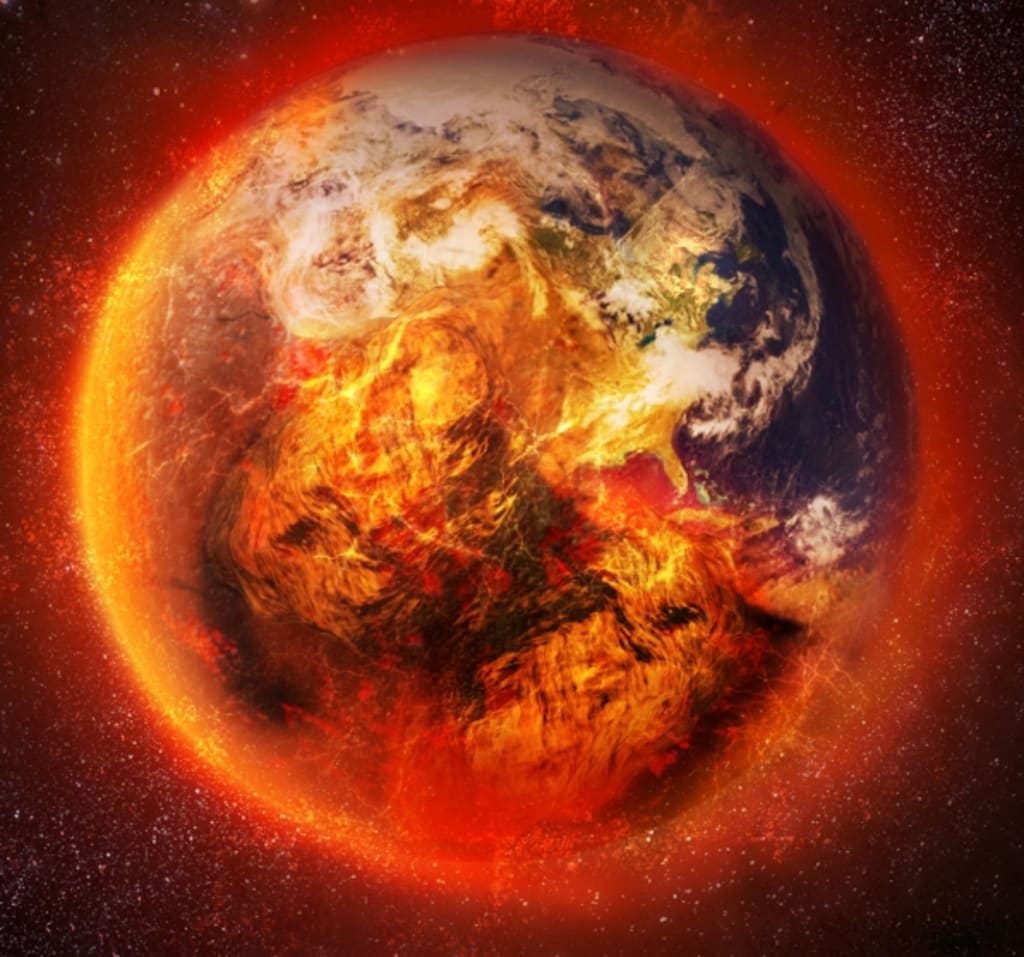
Life on Earth is not going to last forever. The Sun will eventually die in about 5 billion years, wiping out everything here. But before that happens, life will probably be gone. In the past, things like volcanoes, asteroids, and extreme climate change have almost wiped out all life. And there could be even worse things coming, like a nearby supernova or nuclear war. That wouldn't be great for life on Earth. So, what would be the last living thing? Scientists have thought about this a lot, and despite what some may think, it definitely won't be cockroaches.
Earth is a pretty great place to live most of the time, compared to other rocks in the universe. We have a watery planet with comfortable temperatures, and life has been thriving here for billions of years. However, there have been times when life was almost wiped out. The most well-known mass extinction was caused by an asteroid hitting Mexico 66 million years ago, wiping out the dinosaurs and three-quarters of all life. But even before that, 200 million years earlier, a different event killed off 90 percent of all life forms. This event, known as the Great Dying, was the deadliest mass extinction ever recorded. But it wasn't the first time life faced such a threat.
Over a hundred million years ago, around 70 percent of living things died in a series of extinctions during the Devonian Period due to climate change. Fossil records show these die-offs, along with events like asteroid impacts and massive volcanic activity. Scientists are still investigating what caused these doomsday scenarios. Possible reasons include starvation from a dust cloud blocking out the Sun, extreme temperature changes, or acidification of the oceans from an asteroid impact. While it's hard to fully understand past extinctions, scientists have ideas about what could cause future ones. It's important to be aware that some of these disastrous scenarios could still happen in the future.
There's a potential threat to life from supernovas, which are not rare in our galaxy. If a supernova exploded too close to Earth, it could strip our ozone layer and expose us to deadly radiation from the Sun. Scientists have found evidence of supernova debris on Earth in the form of iron-60 in rock layers. This has happened at least twice in the last 10 million years. One theory even suggests a supernova may have triggered a mass extinction event in the past. So while this isn't a common occurrence, it's something to keep in mind when thinking about the universe and our place in it.
Good news! There are no giant stars about to explode within a 160 light-year radius of Earth. One star, IK Pegasi B, is on the edge of the danger zone but won't go supernova for another 2 billion years. Betelgeuse, another star often talked about for its potential explosion, is a safe 700 light-years away. So, when it does explode, it will just be a beautiful light show. However, this doesn't mean Earth is completely safe from supernovas in the future. Our solar system is currently in a less dense part of the Milky Way, but as we move into denser areas, the risk of nearby supernovas will increase. And there are other potential threats from outside the solar system to watch out for.
Sometimes, the universe experiences powerful explosions called gamma ray bursts. These bursts are thought to come from violent events, like the merging of two neutron stars. In just a fraction of a second, a gamma ray burst can release more energy than the Sun does in 10 billion years. We can detect gamma rays from these events hitting Earth almost every day, but they generally don't cause harm because they come from distant sources. The most powerful gamma ray burst ever detected struck Earth in 2022 from about 2 billion light-years away, but it didn't do any damage. If a gamma ray burst were to hit Earth directly, it would be very scary and could have devastating effects, potentially causing a mass extinction. However, these events are rare, with the chance of a harmful gamma ray burst hitting Earth being low. So, while it's not something to lose sleep over, gamma ray bursts are still worth paying attention to on our planet with a long future ahead.
One of the biggest threats to life on Earth is the use of the thousands of nuclear weapons we have stockpiled. If we were to ever use them, a mass extinction would likely follow. Even a small-scale nuclear war, like one between India and Pakistan, could be catastrophic. These countries have many powerful nuclear warheads that could cause immense destruction. The fallout from the radiation would be harmful, but the soot produced would be even worse. It is estimated that around 50 million tons of soot could be sent into the atmosphere, blocking sunlight and causing temperatures to plummet. This would lead to food shortages, ecosystem breakdown, and starvation. The effects of such a war would last for years and have devastating consequences on our planet.
A larger war between Russia and NATO could greatly increase the amount of soot in the atmosphere, leading to a more severe nuclear winter. Nuclear fireballs would also release chemicals that destroy the ozone layer, leaving Earth exposed to harmful levels of radiation from the Sun. These scenarios would be devastating for living things, but some may still manage to survive. It's amazing how resilient some species can be in the face of such challenges.
Let's talk about cockroaches, who have a reputation for being hard to kill. They have survived some tough times, like the Great Dying and the asteroid that wiped out the dinosaurs. One reason they are so resilient is because they are ruthless scavengers. They will eat just about anything, even if it's gone bad. Some can even go months without food. However, they do have weaknesses. Being cold-blooded, they struggle with extreme temperatures. And despite what you may have heard, they are not particularly resistant to radiation. But there are other survivors out there that might give them a run for their money.
Ginkgo trees are incredible survivors, having been around for over 270 million years and enduring three mass extinctions. They even survived the bombing of Hiroshima, showing their resilience. These trees have developed various protections over time, such as producing compounds like methanol and chloroform to fend off bacteria. They can also regenerate new roots from non-root cells and even grow new trunks when damaged by storms. One of their most fascinating traits is their ability to not age - their cells don't have the programming to die, allowing them to maintain their defenses for thousands of years.
Scorpions are really tough creatures that have been around for over 400 million years. They can even survive high levels of radiation, thanks to an amino acid called taurine in their blood. This taurine acts like a shield and helps protect them from the harmful effects of radiation by acting as an antioxidant. Antioxidants bind to harmful molecules created by radiation, preventing damage to cells. Scientists are still studying exactly how taurine works, but it definitely helps scorpions survive in tough condition
The coelacanth, a prehistoric fish, survived the dinosaur-killing asteroid by moving to deep sea. Ground-dwelling mammals also survived underground. Life is resilient - once it exists, it's hard to eradicate. Even if doomsday scenarios don't happen, life on Earth has an expiration date.
The Sun is constantly burning its hydrogen and gradually becoming brighter. In about one billion years, it will be 10 percent brighter, causing Earth's temperatures to rise and oceans to boil off. The evaporated water will trap heat, leading to extreme warming. Studies suggest that as Earth heats up, certain rocks will absorb carbon dioxide and trap it in the crust. This will decrease CO2 in the atmosphere, affecting plant photosynthesis and oxygen production. Oxygen levels may drop drastically, impacting life on Earth. While the exact timelines are uncertain, it's likely that one of these scenarios will have a significant impact on any remaining life on our planet in the distant future.
In the ultimate test of survival, the contenders are likely to be microbes, not cockroaches or ancient plants. These microbes, known as extremophiles, can thrive in extreme conditions that would kill most living things instantly. Some extremophiles, like the "furious fireball," can withstand boiling temperatures in hydrothermal vents. When cells get too hot, their proteins can become disfigured, leading to death. So, these little microbes have special adaptations that allow them to survive where others cannot.
Our amazing fireball, the sun, has special molecules that protect its proteins from damage. These molecules, like heat shock proteins, help to fold and assemble other proteins correctly. They work like diligent assembly line workers ensuring everything is built according to plan
Proteases are like the custodial crew of molecules. They are enzymes that break down and clear out any defective proteins.
Some extremophiles are adapted to survive extreme conditions, like this Antarctic bacterium with antifreeze proteins. These proteins have a unique structure that binds to ice crystals early on, stopping them from growing. Other extremophiles can handle extreme radiation by absorbing and protecting their DNA. While this bacterium can't prevent all radiation damage, it has a system for repairing it. With multiple copies of its genome, repair proteins use these copies as templates to reassemble broken DNA fragments, like putting together a puzzle with a picture on the box.
Extremophiles come in many types, such as those living in acidic hot springs, salty lakes, or deep in the Earth's crust. Anaerobic thermophiles, like Pyrolobus fumarii, can survive in extreme conditions without oxygen. This microbe thrives in hydrothermal vents at boiling temperatures. Unlike most extremophiles, it does not need oxygen to convert food into energy. Instead, it uses nitrate from its environment. If the Earth becomes hot and oxygen-deprived, Pyrolobus fumarii might be one of the last survivors.
We don't know what kind of living things will exist in the next billion years, but it's exciting to think about. It's possible that a mass extinction event could lead to the emergence of new lifeforms that surpass even today's extremophiles. What we do know is that the first living things on Earth were likely extremophiles, and the last ones may be too. Life could end up going full circle - from lush forests and frolicking animals to pockets of single-celled life. And who knows, maybe a humble microbe in a boiling pool will be the one pondering it all at the end.
About the Creator
Keep reading
More stories from Kathy Houston and writers in Earth and other communities.
The Paradox of Chernobyl's Radioactive Wild Boar
After the Chernobyl Nuclear Power Plant exploded in 1986, scientists started studying the area to learn about radiation's effects on the ecosystem. Radiation isn't good for health, so it's good news that contamination levels in nearby animals have been decreasing over the years. However, wild boars in Chernobyl have maintained the same levels of radioactive isotopes in their bodies for years, which goes against what we know about radioactive decay and ecosystems. Scientists called it the Wild Boar Paradox. This year, they may have finally solved the mystery.
By Kathy Houston2 years ago in Earth
Half of World’s CO2 Emissions Come From Just 32 Fossil Fuel Firms, Study Shows
A groundbreaking new study has revealed that 32 fossil fuel companies are responsible for half of global carbon dioxide emissions since the industrial era began. The findings highlight the outsized influence of major oil, gas, and coal producers on climate change, and raise urgent questions about accountability, regulation, and the transition to cleaner energy.
By Aarif Lashari5 days ago in Earth
“Do Not Copy This Site’s Content”: Why Originality Matters More Than Ever in the Digital Age
“Do not copy this site’s content.” It’s a warning most internet users have seen countless times, often at the bottom of webpages or buried in terms and conditions. Many scroll past it without a second thought. But in today’s digital world, that simple sentence carries far more weight than people realize.
By Muhammad Hassana day ago in Earth

Comments
There are no comments for this story
Be the first to respond and start the conversation.