
The Invisible Ones: A Journey Through the Creepy, the Crawly, and the Bizarrely Weird
There are worlds beneath your feet...

Not metaphorical ones; though those exist too, but actual, tangible realms, crawling with life you’ve never heard of. Entire dramas unfold in your backyard while you’re checking the mail. Epic chases play out under garden rocks. Mating rituals worthy of sci-fi movies occur beneath porch lights. And you, dear human, walk right past it all... blissfully unaware.
We don’t notice them because they’re small. Because they’re strange. Because they don’t announce themselves. But if you take the time to look... truly look... you’ll find them. Tiny marvels. Creepy little secrets. Creatures that should be in museums or nightmares... or maybe both.
Let’s meet a few of these overlooked legends. And when we’re done, maybe you’ll never look at a bug the same way again.
1. The Twice-Stabbed Lady Beetle (Chilocorus stigma)
It sounds like something from a gothic horror novel—the twice-stabbed. But this little beetle is more hero than villain. Jet black with two vivid red dots on its back, it looks like it’s been marked by fate. Or by a very tiny, very dramatic vampire.
Found throughout the United States, this insect is a natural predator of aphids, mealybugs, and scale insects... the kinds of pests that destroy plants. It’s a guardian disguised as a harbinger. A gothic knight in tiny, shiny armor. Most people mistake it for a regular ladybug. But it’s not. It’s stranger. Cooler. Like if a ladybug joined a punk band!
2. The Giant Ichneumon Wasp (Megarhyssa macrurus)
Let’s get one thing straight: this insect looks terrifying. It has a massive needle-like “stinger”, stretching several inches past its body. You see it on a tree and immediately assume you’re about to become an ex-human.
But fear not. That "stinger" is actually an ovipositor; a specialized organ used to lay eggs. The giant ichneumon uses it to drill deep into wood, where it deposits its eggs directly into the larvae of wood-boring insects.
You heard that right! It injects its young, into other bugs, through a tree... Horrifying? Yes. Fascinating? Absolutely.
And best of all? It’s completely harmless to humans. You could let one crawl across your hand and it wouldn’t even blink... If it had eyelids.
3. The Antlion (Myrmeleontidae)
If you’ve ever seen small, conical pits in the dirt, you’ve stumbled upon the hunting ground of the antlion. Also known as the doodlebug, this larval predator lies in wait at the bottom of a sand trap it digs itself... mandibles twitching, eyes unblinking, frothing at the mouth.(probably)
When an ant slips into the pit, the sides crumble beneath it, sending it sliding downward like a buggy Slip ‘n Slide, straight into the jaws of death. The antlion grabs it, drags it under, and disappears. Think Star Wars Sarlacc pit, but for insects... Yeesh!
The adult antlion looks like a delicate dragonfly, but don’t let that fool you. Its youth was forged in sand and strategy... a patient predator hiding beneath the surface. Literally.
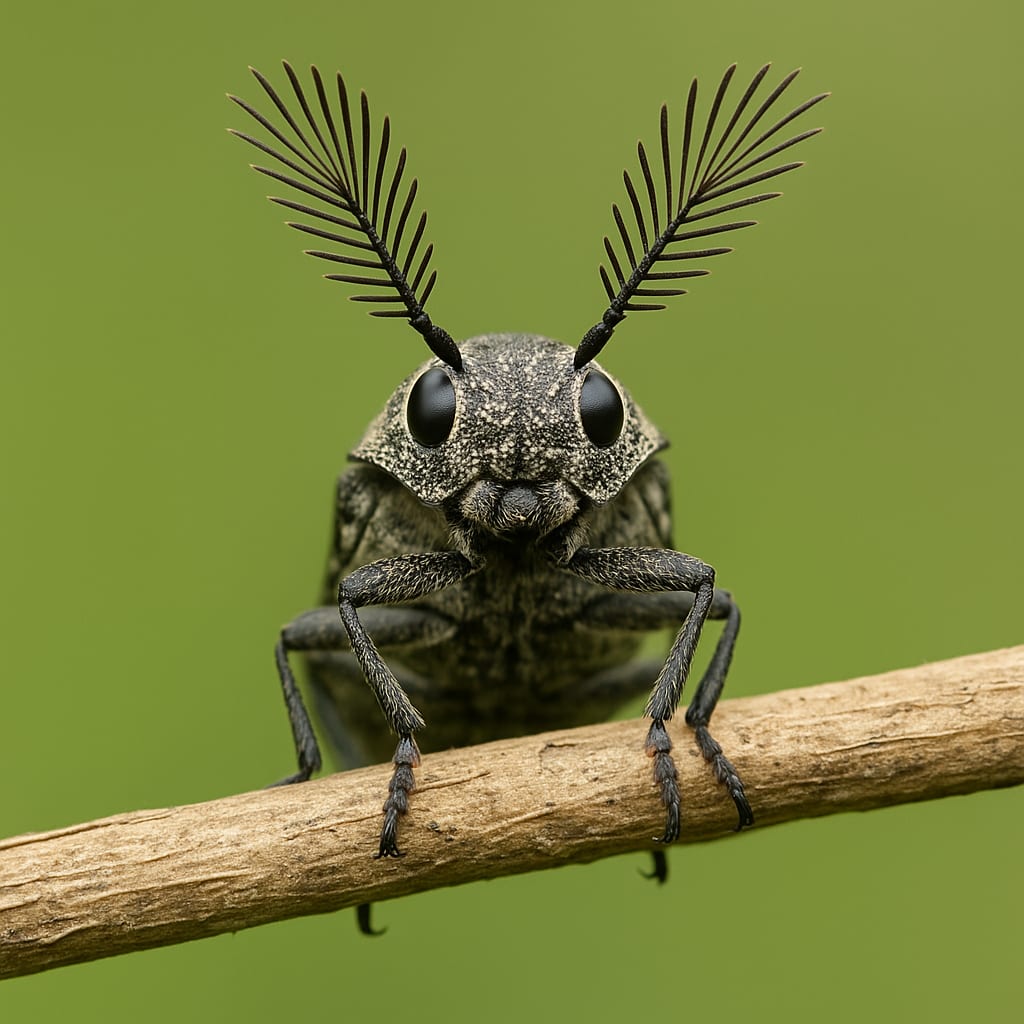
4. The Feather-Horned Beetle (Ptilophorus wrightii)
If Salvador Dalí designed a beetle, it would be this one. The males of the species sport extravagant, feather-like antennae. Delicate fans, that look more like elaborate jewelry than bug anatomy.
These antennas aren’t just for show. They’re highly sensitive tools used to detect the faintest traces of pheromones from nearby females. Think of them as living satellite dishes searching for love.
You’re not likely to see one. They’re rare and shy. Flickering through wooded areas in short, mysterious bursts. But once you do, you’ll wonder if you’ve hallucinated it. A beetle with feathered horns doesn’t sound real. And yet, here it is.
5. The Pleasing Fungus Beetle (Gibbifer californicus)
Its name sounds like a whimsical insult from a medieval scroll... thou pleasing fungus beetle! But it’s real, and yes, it lives in fungus.
You’ll find it in moist forests, nestled in decaying logs and mushroom colonies, munching away on the very stuff most of us avoid stepping in. Its shell gleams in iridescent blues and purples, like an oil slick caught in twilight.
It doesn’t bite. Doesn’t sting. Doesn’t care. It just wants to hang out in fungus and be beautiful. It’s the cottage-core bug icon, we didn’t know we needed.
6. The Four-Spotted Sap Beetle (Glischrochilus quadrisignatus)
It lives inside rotting fruit... Let that settle in for a moment. While most of us recoil from overripe bananas or forgotten peaches fermenting in the sun, this beetle treats them like a VIP lounge. Sticky, sweet, slightly alcoholic environments? Yes please!
These beetles are frequently found partying in tree sap wounds, rotting melons, and fruit left out a little too long. Their glossy black shells and four orange spots make them look like little luxury sedans of the bug world; shiny, compact, and always in the messiest places.
They’re not pests. Just...opportunists. Nature’s cleanup crew with a taste for the overripe.
7. The Eastern Eyed Click Beetle (Alaus oculatus)
At first glance, it looks like a giant, armored insect with two enormous eyes staring you down. But those “eyes” are actually false markings. A defense mechanism meant to scare off predators. And if that doesn’t work? It clicks... Literally.
The Eastern Eyed Click Beetle has a built-in spine-snap mechanism, that lets it launch itself into the air when threatened. It folds its body backward, builds tension, and snaps... Launching itself like a buggy popcorn kernel.
The result is a sudden, jarring click that startles predators... and sometimes lands the beetle safely out of reach. It’s a masterclass in surprise and misdirection... like a ninja in a tuxedo.
8. The Camel Cricket (Ceuthophilus spp.)
Found in damp basements, wood piles, and caves, these humpbacked jumpers look like they crawled out of a Tim Burton movie. They don’t chirp. They don’t fly. But they do jump... Really far!
They’re completely harmless, but their sudden, erratic hopping causes many people to scream and sprint in the opposite direction. Especially at night. In the dark. In the bathroom. When you're barefoot. They’re like organic jump scares... living proof that evolution has a sense of humor.
What They Teach Us
It’s easy to ignore these creatures. To call them pests. Creepy crawlies. Nuisances. But they’ve survived mass extinctions, climate shifts, humanity’s concrete sprawl and they still thrive in shadows and silence. They don’t need attention. They just exist. Small. Efficient. Strange. And maybe that’s why they matter.
In a world obsessed with attention, there’s something sacred about the unnoticed. These insects remind us that there’s life happening outside the spotlight. That beauty can exist in fungus. That elegance can live with antennae. That power doesn’t always roar... sometimes it clicks.
They remind us to look closer. To kneel in the dirt. To pay attention to the things no one else sees. Because when you do… the world changes shape.
Final Reflection: The Ones Beneath Our Feet
Maybe you’ll see one of them tomorrow.... A strange black beetle with red dots, a delicate moth with antennae like lace, a creature in the corner of your eye that disappears before you can focus. You’ll wonder what it was. And maybe you won’t find it again. But you’ll remember that it was there. That it is there. That you share this world not just with the majestic and the loud, but with the quiet, the weird, and the beautifully bizarre. And maybe, in some way, you are one of them.
You don't need to travel to distant planets, when there are real aliens under your feet...
About the Creator
The Iron Lighthouse
Where folklore meets freeway. A guide to the strange heart of the American backroads...
Keep reading
More stories from The Iron Lighthouse and writers in Earth and other communities.
Welcome to The Iron Lighthouse: Shining a Light Where the Road Ends
There are stories in this country that never make the news. Towns with one stop sign and no gas station. Rivers that carry more secrets than water. People who live on the edge of maps, by choice or by force. That’s where we come in.
By The Iron Lighthouse6 months ago in Wander
High-Speed Train Crash in Southern Spain Leaves at Least 21 Dead
A devastating high-speed train crash in southern Spain has left at least 21 people dead and dozens injured, shocking the nation and triggering a major emergency response. The incident, which occurred on a busy rail route connecting key southern cities, has reignited concerns over railway safety, infrastructure maintenance, and emergency preparedness in one of Europe’s most advanced rail networks.
By Aarif Lasharia day ago in Earth
Icy Chaos in Central and Eastern Europe
Winter has unleashed its fury across central and eastern Europe, leaving travelers frustrated and transport networks struggling to keep up. Over the past few days, freezing rain and ice have wreaked havoc on airports, train stations, and highways — forcing flight diversions, delaying trains, and making roads treacherously slippery. From Vienna to Budapest, Prague to Bratislava, this icy grip has brought travel to a near standstill. Let’s take a closer look at what’s happening, how it’s affecting people on the move, and what it tells us about winter travel in Europe. A Sudden Winter Blow A sudden wave of freezing rain swept across the region, coating runways, rail tracks, and roads with a dangerous layer of ice. Major airports in Austria, Hungary, Slovakia, and the Czech Republic were particularly affected. At Vienna International Airport, operations were temporarily suspended when runways became too slick for flights to land safely. Travelers already in the air had to divert to alternative airports in Munich, Frankfurt, and Venice. Meanwhile, Budapest’s Ferenc Liszt International Airport paused all arrivals and departures, and Prague’s Václav Havel Airport continued operating but at limited capacity. Trains Crawling Through Ice Rail networks weren’t spared. Across Austria, Hungary, and the Czech Republic, ice on tracks and power lines caused delays and cancellations. Austria’s national rail operator, ÖBB, urged passengers to postpone non-essential journeys. In the Czech Republic, travelers at Prague’s main station faced long waits as trains struggled to maintain schedules. Hungary’s tram and suburban rail services were temporarily suspended due to ice buildup on power lines. This combination of black ice, frozen switches, and heavy snowfall has tested the limits of winter infrastructure in Europe. Roads Turn Into Skating Rinks The icy weather didn’t just affect public transport — roads became treacherous, too. Authorities in Slovakia and the Czech Republic warned residents to avoid non-essential travel as highways turned into slippery skating rinks. Accidents and minor collisions were reported, and emergency services were busy responding to dozens of injuries from slips and falls. Even schools weren’t immune: parts of Romania shifted to online learning, keeping children safe during the extreme temperatures, which dropped to around -13°C in some areas. Why This Weather Is So Disruptive Meteorologists point to several factors that made this storm particularly severe: Freezing rain on top of existing snow creates an icy layer that’s extremely hard to clear. Rapidly refreezing surfaces make conditions unpredictable. Temperatures hovering around freezing prevent efficient melting during the day. This “perfect storm” scenario underscores just how vulnerable transport systems are to extreme weather. Even well-prepared airports and rail networks can struggle when weather transitions from snow to freezing rain. Voices From the Ground Passengers took to social media to express their frustration: Crowded airports as travelers scrambled to rebook flights. Train stations packed with delayed commuters, unsure when the next train would depart. Warming centers opened to provide shelter and hot drinks for stranded travelers. For many, a simple trip turned into a test of patience and resilience. Tips for Traveling in Freezing Conditions If you must travel during winter storms, experts recommend: Check flight and train schedules regularly, as delays can change quickly. Allow extra time for travel to avoid missing connections. Consider travel insurance that covers weather-related disruptions. If driving, carry winter essentials: blankets, food, water, and check road conditions before departure. Most importantly, prioritize safety over schedules — icy conditions can change rapidly, making travel risky. A Reminder From Winter This recent chaos in central and eastern Europe serves as a stark reminder of how interconnected transport systems are, and how vulnerable they can be to extreme weather. Flights grounded, trains stalled, and highways turned icy show that winter can bring travel to a halt — sometimes with very little warning. As Europe continues to face volatile winter conditions, travelers and authorities alike are reminded: preparation and flexibility are key. Sometimes, the weather truly has the final say. ❄️🛫🚆
By Muhammad Hassan6 days ago in Earth
Center Stage with Paul Stewart
*** I'm keen to republish the interviews I did for my series with Vocal creators. It's been a few years and I thought it might be nice to revisit these wonderful conversations. I'll be releasing them one at a time for a few weeks/months.
By Heather Hubler5 days ago in Interview



Comments
There are no comments for this story
Be the first to respond and start the conversation.