
The interior of the earth is as hot as the sun, where does its energy come from? Have a completely cool day?
The interior of the earth is as hot as the sun

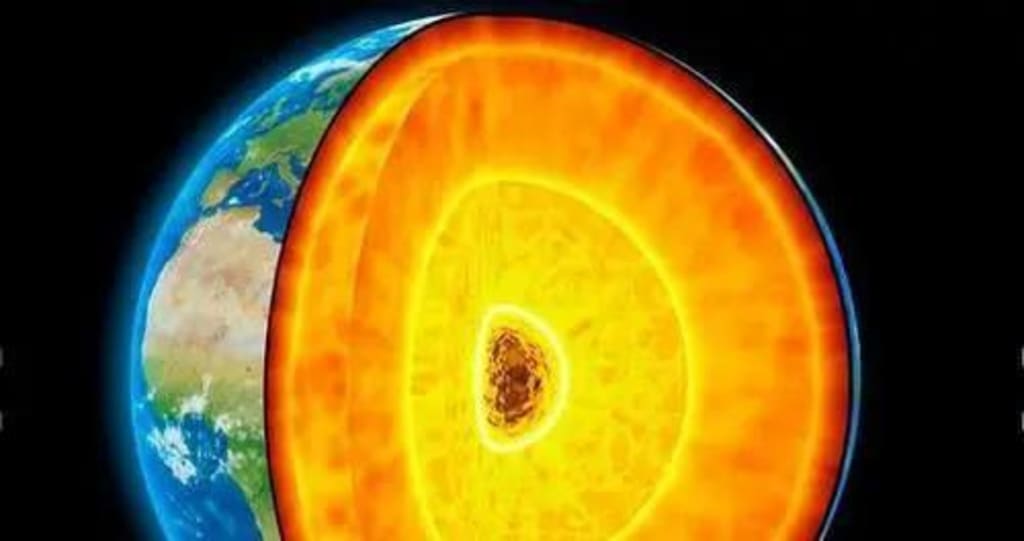
We all know that the earth is a rocky planet, and the place where human beings live is only the surface of the earth. So is the rocky planet Earth a completely solid state? Maybe in the eyes of the ancients, the earth is a solid world except for the hard surface, which is the ocean.
But when human beings entered the age of science and technology, with the deepening understanding of the earth, scientists found that although the earth is called a rocky planet, it is not a solid planet, but a planet composed of liquid and solid, in which liquid substances are also accounted for the majority.
Now we all know that the earth is composed of three structures, namely the crust, the mantle and the core. The crust is the outermost structure, with an average thickness of about 17 kilometers, which is also the thinnest layer of the three structures.
The mantle below the crust is a world composed of magma. The flowing magma supports the surface. The magma emitted by volcanoes comes from the mantle layer, and its average thickness reaches 2865 kilometers.
The center of the earth is the core, which is also the most mysterious area inside the earth, with a radius of 3470 kilometers. According to current research, the core is also divided into two layers: the outer layer is a high temperature and high pressure region composed of liquid substances, and the inner core is a solid high-density sphere composed of iron and nickel.
The temperature inside the earth continues to increase with the increasing depth. The temperature at the core reaches about 6,000 degrees Celsius, which is similar to the temperature on the surface of the sun. So some people have such a doubt: Why is the interior of the earth as hot as the sun? Where does its energy come from? Can it be completely cooled one day?
In fact, the core temperature of the earth has existed since it was born 4.5 billion years ago. The movement of plates on our earth's surface, earthquakes, volcanic activity, and geomagnetic changes are all related to the movement of the earth's core. It is precisely because the interior of the earth is a liquid world that there are various ecological changes on the surface and the current ecological environment.
If the Earth's core cooled completely, the Earth would become a dead planet with no life, just like the Moon, Mercury, and Mars are now. So how did the original energy of the earth come from? To maintain the movement of the earth's core naturally requires a strong supply of energy. What is the origin of this energy?
The original source of energy for the core of the earth is actually not complicated, and it is all related to the early solar system of 4.5 billion years. According to modern scientific research, the solar system was born from a solar nebula, and this solar nebula is not an ordinary solar nebula.
We all know that since the birth of the universe, only hydrogen, helium and a small amount of lithium have appeared, and other elements have not appeared. It was not until the birth of stars that they had the opportunity to convert hydrogen into other elements, but the ability of stars to convert hydrogen was limited, and at most it could only be converted to the level of element 26 iron.
If the elements after No. 26 are to be produced, they need a stronger burst of energy, and they are also related to stars. When massive stars come to an end, supernova explosions will occur, producing a certain amount of various heavy elements. In addition, the collision and fusion of neutron stars will also produce some heavy elements.
It can be seen that the origin of various heavy metal elements is not so easy, and they are rare elements in the universe. However, we have also seen that there are abundant reserves of metallic elements whether it is the earth or other planets in the solar system, which shows that the early solar system contained abundant and various elements, which basically covered the entire periodic table of elements.
So how did these elements come about? In fact, it is related to the predecessor of the solar system. Before the solar system, there were two generations of massive stars in the position of the solar nebula. When they reached the end, a supernova explosion produced a large amount of metallic elements. Later, the two neutron stars collided and fused again. Produces a lot of heavy metal elements.
In this way, these elements formed various chemical molecules in the gas cloud, and continuously gathered under the action of gravity to form the sun, eight planets, and a large number of other small celestial bodies. The accumulation of material elements forms the original celestial embryo, and when a planet is formed, a large number of clumps of objects will collide and gather at very high speeds, and this process will release a large amount of gravitational potential energy, which is converted into heat.
Therefore, when the earth was first formed, it was completely a world of lava. Not only was the core of the earth in a molten state, but the surface was also covered with high-temperature magma. This is the original heat source of the earth's core, and they are all the release of gravitational potential energy. Until the solar system is stabilized, the eight planets also have their own stable orbits.
At this time, the earth gradually began to cool, and the surface of the earth continued to solidify to form the crust, while the mantle and core sealed under the surface continued to maintain the state of liquid substances. Since liquid substances can flow, they will affect the surface during the flow. Therefore, the earth has a good ecological environment one by one, which provides the conditions for the birth of life.
So will the core continue to cool? The answer is naturally yes. From the day the earth stabilized, its heat was continuously released, and the earth began to cool from the outside to the inside, until the core completely turned into a solid state and became a dead planet.
Of course, this cooling takes an extremely long time. You must know that the core of the earth is not completely releasing heat, and its interior will spontaneously produce a part of energy. The main source is the heat generated by the decay of heavy elements deep in the core.
We know that under the action of gravity, heavy elements will fall and hydrogen elements will rise, so there are a lot of heavy elements in the interior of the earth. In theory, as long as elements heavier than lead will decay in a limited time, until they become lead . For 4.5 billion years, the Earth's core has been experiencing the decay of elements, and this slow nuclear reaction has been providing energy to the Earth's core.
Of course, the energy generated by the decay of heavy elements is far less than the energy it releases every year, so from the general trend, the interior of the earth has been netting out heat and has been cooling. Of course, under normal circumstances, it would take at least tens of billions of years for the earth to completely cool down and become a dead planet.
So can the earth wait until that time? In fact, it is very difficult, because the sun will not give us that long. According to the current research, the life of the sun is only 5 billion years. When the life of the sun reaches the end, it will rapidly expand into a red giant star. At that time, the earth will It will be swallowed and disappear completely. If the result is good, there may be an iron-nickel core left behind.
Therefore, we don’t have to worry about the cooling of the earth causing us to lose our homeland. Perhaps after billions of years, human beings have already become an interstellar civilization. At that time, the entire solar system was the home of human beings. The earth or the solar system could no longer survive. We can go to other young The galaxy survives and continues to maintain the prosperity of human civilization.
About the Creator
tannie rusty
little science knowledge
Keep reading
More stories from tannie rusty and writers in Earth and other communities.
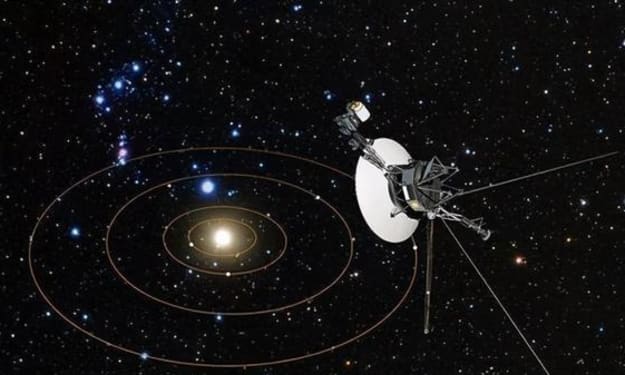
Voyager 2, which is 20 billion kilometers away from the earth, sends back signals in the so-called "space"?
On August 20, 1977, NASA's Voyager 2 probe was sent for liftoff on its ascent to the solar system. After traveling 4.1 billion light-years, Voyager 2 reached the limit of the solar system's heliosphere, the tail end of the solar wind, in November 2018. Since then, Voyager 2 has entered interstellar space, where cosmic radiation is stronger than that of the sun.
By tannie rusty3 years ago in Earth
Old Red Cedar
Western red cedar, over 1000 years old, you grew for 200 years and towered over others, silently observing sights in the forest that are no more, your secrets buried within your spirit. The bark covering your tree trunk, said to be about 23 feet around, was hollow when men discovered you. Inside the hollow trunk, a fire somehow began; you cannot tell us when, how, or why, and there is no record of it. The fire caused your death. Slowly, you died, from the inside out. Such a sad loss for an old soul of the forest, with centuries of knowledge in its cells. Houses, watercraft, shingles, bowls, bows and arrows, and paper that men used to write what they knew of your history could have been made from your body, branches, and bark. Truly, fire was a better death for you than a logger’s saw.
By Andrea Corwin about an hour ago in Earth
Severe Geomagnetic Storm Could Bring Northern Lights Across Much of the U.S.
On Monday evening, skywatchers from the Pacific Northwest to the Midwest got ready for something out of the ordinary: a celestial display that typically occurs at high northern latitudes. Americans who provide forecasts as a powerful cloud of charged particles from the sun accelerates toward the Earth's magnetic field, the National Oceanic and Atmospheric Administration (NOAA) has issued a "G4 (Severe) geomagnetic storm watch."
By Raviha Imrana day ago in Earth



Comments
There are no comments for this story
Be the first to respond and start the conversation.