
The Insect That Can Live After Being Decapitated – Zombie Bug?
Some bugs don’t need a head to survive — at least for a while.

Imagine this: you swat a cockroach, its head goes flying… but the body still twitches, runs, and even stands still like nothing happened. Creepy? Absolutely. But in the insect world, losing your head doesn’t always mean instant death.
Meet the cockroach — nature’s most notorious survivor — and one of the few creatures that can live for days after being decapitated. It’s not a horror movie plot. It’s real biology, and it’s way more fascinating (and gross) than you think.
How Can an Insect Live Without Its Head?
For us humans, being decapitated means instant death. Our brain controls everything, and we need it for even basic body functions like breathing and blood circulation.
But insects are built differently:
- They don’t have blood pressure the way humans do. So removing the head doesn’t cause them to bleed out instantly.
- They breathe through spiracles — tiny holes along the sides of their body — not through their mouth or nose.
- Their nervous system is decentralized. Many functions are handled by clusters of nerve cells (called ganglia) located throughout their body.
So if a cockroach loses its head, the rest of its body can still carry out basic movements like walking or reacting to touch — all without a brain.
How Long Can They Survive?
Surprisingly, a headless cockroach can survive for up to a week.
The main reason it dies eventually isn’t blood loss or injury — it’s dehydration. Without a mouth, it can’t drink water, and over time, it simply dries out.
In a highly humid environment, they could theoretically live even longer.
What Happens to the Head?
Even more disturbing — the head can continue to move too. If you separate it gently, the antennae may still twitch or react to touch for hours. This is because the nerve endings inside the head are still “alive” and responding, even without a body.
Some scientists have even kept roach heads alive in lab conditions, using nutrient solutions to observe brain activity after decapitation.
A Zombie Insect?
While it may sound like something from a zombie apocalypse, it’s not technically “undead.” The cockroach isn't dead… yet. It’s just continuing to operate on automatic survival mode, using its body’s built-in reflexes.
There’s no consciousness or decision-making — just a collection of reflexes firing off without the brain to control or stop them.
Still, the idea of a body walking around without a head? Totally horror-movie worthy.
Are Cockroaches the Only Ones?
Nope. Other insects can survive headless too — at least temporarily.
🔹 Praying Mantis
Known for decapitating their mates during or after mating, female mantises sometimes keep mating after biting off the male’s head. His body continues to deliver sperm, controlled by its abdominal ganglia.
🔹 Fruit Flies
In lab studies, decapitated fruit flies continued to walk and groom themselves for a short while before shutting down.
🔹 Beetles & Locusts
Some large insects like beetles can also twitch and move without their heads for several minutes to hours.
What Makes This Possible?
Insects don’t rely on a centralized brain the way mammals do. Their nervous system is more like a network of mini brains. Each segment of the body can control certain functions independently.
This decentralized system helps insects react quickly — and even keep going without full command from the head.
It’s a key reason why insects are so adaptable and resilient.
Should We Be Worried?
No need to panic about cockroach invasions of immortal zombie bugs (yet 😏). They do die eventually. But their resilience is part of why roaches are so hard to kill — and why they’ve survived for over 300 million years.
Fun fact: they’re even radiation-resistant and could potentially survive nuclear fallout better than humans.
Creepy… but impressive.
Can Science Learn From This?
Absolutely. Studying how insects function without a brain could help scientists:
- Design robots with distributed control systems
- Improve neural prosthetics
- Understand how reflexes and decentralized nerves work in simpler organisms
Sometimes the weirdest parts of nature inspire the most cutting-edge tech.
Final Thought
Nature is full of surprises — and some of them are downright unsettling. The idea that a cockroach can live without a head might send chills down your spine, but it’s also a testament to how incredibly different life can be beyond humans.
Insects like the cockroach may not be pretty, but they’re built for survival in ways we can barely imagine. Headless, relentless, and unstoppable — they remind us that evolution never runs out of ideas… even creepy ones.
So next time you spot a cockroach and reach for the slipper, just know: the fight might not be over, even if the head is gone.
About the Creator
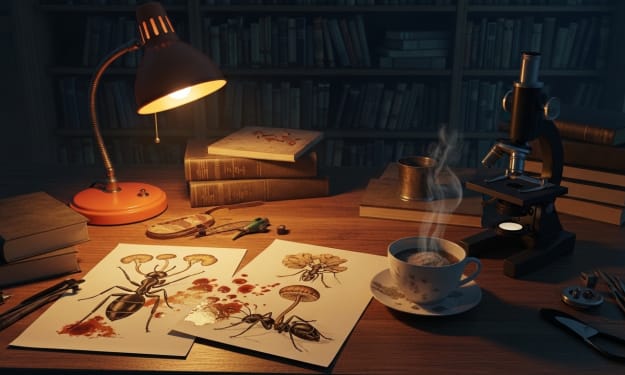
The Cordyceps Reality: How a fungus turns ants into "architects of their own death."
The mandible cracked. It was a dry, hollow snap that echoed in the silence of my library like a gunshot muffled by velvet. I wasn’t there in the Brazilian rainforest, of course; I was staring at a microscopic slide, illuminated by a flickering bulb that smells faintly of ozone and scorched dust. But the sound lived in my head. I could imagine the Camponotus leonardi—a soldier ant built for war—locking its jaws onto the underside of a leaf with such visceral force that its own head muscles began to liquefy. It was a final, involuntary act of architecture. The ant was building its own tomb, but the blueprint belonged to a ghost.
By The Chaos Cabinet5 days ago in Earth
📢 Raise Your Voice Thread: 03/05/2026
Our “Raise Your Voice Threads” are hosted most alternating Thursdays at 12PM ET to offer creators more avenues to uncover exceptional stories on Vocal. As we are continuously searching for fresh creators and inspiring stories, this thread provides an opportunity to exchange and discuss the stories that have moved and motivated us on Vocal.
By Raise Your Voice by Vocal5 days ago in Resources


Comments
There are no comments for this story
Be the first to respond and start the conversation.