
The Health Hazards of Air Pollution in Sub-Saharan Africa: A Distress Call to World Health Agencies for Immediate Action
Proposing Solutions to Combat Air Pollution in Sub-Saharan Africa


Introduction:
Air pollution is a grave global crisis that poses significant threats to human health and the environment. While the issue affects regions across the globe, the health hazards associated with air pollution in Sub-Saharan Africa have reached alarming levels. Some Data obtained from the World Health Organization (WHO) shows that an estimated 4.2 to 7 million people die from air pollution worldwide every year and that nine out of 10 people breathe air that contains high levels of pollutants. In Africa, 258,000 people died as a result of outdoor air pollution in 2017, up from 164,000 in 1990, according to UNICEF.
This article serves as a distress call to world health agencies to recognize the severity of the situation and take immediate action to address the devastating effects of air pollution in Sub-Saharan Africa.
The Alarming Reality:
Sub-Saharan Africa, with its rich biodiversity and diverse cultures, is grappling with severe air pollution challenges. The rapid industrialization, urbanization, reliance on biomass for cooking and heating, inefficient energy sources, and inadequate environmental regulations have contributed to the deteriorating air quality in the region. The consequences are dire, impacting millions of lives and burdening already strained healthcare systems.
1. Respiratory Health Crisis:
The high levels of particulate matter (PM), volatile organic compounds (VOCs), nitrogen oxides (NOx), and other harmful gases have led to a respiratory health crisis in Sub-Saharan Africa. According to World Health Organization (WHO) estimates, more than 500,000 premature deaths occur each year in the region due to household and ambient air pollution.
2. Cardiovascular Complications:
Exposure to air pollution increases the risk of cardiovascular diseases, including heart attacks, strokes, and high blood pressure. The fine particulate matter, known as PM2.5, penetrates deep into the lungs and enters the bloodstream, causing inflammation and damage to the cardiovascular system. The Global Burden of Disease study estimates that outdoor air pollution contributes to approximately 7% of total cardiovascular disease deaths in Sub-Saharan Africa.
3. Adverse Effects on Children:
Children are particularly vulnerable to the harmful effects of air pollution. The toxic pollutants in the air impair lung development, leading to long-term health consequences. According to UNICEF, approximately 620 million children in Africa are breathing air polluted above international guidelines, putting them at risk of respiratory infections, asthma, and impaired cognitive development.
4. Environmental Impact:
Air pollution not only affects human health but also poses a severe threat to the environment. Emissions from industries, vehicle exhaust, open burning, and deforestation contribute to climate change, ecosystem degradation, and loss of biodiversity. These environmental consequences exacerbate the health crisis, creating a vicious cycle of pollution and its consequences.
Immediate Action Required:
Given the urgency of the situation, immediate action is essential to combat the health hazards of air pollution in Sub-Saharan Africa. The following measures are crucial for addressing the crisis and protecting public health:
1. Strengthen Environmental Policies:
Governments must enforce stricter environmental regulations and promote sustainable practices. This includes implementing emission controls, encouraging cleaner industrial processes, and investing in renewable energy sources.
2. Promote Clean Energy Sources:
Efforts should be made to transition from fossil fuels to clean and renewable energy sources such as solar, wind, and hydroelectric power. Expanding access to clean energy technologies will significantly reduce air pollution and its detrimental health impacts.
3. Enhance Monitoring and Data Collection:
Improving air quality monitoring systems and data collection is crucial for assessing the scale of pollution and identifying hotspots. This data will guide policy decisions and facilitate targeted interventions to reduce pollution levels.
4. Public Awareness and Education:
Raising awareness about the health risks of air pollution is vital. Educational campaigns, community outreach programs, and media initiatives can inform the public about the consequences of air pollution and encourage behavioral changes to reduce exposure.
5. Strengthen Healthcare Systems:
The escalating health crisis demands that healthcare systems receive adequate resources, infrastructure, and trained professionals to manage the burden of air pollution-related diseases. This includes investing in healthcare facilities, improving diagnostic capabilities, and ensuring access to quality healthcare services.
Summary:
The health hazards associated with air pollution in Sub-Saharan Africa demand urgent attention from world health agencies. Immediate action is required to address the devastating impact on human health and the environment. By enforcing stricter environmental policies, promoting clean energy sources, enhancing monitoring systems, raising public awareness, and strengthening healthcare systems, we can mitigate the health risks and protect the well-being of millions across the region. It is a collective responsibility to take immediate action and ensure a healthier, cleaner future for Sub-Saharan Africa and the generations to come.
About the Creator
Adeola King
Hey Buddies, you're welcome to my world. I'm a writer, researcher, poet, and a lover of humanity. My areas of interest are relationship, inspiration, poetry, nature, and life in general. Join me, let's make the world a better place!
Keep reading
More stories from Adeola King and writers in Earth and other communities.
Conquering the Annapurna Base Camp Trek: A Himalayan Odyssey
Conquering the Annapurna Base Camp Trek: A Himalayan Odyssey The Annapurna Base Camp (ABC) trek is more than just a trek; it is a spiritual journey into the core of the Himalayas. The towering snow- covered peaks reach for the sky while the rhododendron woods seem to tell the tales of the adventure in their whispers. Located in the Annapurna region of Nepal, the ABC trek is a magnet for thousands of adventurers annually. This trek provides the stunning vistas of some of the biggest Himalayan peaks including Annapurna I (8, 091m) and the uniquely fishtail, shaped Machapuchare mountain (6, 993m). It is a must for all adventurers, regardless of their experience level. The ABC trek is like a melting pot of adventure, culture, and nature that are barely matched anywhere else on this planet.
By Pranjal Pandey3 days ago in Earth
Magnetic Magma earth
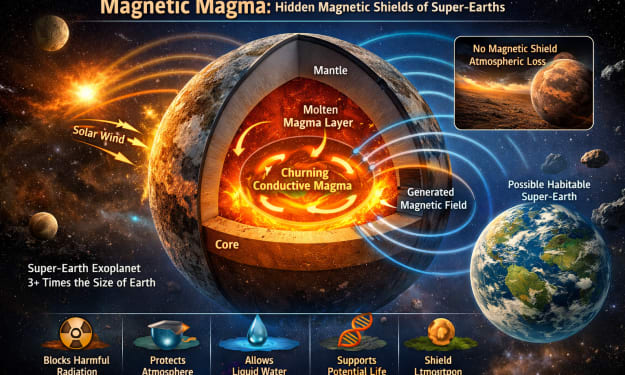
Super-Earths are rocky exoplanets more than three times the size of our planet, with far greater internal pressures and temperatures. For years, scientists assumed that if these worlds had magnetic fields, they would form the same way Earth’s does — through movement in a molten iron core. However, new laboratory experiments suggest something very different may be happening deep inside these massive planets. Under extreme pressure, certain molten rocks become electrically conductive. When these materials churn and circulate between the core and the mantle, they can generate magnetic fields on their own. This means a super-Earth might not rely solely on its core for protection. Instead, a thick, dynamic layer of magma could act as a natural magnetic shield, powered by internal heat and motion.
By USA daily update 3 days ago in Earth



Comments
There are no comments for this story
Be the first to respond and start the conversation.