
“The Green Miracle"
Photosynthesis Powers Life on Earth

“The Green Miracle"
Photosynthesis Powers Life on Earth
Introduction:
Every breath we take, every bite of food we eat, and every shade of green that colors our planet — all owe their existence to one incredible process: photosynthesis. Hidden within the leaves of plants lies a silent factory powered by sunlight, turning air and water into the fuel of life. It’s nature’s most elegant invention, a dance of light and chemistry that sustains nearly every living creature on Earth. Let’s step into the secret world of green energy — where sunlight becomes sugar and plants become life-makers.
________________________________________
The Magic Inside the Leaf
Inside each green leaf are millions of microscopic structures called chloroplasts, which contain the pigment chlorophyll — the substance that gives plants their green color. Chlorophyll is like a solar panel, capturing sunlight and converting it into energy. This energy drives the transformation of carbon dioxide (from the air) and water (from the soil) into glucose, a type of sugar that plants use to grow and thrive. As a byproduct, oxygen is released into the air — the same oxygen that animals and humans need to survive.
In simple terms, photosynthesis is nature’s recipe for life:
🌞 Sunlight + 💧 Water + 🌬️ Carbon Dioxide → 🍃 Glucose + 🌬️ Oxygen
________________________________________
Why Photosynthesis Matters
Photosynthesis is not just about feeding plants — it fuels the entire planet. The sugars plants produce serve as the base of the food chain, feeding herbivores, which in turn feed predators. Meanwhile, the oxygen released refreshes Earth’s atmosphere, making it breathable for all living beings. Without photosynthesis, our planet would be a barren rock — lifeless, airless, and dark.
Definition:
Photosynthesis is the process by which green plants, algae, and some bacteria convert light energy from the sun into chemical energy stored in glucose (sugar) molecules.
Carbon dioxide + Water + Light energy → Glucose + Oxygen
🌿 Where It Happens:
Photosynthesis takes place in the chloroplasts of plant cells, which contain chlorophyll, the green pigment that captures sunlight.
🔬 🌍 The Importance of Photosynthesis to Life on Earth
Photosynthesis is far more than a simple plant process — it’s the foundation of all life and energy flow on Earth. Its importance can be understood through several key contributions:
Production of Oxygen:
Almost all the oxygen in our atmosphere comes from photosynthetic organisms. Without photosynthesis, the air would be unbreathable, and aerobic life would cease to exist.
Energy Source for All Living Things:
Plants form the base of the food chain. The glucose they produce is consumed by herbivores, which in turn are eaten by carnivores. Ultimately, every living creature depends on photosynthesis for energy.
Climate Regulation:
Photosynthesis absorbs massive amounts of carbon dioxide (CO₂) — one of the main greenhouse gases responsible for global warming. Forests, oceans, and plants act as carbon sinks, helping to stabilize the planet’s climate.
Sustainable Energy and Life Balance:
The process demonstrates the ultimate model of sustainability, using renewable energy from the sun and recycling essential elements like carbon, oxygen, and hydrogen through ecosystems.
🌾 Photosynthesis and the Future of Our Planet
In an era of environmental challenges, understanding and protecting the process of photosynthesis has become more critical than ever. Deforestation, pollution, and climate change threaten the planet’s green systems that maintain our atmosphere and food supply. Modern science is even exploring ways to mimic photosynthesis artificially to create clean energy and reduce carbon emissions — a field known as artificial photosynthesis.
By studying how plants efficiently convert sunlight into energy, researchers hope to develop technologies that can power our world in a sustainable, eco-friendly way. Thus, the ancient natural process of photosynthesis could hold the key to the future of renewable energy.
________________________________________
A Process of Perfect Balance
Photosynthesis also plays a key role in maintaining Earth’s climate. By absorbing carbon dioxide, plants help reduce greenhouse gases and keep global temperatures stable. Forests, grasslands, and even ocean algae act as Earth’s natural air purifiers, reminding us how deeply connected we are to the green world around us.
________________________________________
Conclusion: The Heartbeat of Nature
Photosynthesis is more than a scientific process — it’s the heartbeat of our planet. It connects the sky to the soil, the sun to the leaf, and the plant to every living creature. Each ray of sunlight that touches a leaf sparks a chain reaction that sustains life itself. In the quiet green of a forest or the delicate blade of grass, the miracle of photosynthesis is happening — endlessly, gracefully, and vitally.
About the Creator
Keep reading
More stories from Abdelrahem10 and writers in Earth and other communities.
Trichoderma Applications in Agriculture and Environmental Protection
Trichoderma Applications in Agriculture and Environmental Protection Introduction Trichoderma is a genus of soil-dwelling fungi that has gained significant attention in agriculture and environmental protection due to its potent biocontrol, growth-promotion, and degradation properties. Its diverse mechanisms make it a sustainable alternative to chemical pesticides, fertilizers, and environmental pollutants. This review delves into the multifaceted roles of Trichoderma in improving agricultural productivity, managing plant diseases, and its environmental benefits.
By Abdelrahem105 months ago in Earth
The Geology of Your Inner World
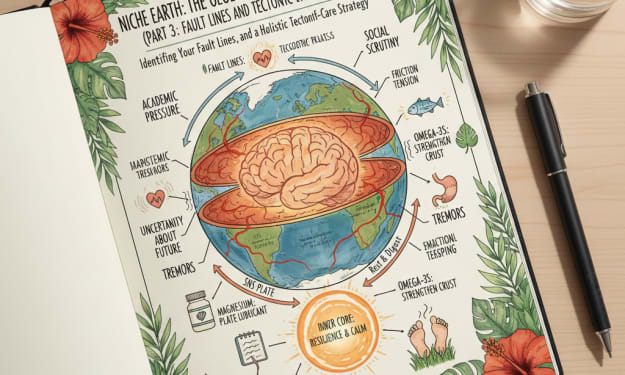
Just like the Earth’s surface is riddled with invisible cracks where tectonic plates meet, our minds have their own deep-seated fault lines. These aren't always obvious; they're the recurring triggers, the sensitive spots, the areas where stress can quickly build up, leading to a mental "tremor" or even a full-blown anxiety "earthquake." As an overthinking girl, my fault lines are often hidden under layers of forced calm and academic ambition. But as a Nutrition student, I'm learning to map them out, not just to avoid collapse, but to understand how to build stronger, more resilient structures.
By Being Inquisitive6 days ago in Earth



Comments
There are no comments for this story
Be the first to respond and start the conversation.