
The Forgotten Map That Led Me to a Hidden World
A Journey of Discovery in the Heart of the Himalayas


Last summer, I stumbled upon something that changed my life forever—a tattered, hand-drawn map tucked inside an old book I bought from a dusty shop in Darjeeling. The shopkeeper, an elderly man with a weathered smile, handed me the book with a cryptic warning: “Some things are meant to be found, but not by everyone.” I didn’t think much of it at the time. I was just a restless 30-year-old looking for an escape from my mundane job as a graphic designer. But that map, with its faded ink and cryptic symbols, felt like a call to adventure. It led me on a journey deep into the Himalayas, where I discovered a hidden world that taught me the true meaning of connection, courage, and wonder.
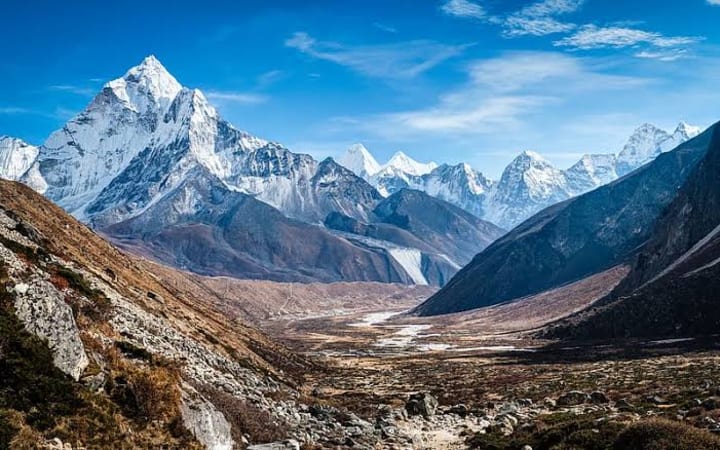
The map pointed to a remote valley in the eastern Himalayas, a place not marked on any modern chart. It was labeled “The Valley of Echoes,” with a small note in the corner that read, “Where the past speaks to the present.” I couldn’t resist the mystery. After weeks of preparation—gathering supplies, researching the terrain, and convincing my skeptical friend Arjun to join me—I set off. Arjun, a pragmatic engineer, thought I was chasing a wild dream, but he couldn’t say no to a trek in the mountains. We started our journey from a small village at the base of the Himalayas, where locals warned us about the valley. “It’s a place of spirits,” an old woman told us, her eyes wide with caution. “Not everyone who goes there comes back the same.”
The trek was grueling. For three days, we navigated steep trails, crossed icy streams, and battled freezing winds. My backpack felt heavier with every step, and Arjun’s complaints grew louder. Just when we were about to turn back, we found it—a narrow pass hidden behind a wall of vines, exactly as the map described. We squeezed through the gap, and what we saw on the other side took our breath away. The Valley of Echoes was a paradise untouched by time. Lush greenery stretched as far as the eye could see, dotted with vibrant wildflowers and shimmering waterfalls. The air was thick with the scent of pine and earth, and the sound of distant birdsong filled the silence. It felt like stepping into a painting, a world that had been waiting for us to arrive.
But the valley wasn’t empty. As we explored, we stumbled upon a small settlement of stone huts nestled against a cliff. The people who lived there—about 30 of them—greeted us with a mix of curiosity and suspicion. They called themselves the Keepers of the Echo, a community that had lived in the valley for centuries, isolated from the outside world. Their leader, a woman named Saira, explained that the valley was a sacred place where the voices of their ancestors echoed through the mountains, guiding them through life. She showed us ancient carvings on the cliff face, symbols that matched those on my map. “You were meant to find us,” Saira said, her voice soft but firm. “The map chooses its seekers.”
Over the next few days, we lived with the Keepers, learning their ways and listening to their stories. They had no technology, no electricity, and no contact with the outside world, yet they were the happiest people I’d ever met. They taught us how to fish in the crystal-clear streams, how to weave baskets from reeds, and how to listen to the echoes—faint whispers in the wind that carried wisdom from generations past. One night, as we sat around a fire under a sky full of stars, Saira shared the valley’s greatest secret: a hidden cave at the base of the tallest waterfall, said to hold a relic that could “heal the broken.” I felt a chill run down my spine. My mother had passed away two years earlier, and the grief still weighed on me like a stone. Could this relic heal the hole in my heart?
Arjun and I decided to find the cave. Saira warned us that the journey was dangerous, but she gave us her blessing, handing me a small amulet carved with the same symbols as the map. The trek to the waterfall was treacherous, with slippery rocks and a narrow ledge that dropped into a roaring river below. At one point, Arjun slipped, and I grabbed his arm just in time, my heart pounding as I pulled him back. “We’re in this together,” I said, and he nodded, his usual skepticism replaced by determination. When we finally reached the cave, we found the relic—a small, glowing crystal that pulsed with a soft blue light. As I held it, I felt a warmth spread through me, and for the first time in years, I felt my mother’s presence, as if she were telling me it was okay to let go. Tears streamed down my face, but they were tears of release, not pain.
We returned to the village as changed people. Arjun, who had always been cynical, admitted that the experience made him believe in something bigger than himself. I felt lighter, as if the weight of my grief had lifted. Before we left, Saira asked us to keep the valley a secret, to protect her people from the outside world. I promised we would, knowing that some places are too precious to be exposed. We hiked back to civilization, the map still in my pocket, but its purpose fulfilled. Back in Darjeeling, I returned the book to the shopkeeper, who smiled knowingly. “You found what you were looking for, didn’t you?” he asked. I nodded, unable to find the words to describe what the Valley of Echoes had given me.
The journey taught me that adventure isn’t just about discovering new places—it’s about discovering yourself. The Valley of Echoes, with its whispers of the past, reminded me that we’re all connected to something greater, whether it’s our ancestors, our loved ones, or the earth itself. I’ll never forget the Keepers, their simple yet profound way of life, or the crystal that helped me heal. Sometimes, I wonder if the map will call to someone else, leading them to the same hidden world. If it does, I hope they find what they’re searching for, just as I did.
About the Creator
Ahmed Jubayer
Amplifying untold stories with a bold, authentic voice. Passionate about weaving words that resonate, provoke, and inspire.
Keep reading
More stories from Ahmed Jubayer and writers in Earth and other communities.
First-Ever Images of Free-Range Atoms Captured in Space
On May 11, 2025, scientists announced a groundbreaking achievement that feels like something out of a science fiction novel: they’ve captured the first-ever images of individual atoms moving freely through space. This milestone, reported by Earth.com, marks a turning point in quantum physics, allowing us to see the unseen in a way that was once thought impossible. For the first time, researchers at MIT, led by physicist Martin Zwierlein, have snapped pictures of these “free-range” atoms, revealing their behaviors and interactions in real time. This breakthrough not only confirms theories proposed over a century ago but also opens up new possibilities for understanding the quantum world, potentially reshaping fields from technology to energy. Let’s dive into the science behind this feat, its historical significance, the technology that made it possible, and what it could mean for the future.The challenge of imaging individual atoms lies in their quantum nature. Atoms aren’t like everyday objects—they behave as both particles and waves, and their position and speed can’t be pinpointed simultaneously due to the Heisenberg Uncertainty Principle. This fundamental quirk of quantum mechanics has long frustrated scientists trying to observe atoms in motion. In the past, researchers could image entire clouds of atoms, capturing their collective behavior, but the individual atoms within remained elusive, like trying to see a single water molecule in a cloud. The MIT team overcame this hurdle using a technique called atom-resolved microscopy, which allows atoms to interact freely in a controlled environment before being frozen in place with laser light for imaging. The result is a stunning set of pictures that show single atoms—each about a tenth of a nanometer across—moving and interacting in ways that were previously only theorized.The images reveal fascinating differences between two types of quantum particles: bosons and fermions. Bosons, like sodium atoms, tend to cluster together in a phenomenon known as bunching, forming a Bose-Einstein condensate at ultra-low temperatures. This condensate is a state of matter where atoms lose their individuality and act as a single quantum entity, a discovery that earned MIT’s Wolfgang Ketterle a Nobel Prize in 2001. The images of bosons show them bunching together with wavelike trails of light behind them, a visual confirmation of their wave-particle duality. Fermions, like lithium atoms, behave differently—they repel each other, a behavior called anti-bunching, due to the Pauli exclusion principle. The MIT team captured fermions pairing up in free space, a key mechanism behind superconductivity, where materials conduct electricity with zero resistance. These images, published in Physical Review Letters, provide a rare glimpse into the quantum dance of atoms, validating long-held theories with direct visual evidence.This achievement has deep historical roots in the development of quantum mechanics. Over a century ago, pioneers like Louis de Broglie proposed that particles exhibit wave-like behavior, a theory that laid the groundwork for understanding quantum phenomena. Later, scientists predicted effects like boson bunching and fermion pairing, but these remained abstract concepts, demonstrated through mathematics rather than observation. The ability to see these effects in real space is a testament to how far science has come. It’s a moment that connects the theoretical breakthroughs of the early 20th century with the experimental capabilities of today, showing how persistent curiosity and technological innovation can bring abstract ideas into the realm of the tangible. The MIT team’s work builds on decades of research into ultracold quantum gases, a field that has pushed the boundaries of what we believe is possible in physics.The technology behind this breakthrough is as remarkable as the images themselves. Atom-resolved microscopy involves trapping a cloud of atoms in a loose laser beam, allowing them to move and interact freely. The atoms are then cooled to temperatures near absolute zero—colder than outer space—to slow their motion. At this point, the team uses laser light to freeze the atoms in place without destroying their delicate quantum states, a process that requires incredible precision. Too much heat or light would scatter the atoms, ruining the experiment. The resulting images capture the atoms’ positions and interactions with unprecedented clarity, revealing details at the single-atom level. This technique differs from traditional methods like absorption imaging, which only show the shadowy outline of an atom cloud. The ability to image atoms in situ, as they interact, is what makes this method so powerful, offering a window into the quantum world that was previously out of reach.The implications of this discovery are vast and exciting. For one, it provides a new tool for studying quantum phenomena that could lead to practical applications. The observation of fermion pairing, for instance, could guide the development of superconductors that operate at higher temperatures, reducing energy waste in power grids or electronics. Superconductivity currently requires extreme cold, making it impractical for widespread use, but understanding how fermions pair in free space might unlock new materials that work at room temperature. Additionally, the technique could be used to explore other quantum effects, such as the quantum Hall effect, where electrons synchronize under strong magnetic fields. This could pave the way for advancements in quantum computing, where precise control of quantum states is crucial. Beyond technology, these images deepen our understanding of the fundamental laws governing the universe, offering insights into the behavior of matter at its smallest scales.However, this breakthrough also raises questions about the broader implications of quantum research. As we gain the ability to visualize and manipulate atoms with such precision, we must consider the ethical and societal impacts. Quantum technologies, like quantum computing or advanced materials, could disrupt industries, economies, and even geopolitics, potentially widening the gap between nations with access to these technologies and those without. Moreover, the energy-intensive nature of cooling atoms to near absolute zero poses environmental challenges, especially as we strive for sustainability. While these concerns are not immediate, they remind us that scientific progress must be paired with responsible stewardship to ensure its benefits are shared equitably.The first-ever images of free-range atoms are a moment to celebrate—a triumph of human ingenuity and a testament to the power of curiosity-driven science. They bring us closer to understanding the invisible forces that shape our world, from the behavior of particles to the potential for new technologies. As researchers continue to refine this technique, we can expect even more discoveries that challenge our understanding of quantum mechanics. For now, these images stand as a beautiful reminder of what’s possible when we push the boundaries of what we believe can be seen. The quantum world, once hidden in equations and theories, is now visible, inviting us to explore its mysteries in ways we never thought possible.
By Ahmed Jubayer9 months ago in Earth
The Weather Tomorrow Feels More Personal Than Ever
Every night before going to bed, I check the weather for tomorrow. It used to be a small, mechanical act — like setting an alarm or brushing my teeth. Now it feels almost existential. I tap into the forecast app and stare at those color-coded icons as though they’re tarot cards trying to tell me something about what kind of day I’ll wake up to.
By Trend Vantageabout 23 hours ago in Earth
The Collapse of a Brazilian Bank Ensnares Politicians and Judges
Brazil is grappling with one of the most shocking financial scandals in recent history: the collapse of a major bank that has sent tremors through the economy, the political system, and the judiciary. What began as a financial crisis quickly transformed into a story of political entanglement, judicial scrutiny, and public outrage, raising questions about oversight, accountability, and the fragile trust that binds citizens, bankers, and politicians. The implications of this collapse are vast, affecting not just shareholders and depositors, but also shaking the foundations of governance in Brazil. The Collapse: A Perfect Storm of Mismanagement The bank in question, a significant player in Brazil’s retail and corporate banking sectors, reportedly faced years of mismanagement, risky lending practices, and opaque financial dealings. For years, internal audits hinted at irregularities, but these warnings were either ignored or covered up. When the collapse finally occurred, thousands of customers lost access to their accounts, and businesses relying on the bank for loans and credit lines faced immediate disruption. The ripple effect extended beyond the banking sector, affecting real estate, commerce, and public confidence in financial institutions. Politicians in the Crossfire As investigations unfolded, authorities discovered that several politicians had deep financial ties to the bank. Allegations include preferential loans, insider deals, and the use of political influence to shield executives from scrutiny. These revelations have sparked outrage among the public, who see the situation as yet another example of how money and power intersect in ways that harm ordinary citizens. Brazil’s history of corruption scandals — including Operation Car Wash — has made the public wary of politicians’ involvement in business, and this banking collapse appears to confirm those fears. Some politicians are now under formal investigation, facing charges ranging from corruption to conflict of interest. Legal experts predict that the case could lead to resignations, trials, and possibly convictions. Judges Under Scrutiny The crisis has also ensnared members of the judiciary. Reports indicate that some judges may have overlooked warning signs, delayed investigations, or facilitated questionable transactions involving the bank. While it is unclear whether these actions were deliberate or a result of systemic inefficiencies, the optics are troubling. Public confidence in the judiciary is essential for democracy, yet this scandal highlights the vulnerability of institutions when financial and political interests collide. Brazilian citizens are now demanding transparency, calling for independent oversight to ensure justice is applied equally — whether to bankers, politicians, or judges. Economic and Social Fallout Beyond politics and the courts, the bank’s collapse has real-world consequences for everyday Brazilians. Customers report frozen accounts, lost savings, and halted payments. Small business owners face canceled loans and delayed contracts. Even those not directly affected worry about contagion in the financial system, fearing a broader economic downturn. Experts warn that if regulatory systems fail to prevent similar crises, Brazil’s economic growth could slow, foreign investment could decline, and public trust in institutions may erode further. The social cost — protests, strikes, and political unrest — is already visible in major cities. Why Oversight Failed The collapse raises important questions about regulation in Brazil. Financial watchdogs and central bank authorities are under pressure to explain how such a significant failure went unnoticed. Analysts suggest several systemic issues: Weak regulatory enforcement — audits and compliance checks were reportedly insufficient. Political interference — pressure from powerful politicians may have delayed corrective measures. Opaque financial practices — complex corporate structures and hidden liabilities masked the bank’s instability. This combination created a perfect storm, allowing risky practices to continue unchecked until the bank could no longer operate. Lessons for Brazil and Beyond The scandal is more than a national story — it is a cautionary tale for emerging economies worldwide. Financial institutions, no matter how large or influential, cannot be above scrutiny, and political entanglements must be carefully managed. Transparency, independent oversight, and robust regulatory frameworks are essential to prevent similar disasters. In countries where finance and politics overlap too closely, the risk of systemic failure is amplified, with devastating consequences for ordinary citizens. What Happens Next? Brazilian authorities are now facing immense pressure to act swiftly. Investigations will likely continue for months, if not years. Some potential outcomes include: Trials and convictions of bank executives and politicians Reforms in banking regulations and financial oversight Strengthened judicial accountability mechanisms Measures to restore public confidence in the financial system Meanwhile, citizens and businesses are left to navigate uncertainty, hoping for clear answers and protections against further damage. Final Thoughts The collapse of this Brazilian bank is more than a financial event — it is a story about the fragility of systems where money, politics, and justice intersect. It serves as a stark reminder that trust is the foundation of both banking and governance. When that trust is broken, the consequences are profound and far-reaching. For Brazil, this is a moment of reckoning. For the world, it is a cautionary tale about the need for transparency, oversight, and accountability in every institution that touches the lives of millions.
By Muhammad Hassanabout 17 hours ago in Earth




Comments
There are no comments for this story
Be the first to respond and start the conversation.