
The Flat Earth Debate - Unveiling the Curvature of Knowledge
Earth's Lessons
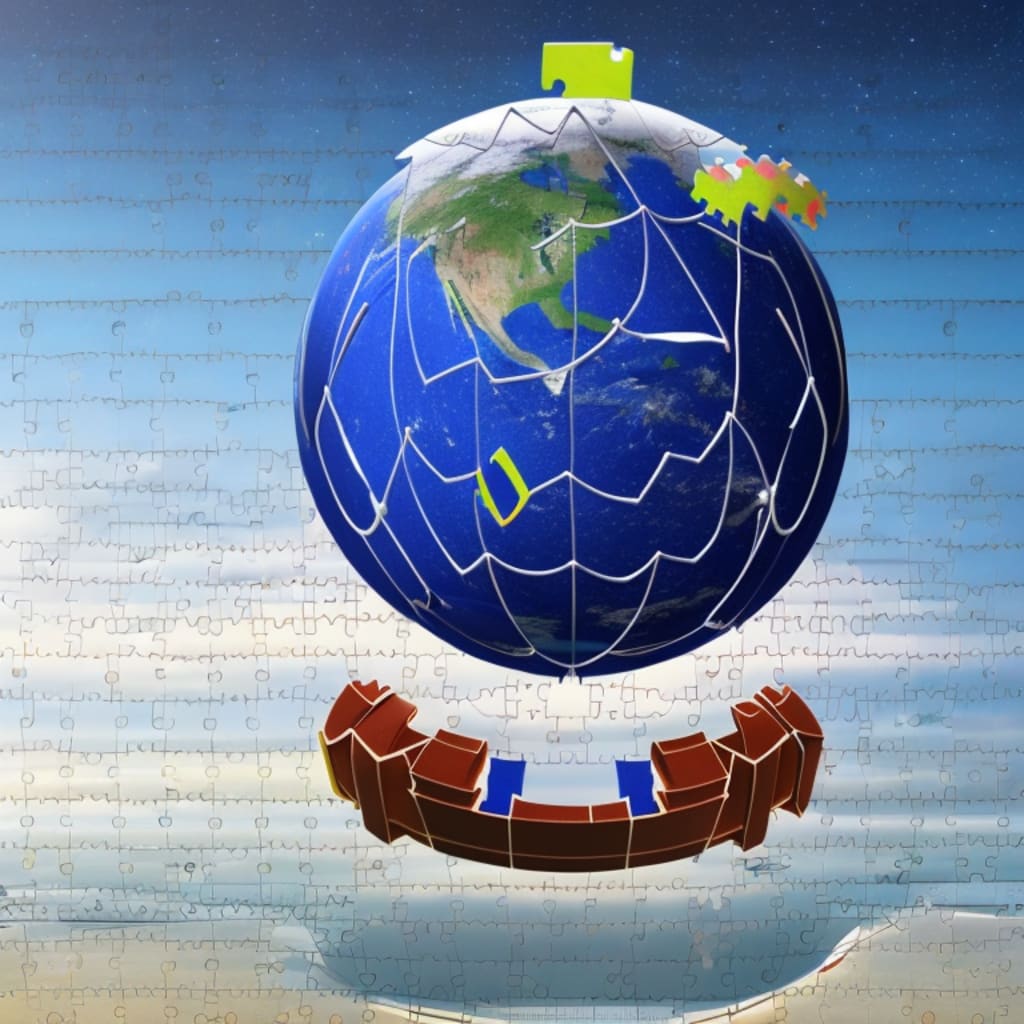
Today, we're delving into the intriguing realm of the flat Earth debate. Join me as we uncover the surprising arguments, historical misconceptions, and the complex nature of knowledge itself.
It all started back in 2003 when researchers made a fascinating discovery: Kansas is, in fact, flatter than a pancake. But before you jump to conclusions, let's clarify that the Earth is not actually flat—it's round. If the Earth were truly flat, we'd have travelers falling off the edge all the time, right? Well, not exactly. Imagine a flat disk instead of a spherical Earth, like a plate. In the center, things would feel normal due to gravity, but as you move towards the edge, gravity would tilt, pushing you back towards the center at a steeper angle. To help visualize this, my friend Nick from 'yeti dynamics' created a simulation that shows the increasingly diagonal gravity on a disk-shaped Earth.
If you were a runner heading towards the edge of this flat Earth, it would feel like you're struggling to climb a steeper and steeper hill. The buildings near the edge would have foundations designed to make people feel like down is perpendicular to the floor, just as we experience on our round Earth. As you approach the edge, things would get pretty scary. Even though it's a flat Earth, it would appear as a sheer drop-off. Surprisingly, due to gravity, the real risk would be falling away from the edge and rolling all the way back to the center.
But let's step back for a moment and acknowledge that this flat Earth model is impossible in reality. Any object as massive as the Earth shaped like a flat disc would naturally collapse back into a spherical shape under its own gravity. That's why in outer space, objects larger than a few hundred miles in diameter are always round. So, the idea of a flat Earth doesn't hold up scientifically.
Now, let's explore the misconceptions surrounding the belief in a flat Earth. Contrary to popular belief, Christopher Columbus didn't discover that the Earth is round. Scholars and major religions in the West have accepted the Earth's roundness for centuries, dating back to the Ancient Greeks. They observed that boats disappear bottom first when sailing away, and as you travel north or south, different stars come into view. The misconception that people believed in a flat Earth only a few hundred years ago actually emerged in more recent times as an insult, perpetuated by repetition and publication.
But what about the modern-day flat Earthers who continue to advocate for a flat Earth? They have explanations for every piece of evidence supporting a round Earth. They argue that circumnavigation is just a circular path, the round shadow Earth casts on the Moon during a lunar eclipse could be created by a flat disc, and time zones are caused by a spotlight sun. They even challenge the existence of gravity as we know it, proposing that the flat Earth is accelerating upward at 9.8 meters per second instead. To them, all the photos and videos showing a round Earth are fabricated hoaxes perpetrated by what they call "Big Globe"—space agencies, airlines, and globe manufacturers who profit from our belief in a round Earth.
However, these flat Earth theories are ad hoc explanations that only address specific issues and fail to account for all the evidence. Science rejects such theories when better explanations align with a greater number of observations. Our understanding of the Earth's shape is based on a vast interconnected network of knowledge, much like a crossword puzzle. The clues are the questions we ask, and the answers reinforce each other, creating a grid of confidence in our understanding. But just like a crossword puzzle, there may not be a definitive answer for every clue. Some questions may lack a single satisfying answer, making the puzzle forever playable.
Richard Feynman beautifully encapsulated this notion by saying, "Some people say, 'How can you live without knowing?' I do not know what they mean. I always live without knowing—that is easy. How you get to know is what I want to know." It's a reminder that the pursuit of knowledge is an ongoing journey, filled with unanswered questions and possibilities.
So, as we conclude our exploration of the flat Earth debate, remember that knowledge is ever-evolving, and the search for answers continues. Embrace the complexity of our world and the joy of discovering new truths.
About the Creator
Keep reading
More stories from Myke & Amy and writers in Earth and other communities.
Earth's Price Tag
Earth, Texas – a place on Earth officially named Earth. It's a curious coincidence that Earth only contains 1066 people. But did you know that Earth, the entire planet, has had more than one Moon? While we usually think of the Moon as Earth's only natural satellite, there was a brief period from September 2006 to June 2007 when Earth had an additional Moon called 2006 RH120. This near-Earth asteroid fell into orbit around our planet, becoming another Moon of Earth. Technically, a Moon is just a natural satellite, so any object in orbit around a planet qualifies.
By Myke & Amy3 years ago in Earth
Denmark and Greenland Prepare for US Talks as Trump Says Territory’s PM Has a ‘Big Problem’
Denmark and Greenland are preparing for crucial talks with the United States amid renewed diplomatic tension, after former US President Donald Trump claimed that Greenland’s prime minister has a “big problem.” The remarks, reported as part of ongoing European political coverage, have drawn attention to the fragile balance between diplomacy, sovereignty, and strategic interests in the Arctic. As delegations ready themselves for discussions in Washington, the episode underscores how Greenland has once again become a focal point in global geopolitics.
By Aarif Lashari4 days ago in Earth


Comments
There are no comments for this story
Be the first to respond and start the conversation.