
The Fascinating Cosmos: Its Complexity, Energy, History, and Mysteries
By Ayan Zaidi
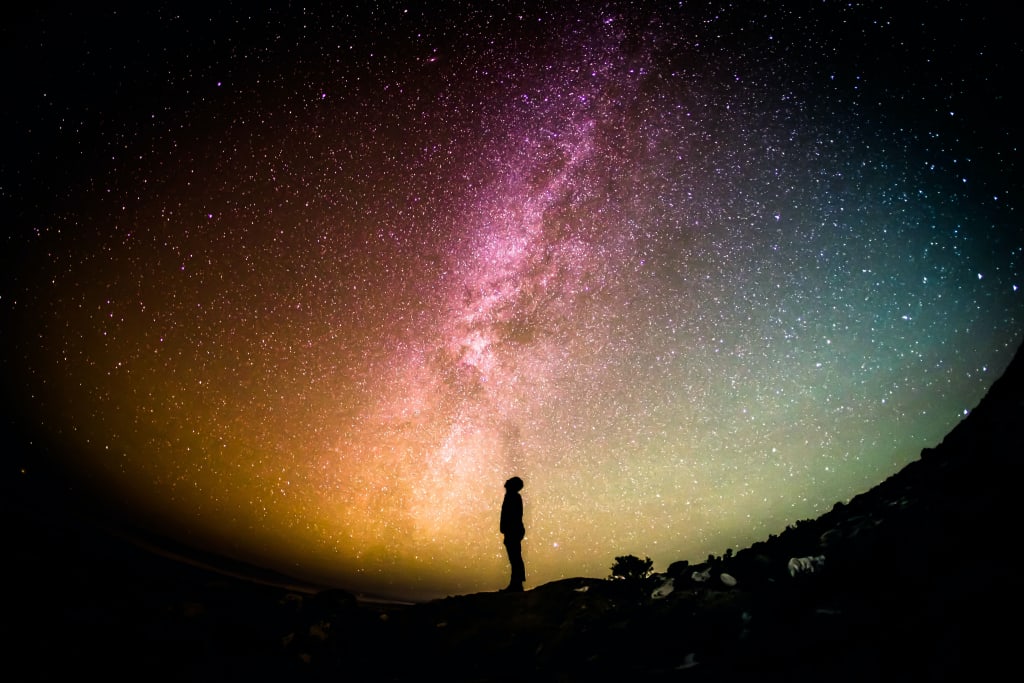
The cosmos, also known as the universe, is a vast and complex entity that has fascinated humans for centuries. With its seemingly endless expanse and limitless possibilities, the cosmos has inspired countless scientists, philosophers, and poets to contemplate its mysteries and search for answers about our place within it.
The cosmos is defined as the entirety of all matter and energy in existence, including all galaxies, stars, planets, and other celestial bodies. It is estimated to be around 13.8 billion years old, and its size is difficult to comprehend, with current estimates suggesting that the observable universe is around 93 billion light-years in diameter.
One of the most remarkable features of the cosmos is its complexity. It contains billions of galaxies, each of which contains billions of stars, and countless planets and other celestial bodies. These galaxies are not randomly scattered, but are arranged in complex patterns that reveal the underlying structure of the universe.
The cosmos is also characterized by its incredible energy, which is generated by the interactions of particles at the smallest scales all the way up to the largest structures in the universe. Stars, for example, generate energy through the process of nuclear fusion, in which hydrogen atoms are fused together to form helium, releasing vast amounts of energy in the process. This energy is what allows stars to shine and provides the basis for life on many planets.
One of the most fascinating aspects of the cosmos is its history. The universe began with the Big Bang, a massive explosion that occurred around 13.8 billion years ago. This explosion released enormous amounts of energy and matter, which began to coalesce into the galaxies, stars, and planets that we see today.
Over the course of billions of years, the cosmos has gone through countless changes and transformations. Galaxies have collided and merged, stars have been born and died, and planets have formed and been destroyed. Through all of these changes, the cosmos has continued to evolve and change, with new structures and phenomena emerging at every turn.
Today, scientists continue to explore the cosmos and discover new wonders and mysteries. One of the most exciting areas of research is the search for exoplanets, which are planets outside of our own solar system. With the discovery of thousands of exoplanets in recent years, scientists are beginning to get a better understanding of the prevalence and diversity of planets in the universe.
Another area of research is the search for dark matter and dark energy, two mysterious substances that are believed to make up the vast majority of the mass and energy in the universe. Despite years of research, scientists still know very little about these substances, but their discovery could revolutionize our understanding of the universe and its evolution.
Overall, the cosmos is an incredible and awe-inspiring entity that continues to captivate and inspire humans to this day. With its complexity, energy, and history, it is a testament to the incredible power and creativity of the natural world, and a reminder of our own place within it.
The study of the cosmos has come a long way in recent decades, thanks in large part to advances in technology. Telescopes, both on the ground and in space, have allowed scientists to observe distant galaxies and stars in unprecedented detail, while computer simulations have enabled them to model the behavior of the universe on a massive scale.
One of the most significant discoveries in recent years has been the detection of gravitational waves, ripples in the fabric of space-time caused by the movement of massive objects. In 2015, the Laser Interferometer Gravitational-Wave Observatory (LIGO) detected the first direct evidence of gravitational waves, confirming a prediction made by Albert Einstein over 100 years ago. This discovery has opened up a new way of studying the cosmos, allowing scientists to observe events such as black hole mergers and supernovae in a completely new way.
Another area of research that has gained attention in recent years is the search for extraterrestrial life. With the discovery of so many exoplanets, scientists are beginning to ask whether there might be other forms of life out there in the universe. While we have not yet found any definitive evidence of extraterrestrial life, scientists continue to search for signs of life on other planets and moons, and to explore the conditions under which life might be able to exist.
The study of the cosmos also raises many philosophical and existential questions. For example, the vast size and complexity of the universe can make us feel insignificant and small, leading to questions about the meaning of our own existence. At the same time, the study of the cosmos can also inspire a sense of wonder and awe, reminding us of the incredible beauty and power of the natural world.
In conclusion, the study of the cosmos is a complex and multi-faceted topic that encompasses many different areas of science, philosophy, and culture. From the search for exoplanets to the study of dark matter and dark energy, the cosmos continues to inspire and fascinate us with its mysteries and complexities. As we continue to explore the universe, we are sure to uncover new wonders and questions that will continue to push the boundaries of our understanding of the cosmos and our place within it.
Certainly! The study of the cosmos encompasses a wide range of fields and disciplines, including astronomy, astrophysics, cosmology, and planetary science, among others. Each of these fields focuses on different aspects of the cosmos and uses different methods and tools to study them.
Astronomy is the study of celestial objects and phenomena, including stars, galaxies, and other cosmic bodies. It involves the observation and analysis of light and other forms of radiation emitted by these objects, and has been practiced by humans for thousands of years.
Astrophysics is a branch of physics that studies the physical properties of celestial objects and the processes that govern their behavior. It applies the principles of physics, such as thermodynamics and electromagnetism, to the study of the cosmos.
Cosmology is the study of the origin, evolution, and structure of the universe as a whole. It involves the study of large-scale structures such as galaxies and clusters of galaxies, as well as the properties of the universe as a whole, such as its geometry, expansion rate, and composition.
Planetary science is the study of planets, moons, and other bodies in our solar system, as well as those orbiting other stars. It includes the study of their physical properties, such as their composition and structure, as well as their formation and evolution.
In addition to these scientific fields, the study of the cosmos also has cultural and philosophical dimensions. Throughout history, humans have used the cosmos as a source of inspiration and wonder, and have created art, literature, and music that reflect our fascination with the natural world.
The study of the cosmos has also raised profound philosophical questions about our place in the universe and the nature of existence itself. For example, the discovery that the universe is expanding has led to questions about the ultimate fate of the universe and the possibility of multiple universes. The study of the cosmos has also challenged our understanding of time and space, and has forced us to reexamine our fundamental assumptions about reality.
Overall, the study of the cosmos is a multifaceted and interdisciplinary field that encompasses many different areas of science, philosophy, and culture. It continues to inspire and challenge us with its mysteries and complexities, and is sure to continue to do so for generations to come.
The study of the cosmos also has practical applications beyond the realm of scientific curiosity. For example, the development of space technology has led to many innovations that have transformed our daily lives. Satellites, for example, allow us to communicate with people all over the world, access the internet, and use GPS to navigate our way around. Space technology has also led to advances in medicine, environmental monitoring, and disaster management, among other fields.
Another important aspect of the study of the cosmos is its role in shaping culture and inspiring artistic expression. Throughout history, the cosmos has been a source of wonder and inspiration for artists, writers, and musicians. From the epic poems of ancient civilizations to the science fiction novels and movies of today, the cosmos has captured the imaginations of people from all walks of life.
The study of the cosmos also has implications for our understanding of ourselves and our place in the world. By studying the origins and evolution of the universe, we can gain insight into the fundamental nature of reality and the forces that have shaped our world and ourselves. This can lead to a deeper appreciation of our interconnectedness with the universe and a greater sense of responsibility for our impact on the planet and its ecosystems.
In addition, the study of the cosmos has the potential to inspire a sense of wonder and awe, which can have profound emotional and psychological benefits. Many people report feeling a sense of connectedness and perspective when contemplating the vastness of the universe, which can help to alleviate feelings of stress, anxiety, and isolation.
Overall, the study of the cosmos is a vast and complex field that encompasses many different areas of inquiry. From the study of the origins and evolution of the universe to the search for extraterrestrial life, the cosmos continues to fascinate and inspire us with its mysteries and complexities. As we continue to explore the universe and unravel its secrets, we are sure to gain new insights into the nature of reality and our place within it.
About the Creator
Keep reading
More stories from ayan zaidi and writers in Earth and other communities.
Aspects of the Changing Atmosphere and Its Impacts on Our Planet
The atmosphere of the Earth is constantly changing due to various natural and human-made factors. The atmosphere is a thin layer of gases that surrounds the planet and provides us with the air we breathe. It plays a vital role in regulating the temperature of the planet, protecting us from harmful radiation from the sun, and maintaining the water cycle. Here are some of the changes that are occurring in the atmosphere of the Earth:
By ayan zaidi3 years ago in Earth
The Reality of the Illusion of Time
Recently, as I strolled along the short stretch to my strength training session, I aimlessly took in the row of tatty shops and shabby buildings along the route and passed an off-street, in which one of my sisters used to live, around thirteen years ago.
By Chantal Christie Weiss4 days ago in Earth
Why Putin Went Quiet When Challenged by Trump Over Venezuela
When U.S. forces captured Venezuelan President Nicolás Maduro in early January 2026, the world was stunned. Venezuela has long been a Russian ally, yet Russian President Vladimir Putin remained almost completely silent when challenged directly by U.S. President Donald Trump. Why would a leader so often outspoken on the world stage hold back in such a dramatic moment? Let’s unpack the story and explore what it means for global politics. A Bold Move That Shocked the World On January 3, U.S. forces executed a daring operation in Venezuela, taking Maduro into custody in New York to face charges including drug trafficking and narco‑terrorism. The operation was framed by the U.S. as a step to enforce justice, but critics saw it as an extraordinary overreach of power. Venezuela is no ordinary country for Russia. Since the days of Hugo Chávez, Moscow has cultivated close ties with Caracas, offering military support, energy deals, and diplomatic backing on the global stage. Past actions included Russian bombers visiting Venezuela and high-profile defense agreements. Given this history, many expected a fiery response from Putin. Yet, the Kremlin remained calm, issuing measured statements rather than sharp threats. Why Silence Was Strategic Experts suggest there are several reasons for Putin’s muted reaction, each revealing the careful calculation behind the Kremlin’s foreign policy. 1. Focus on the War in Ukraine Russia’s primary priority remains Ukraine. Engaged in a high-stakes military and diplomatic battle, Putin cannot afford distractions or new confrontations far from home. Escalating tensions with the United States over Venezuela could jeopardize Moscow’s position in Europe. A New York Times report highlighted that Russia is “subordinating all other interests to the war in Ukraine,” suggesting that even a high-profile ally like Venezuela takes a back seat to Moscow’s strategic goals. 2. Limited Military Options While Russia’s alliance with Venezuela is longstanding, much of the support has been symbolic rather than operational. Defense systems and military cooperation exist on paper, but Russia lacks the immediate ability to counter a U.S. operation thousands of miles away. Putin may have recognized that responding aggressively would be both ineffective and costly, potentially risking military and economic consequences that Moscow cannot afford. 3. Maintaining Diplomatic Channels with Washington With Donald Trump back in the White House since 2025, there has been cautious optimism in Moscow about recalibrating U.S.–Russia relations. Avoiding a dramatic confrontation over Venezuela keeps diplomatic channels open, allowing Russia to negotiate on other high-priority issues like Ukraine and sanctions relief. In other words, silence can be a calculated strategy, signaling restraint rather than weakness. 4. Russia’s Global Influence Is Waning The Maduro episode also highlights a broader geopolitical reality: Russia’s global reach has limits. Since the 2022 invasion of Ukraine, Moscow’s influence in regions like the Middle East and parts of the former Soviet Union has weakened. Venezuela remains one of its few high-profile allies outside Europe, but even there, Russia’s power is largely symbolic. By not escalating, Putin is acknowledging a practical truth: Russia cannot be everywhere at once, and some battles are not worth fighting. 5. Choosing Battles Wisely Some analysts emphasize that Putin’s quiet response is more about strategic prioritization than capitulation. In a world dominated by nuclear powers and volatile global politics, direct confrontation with the United States over Venezuela could spiral into a far larger crisis. By staying silent, the Kremlin may be signaling that it picks its battles carefully, focusing resources on Ukraine, where the stakes are highest. What This Means for the World Putin’s silence sends several messages: Russia is currently stretched, economically and militarily. Moscow is prioritizing Ukraine over symbolic allies. Strategic restraint is sometimes more powerful than public confrontation. The limits of Russian influence are becoming more visible to the world. This episode reflects a new reality in geopolitics: power is as much about choosing when not to act as when to assert force. The Bigger Picture The capture of Maduro is a defining moment not just for Venezuela, but for global politics. It shows the United States asserting power in a way not seen for decades, while Russia’s quiet reaction underscores its current limits and priorities. For observers, Putin’s silence is a lesson in modern geopolitics: even the most assertive leaders exercise restraint when stakes are high and risks are global. In the end, the Maduro affair reminds us that in today’s world, the loudest response is not always the most effective one — sometimes, quiet calculation speaks volumes. Sources and Further Reading The US capture of Maduro reveals Russia’s weakness – Atlantic Council ‘It sends a horrible signal’: US politicians react to capture of Nicolás Maduro – The Guardian Russia slams 'neocolonial threats' against Venezuela – Reuters
By Muhammad Hassan7 days ago in Earth
How to Succeed at the Benson Directory®
Congratulations and welcome to the Benson Directory® employee #22391! As our newest call handler, you will have the privilege of speaking with dozens of unique and interesting people on a daily basis as well as the opportunity to earn bonuses for high performance. Contained within this handbook you will find a set of ease to follow instructions designed to help you settle in to your new role and begin paving the way to success.
By S. A. Crawfordabout 20 hours ago in Fiction




Comments
There are no comments for this story
Be the first to respond and start the conversation.