
The Extraordinary Birth of Planet Earth A 4.6 Billion Year Journey
A 4.6 Billion Year Journey

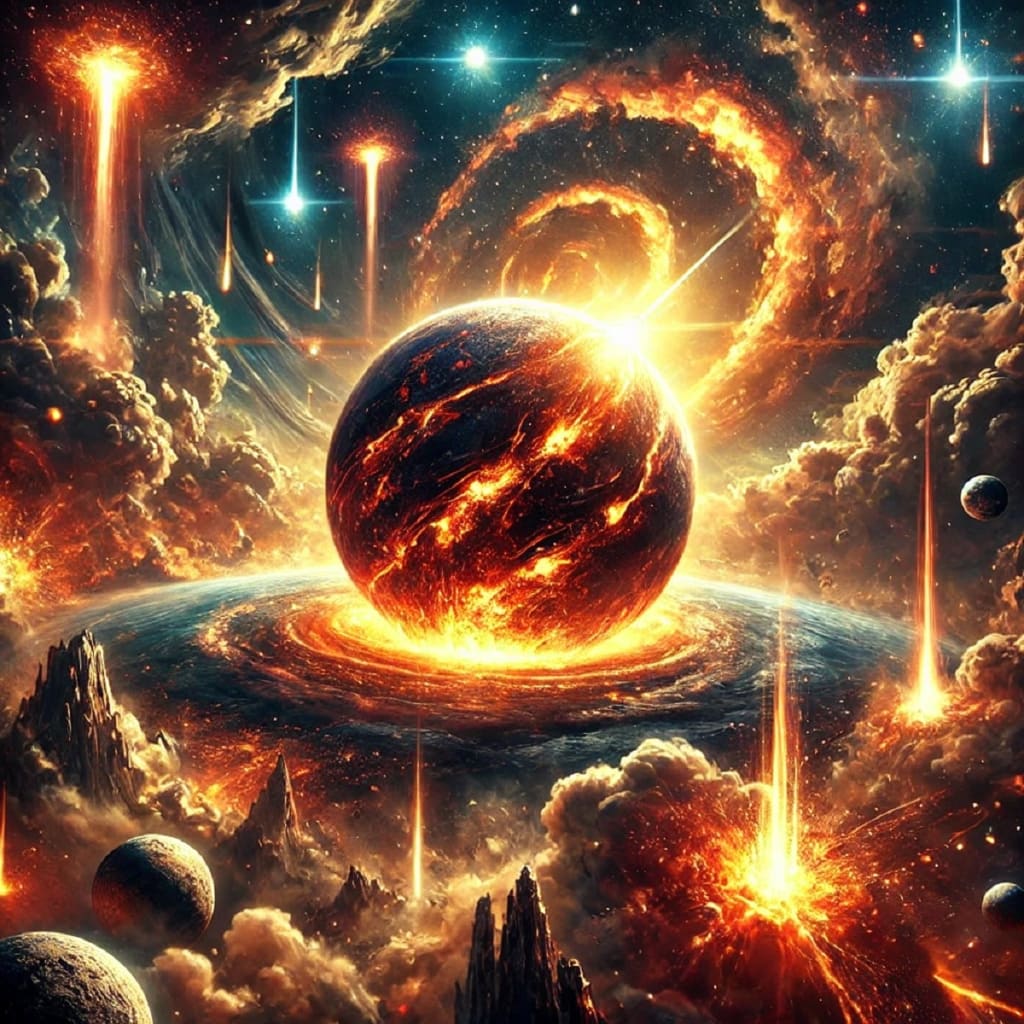
Can you envision our Earth, a vibrant home to countless species, originating as a molten ball of lava around 4 billion years ago? This transformation from lifeless lava to the lush planet we inhabit today is a captivating story. Join me as we explore the intricate details of Earth's birth, the formation of our Moon, and the origins of water that made life possible.
The Solar Nebula: The Beginning of Everything
4.6 billion years ago, our Solar System was nothing but a vast expanse of darkness, filled only with a cloud of dust and gas known as the Solar Nebula, or Niharika in Hindi. This nebula primarily consisted of hydrogen and helium, peacefully drifting through space for millions of years. However, this tranquility was disrupted by a cataclysmic event: a nearby star exploded in a supernova.
The shock waves from this explosion triggered gravitational instabilities within the nebula, causing sections of gas and dust to compress and collapse inward. As this process unfolded, the nebula transformed into a flat, rotating disk, aptly named the Proto-Planetary Disk. This disk was crucial in shaping our Solar System's flat structure, as all the planets orbit the Sun in a similar plane.
From Dust to Sun: The Birth of a Star
At the center of the Proto-Planetary Disk, pressure and temperature soared, leading to the formation of a Protostar. This stage marked the inception of nuclear fusion, where hydrogen atoms fused to form helium at temperatures reaching 15 million degrees Celsius. This fusion reaction birthed our Sun, which today constitutes about 99.8% of the Solar System's total mass.
But what about the remaining 0.2%? This tiny fraction gave rise to eight planets, numerous moons, thousands of comets, and millions of asteroids. The formation of these celestial bodies is a fascinating tale of collisions and accretion.
The Formation of Planets: Accretion and Collisions
In the rotating disk, small dust particles began colliding and sticking together, forming clusters. Over millions of years, these clusters grew larger, evolving into bodies known as planetesimals. As gravity pulled these planetesimals together, they formed protoplanets, a crucial step in creating the planets we know today.
This process is known as Accretion, defined as the cohesion of matter under gravitational influence. Soviet astronomer Victor Safronov first proposed this concept in 1969, but it gained traction only decades later. Today, astronomers have observed similar accretion processes in other solar nebulae, reinforcing our understanding of how planets form.
The Hadean Eon: A Hellish Beginning
As protoplanets collided, they generated immense heat, melting rocks and creating a surface of molten lava. This chaotic period, known as the Hadean Eon (4.6 to 4 billion years ago), was marked by frequent collisions with planetesimals as large as 100 to 200 km in diameter. Any existing rocks on Earth melted into lava, forming a homogenous ball of magma.
Interestingly, it was during this tumultuous time that water began to accumulate on Earth. Comets and asteroids, which contained high concentrations of water, collided with our planet, contributing to its water reserves. Some of the water present on Earth originated from the solar nebula, where ice crystals were also trapped.
The Birth of Water and Differentiation
As the planet cooled, steam from the colliding bodies condensed and fell as rain, forming oceans. By the end of the Hadean Eon, Earth's surface had transformed into a uniform layer of lava, leading to a process known as Differentiation.
This process involved heavy elements like iron and nickel sinking towards the center of the Earth due to gravitational forces, while lighter elements rose to form the crust. Over millions of years, this led to the establishment of Earth's three main layers: the crust, mantle, and core.
The Archean Eon: The Birth of the Earth’s Layers
During the Archean Eon (4 to 2.5 billion years ago), Earth's layers began to solidify. As the planet's temperature decreased, the lighter elements formed the crust while heavier elements accumulated at the core. The core, consisting predominantly of iron and nickel, became the hottest part of the Earth, with temperatures reaching up to 6,000°C.
Interestingly, the mantle, which is over 3,000 km thick, was not solid during this period. It was still filled with magma. As the surface cooled, the crust formed, primarily composed of oxygen, silicon, and other lighter elements.
The Moon’s Formation: A Cosmic Collision
With Earth forming, the question arises: how did our Moon come into existence? The leading theory today is the Giant Impact Hypothesis. This theory suggests that around 4.5 billion years ago, a Mars-sized protoplanet named Theia collided with the molten Earth. This catastrophic event fused the cores of both bodies and expelled debris into orbit around Earth, which eventually coalesced to form the Moon.
Evidence supporting this theory comes from lunar samples collected during NASA's Apollo missions, revealing that the Moon's rocks share similar isotopic compositions with those on Earth.
The Role of the Moon in Earth's Evolution
The Moon’s formation had profound implications for Earth. This collision caused a significant tilt in Earth’s rotational axis, leading to the seasons we experience today. Additionally, the Moon’s gravitational pull influences ocean tides, which played a critical role in the evolution of life as organisms transitioned from water to land.
Life’s Beginnings: From Oceans to Atmosphere
As Earth stabilized, volcanic activity released gases such as water vapor, carbon dioxide, methane, and ammonia into the atmosphere. While initially toxic, this mixture set the stage for the eventual emergence of life. As temperatures cooled, water vapor condensed, forming vast oceans that absorbed carbon dioxide and heat, creating a habitable environment.
The oceans acted as a buffer, maintaining stable temperatures and allowing oxygen levels to rise, paving the way for the first life forms to emerge. Remarkably, even today, oceans absorb significant amounts of carbon emissions, highlighting their crucial role in our planet's climate balance.
The Precise Conditions for Life
The conditions that allowed life to flourish on Earth are nothing short of extraordinary. From the Sun’s ideal distance to Earth’s perfect size and gravitational pull, each factor contributed to maintaining a stable atmosphere conducive to life. The magnetic field generated by the outer core protects us from harmful solar radiation, ensuring that life can thrive.
Understanding these intricate processes and the delicate balance of factors that led to life on Earth is essential. It emphasizes our responsibility to protect our planet and recognize how rare and precious our existence is.
As we reflect on the incredible journey from a molten ball of lava to the vibrant planet teeming with life, we must acknowledge the fragility of this balance. The unique conditions that allowed life to emerge are rare in the universe, making our planet invaluable. It's our duty to safeguard Earth for future generations, ensuring that it remains a sanctuary for life.
Join the conversation and share your thoughts on this remarkable journey. Together, let’s commit to protecting our planet and understanding the wonders of the universe.
About the Creator
Ellen Sammy
Writer and Blogger
Keep reading
More stories from Ellen Sammy and writers in Earth and other communities.
Mystery Of The Yeti Unveiling The Truth Behind The Legend
The Himalayan region has long been the backdrop for one of the most captivating mysteries of all time—the Yeti, also known as the Abominable Snowman. This creature, steeped in folklore, has been the subject of countless stories, sightings, and scientific inquiries. But what is the truth behind this legendary being? Is it a real animal, a misunderstood creature, or simply a figment of imagination? Let’s dive into the chilling tales, historical accounts, and scientific investigations surrounding the enigmatic Yeti.
By Ellen Sammy10 months ago in Earth
O-Ring Seals Market Size and Forecast 2025–2033
Introduction In an era defined by advanced engineering, sustainability goals, and performance efficiency, the smallest components often play the biggest roles. Among these unsung heroes of modern manufacturing are O-ring seals—simple, circular devices that quietly prevent leaks, ensure safety, and keep critical systems functioning under extreme conditions.
By Aaina Oberoi4 days ago in Earth
The Refrigerant Transition
Cooling seldom features in climate headlines, yet it is one of the quietest success stories of the last decade. Under the Kigali Amendment to the Montreal Protocol, countries are phasing down hydrofluorocarbons (HFCs)—super-pollutant refrigerants—while retailers and manufacturers rapidly switch to ultra-low-GWP “natural” refrigerants such as carbon dioxide (R744) and propane (R290). Fully implemented, Kigali alone can avert roughly 0.4–0.5°C of warming by 2100; paired with efficiency improvements, the avoided warming can be closer to ~1°C—an enormous contribution from a single policy family [1–2].
By Futoshi Tachino7 days ago in Earth




Comments
There are no comments for this story
Be the first to respond and start the conversation.