
The Enigma of the Hollow Earth: Myths, Theories, and Legends Uncovered
Delving into the Mysterious World of the Hollow Earth: Separating Fact from Fiction and Examining the Evidence
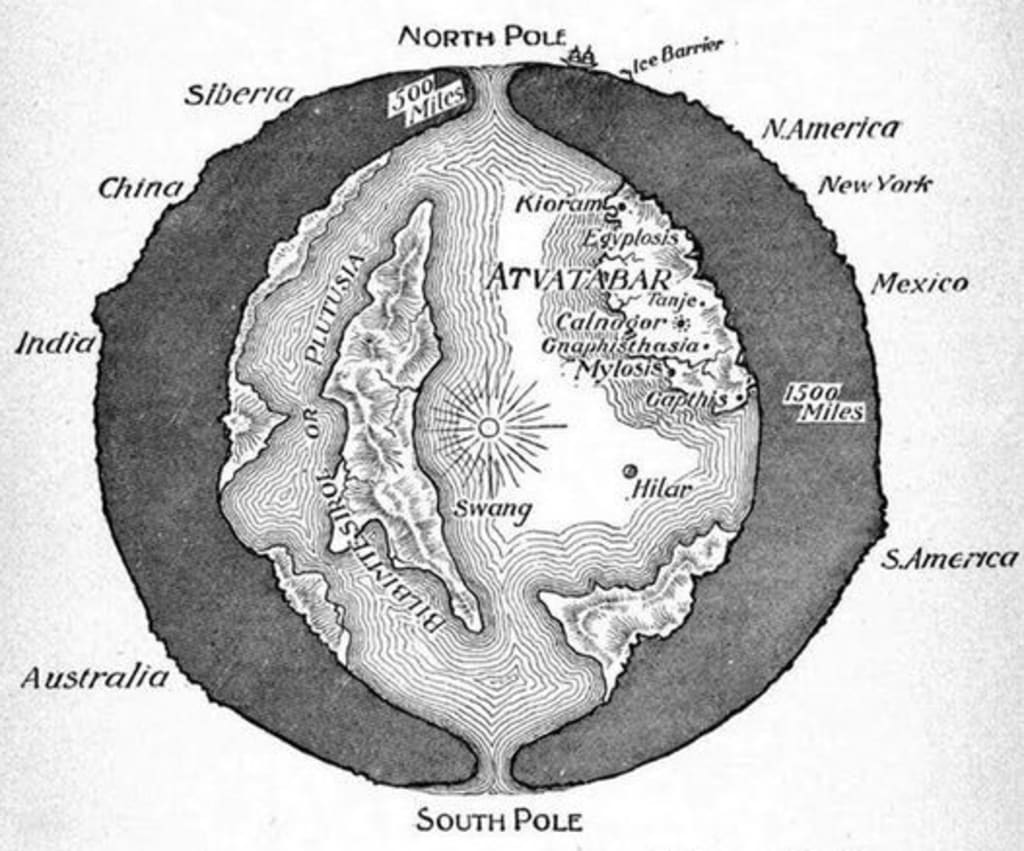
The Hollow Earth theory is a topic that has captured the imagination of people for centuries. From ancient myths to modern legends, the idea of a subterranean world has been explored in various forms of media. In this article, we will delve deeper into the history of the Hollow Earth theory, examine some of its proponents and skeptics, and explore the myths and legends that have grown around the idea.
The Hollow Earth theory posits that the planet Earth is not a solid sphere, but rather a hollow shell with a central sun or other internal light source. This theory dates back to the ancient Greeks, who believed in a subterranean world called Hades, which was home to the dead and ruled by the god of the same name.
In the 17th century, the French writer Bernard de Fontenelle wrote a book titled "Conversations on the Plurality of Worlds," where he speculated that the Earth might be hollow and inhabited. However, it was not until the 19th century that the Hollow Earth theory gained popularity with the publication of "Symzonia: A Voyage of Discovery" by Captain Adam Seaborn (a pseudonym for John Cleves Symmes Jr.) in 1820.
Symmes claimed that the Earth was hollow and that it could be accessed through polar openings at the North and South Poles. He even organized an expedition to the Arctic to search for the entrance, but it was never successful. However, this did not stop others from continuing to promote the theory.
One such proponent was Cyrus Reed Teed, who founded a religious movement called the Koreshan Unity in the late 19th century. Teed claimed to have had a vision in which he saw that the Earth was hollow and that we were living on the inside surface of the shell. He believed that the sun, moon, and stars were all inside the Earth, and that gravity was caused by the rotation of the hollow sphere.
Despite the lack of scientific evidence to support the Hollow Earth theory, it has continued to capture the imagination of many, and has even inspired a number of myths and legends. One such myth is that the Nazis believed in the Hollow Earth and conducted expeditions to the Arctic to search for the entrance. While there is no evidence to support this claim, it has become a popular trope in fiction, appearing in books, movies, and video games.
Another legend associated with the Hollow Earth is that it is home to an advanced civilization of beings known as the Agartha. According to this myth, the Agartha have existed for thousands of years and possess technology far beyond our own. Some even believe that they are the true rulers of the world, manipulating human affairs from behind the scenes.
While the Hollow Earth theory may be intriguing, it is important to remember that it has no basis in scientific fact. Our current understanding of the Earth's structure is based on evidence from seismology, geology, and other fields of study, and there is no indication that the planet is hollow.
However, the concept of a subterranean world continues to fascinate us, and it has been explored in various forms of media. For example, Jules Verne's "Journey to the Center of the Earth" is a classic adventure novel that takes readers on a fantastical journey to the Earth's core. Similarly, Edgar Rice Burroughs' "Pellucidar" series explores a fictional subterranean world filled with prehistoric creatures and advanced civilizations.
-Theories of the Hollow Earth
While the idea of a hollow earth was once considered a legitimate scientific theory, it has since been thoroughly debunked. Modern science has shown that the earth is a solid sphere, with a dense core at its center and lighter layers of rock and metal surrounding it.
Despite this, some believers in the hollow earth theory continue to put forth various arguments to support their beliefs. One such argument is that seismic waves from earthquakes behave strangely, as if they are bouncing off a hollow chamber within the earth. However, this phenomenon can be explained by the fact that seismic waves travel at different speeds through different types of rock.
Another argument put forth by believers in the hollow earth theory is that there are mysterious entrances to the interior of the planet, such as the supposed hole at the North Pole. However, there is no evidence to support the existence of such entrances, and modern satellite imagery has thoroughly debunked the idea that there are large openings at the poles.
-Myths and Legends of the Hollow Earth
The idea of a hollow earth can be traced back to ancient mythology. In Hindu mythology, there is a story of a subterranean realm called Patala. Similarly, the Greeks believed in a subterranean world ruled by Hades, the god of the underworld. In Norse mythology, there is a tale of a world beneath the earth called Nidavellir, home to the dwarves.
In the 17th century, the English astronomer Edmund Halley proposed that the earth was composed of several concentric spheres, including one that was hollow and contained three smaller spheres within it. This concept was further popularized in the 19th century by the American writer Edgar Allan Poe, who wrote a novel called "The Narrative of Arthur Gordon Pym of Nantucket" that featured a journey to the center of the earth.
-Legends of the Hollow Earth
Despite the lack of scientific evidence to support the idea of a hollow earth, the concept continues to inspire legends and stories in popular culture. For example, the 1864 novel "Journey to the Center of the Earth" by Jules Verne tells the story of a group of explorers who discover a vast open space within the earth's interior. Similarly, the 1933 film "King Kong" features a scene in which the titular character battles a group of dinosaurs within a hollow earth environment.
In recent years, the idea of a hollow earth has also been embraced by conspiracy theorists, who believe that the truth about the planet's true nature is being kept hidden by a shadowy cabal of elites. Some conspiracy theorists even claim that the earth is not only hollow but also contains an inner sun and is home to advanced civilizations.
-Conclusion
While the idea of a hollow earth may seem far-fetched, it has captured the imaginations of people for centuries. From ancient myths to modern pop culture, the concept of a vast open space within the earth's interior continues to inspire wonder and speculation. While modern science has thoroughly debunked the idea, it remains a fascinating enigma that continues to captivate the human imagination.
Thank you for taking the time to read this article. Your support is what drives me to keep writing and exploring fascinating topics like the Hollow Earth theory. I hope you found this piece informative and thought-provoking. Stay curious and keep exploring the mysteries of our world!If you find this piece interesting, please consider leaving a ❤️, or even a tip.
About the Creator
Keep reading
More stories from writers in Earth and other communities.
Assisted Dying Bill ‘No Hope’ of Passing Unless Lords Change Approach, Warns Peer
The future of the assisted dying bill in the UK is hanging by a thread, with a senior peer warning that it has “no hope” of passing unless the House of Lords dramatically changes its current approach. The stark warning has reignited a deeply emotional national debate—one that sits at the crossroads of ethics, personal freedom, medical responsibility, and the role of Parliament in end-of-life decisions.
By Aarif Lashari4 days ago in Earth


Comments
There are no comments for this story
Be the first to respond and start the conversation.