
“The Day We Celebrate Our Home: A Story of Earth Day”
"How One Special Day Sparked a Global Movement to Protect Our Planet"

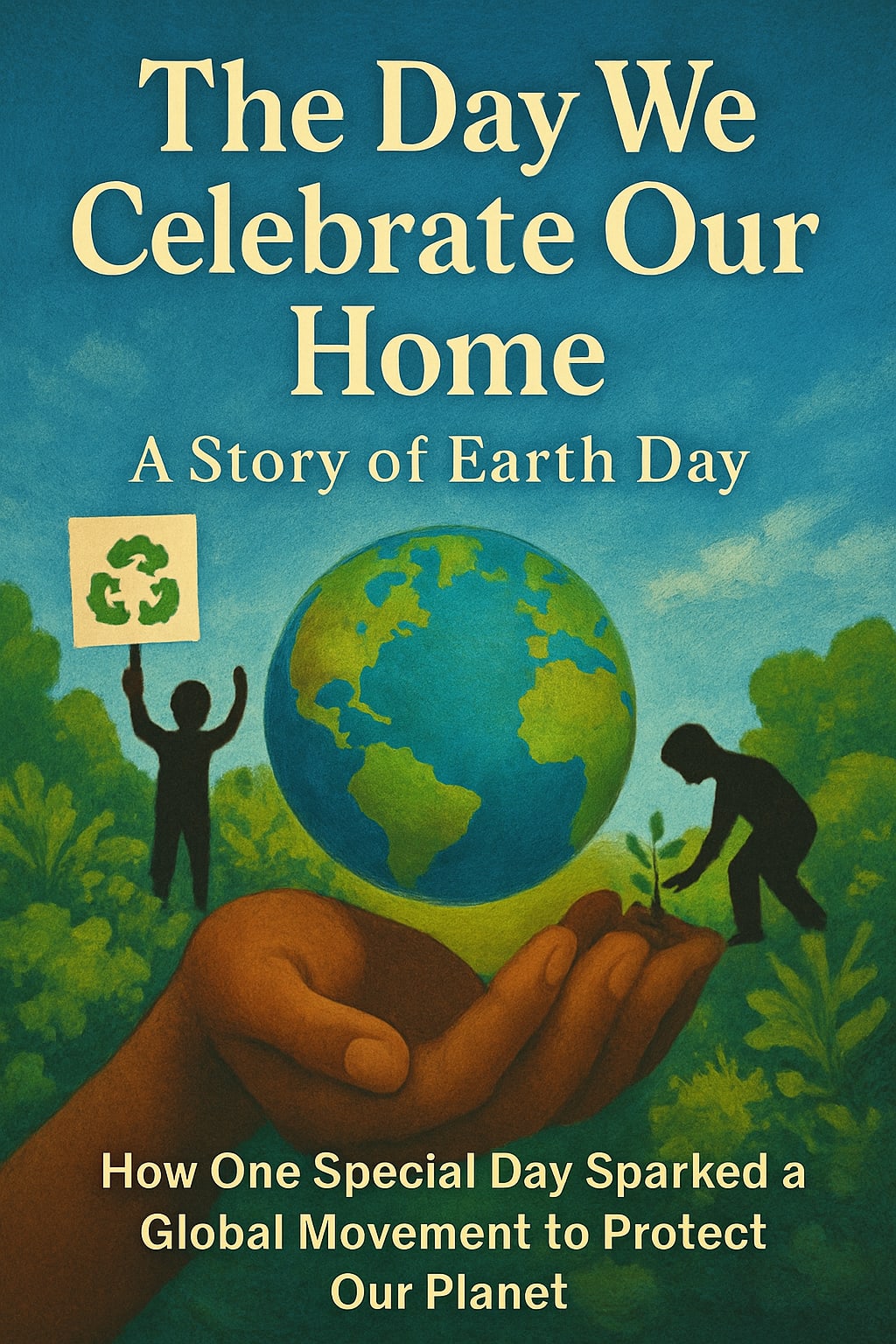
Every year, on April 22nd, people all over the world come together to plant trees, clean up parks, recycle, and raise awareness about protecting the environment. But have you ever wondered how Earth Day began? Like many great movements, it started with a few concerned voices and grew into something that would inspire millions.
Our story begins in the 1960s—a time of peace rallies, civil rights marches, and growing public awareness. Back then, the environment wasn’t at the top of people’s minds. Factories puffed black smoke into the air, rivers were so polluted they caught fire, and chemicals were sprayed freely on crops. There were no government regulations to stop it, and most people simply didn’t know the damage being done.
But one man noticed. His name was Senator Gaylord Nelson from Wisconsin. A nature lover and advocate for the outdoors, Nelson was deeply disturbed by a massive oil spill off the coast of California in 1969. It was one of the worst environmental disasters in U.S. history at the time. Birds, fish, and marine life suffered horribly, and black oil coated once-beautiful beaches.
Nelson realized that something had to be done. But how could he get the attention of a nation distracted by war, politics, and social unrest?
He had an idea. Inspired by the energy of student-led protests, he proposed a national day of environmental education and action. A day when people would come together to learn, speak up, and care for the Earth. He called it “Earth Day.”
To help organize it, he recruited a young activist named Denis Hayes, who quickly built a team of volunteers. They worked tirelessly, spreading the word through colleges, newspapers, and community groups. Their message was simple but powerful: our planet is in trouble, and it’s up to us to protect it.
On April 22, 1970, the first Earth Day took place.
Across the United States, more than 20 million people—students, teachers, parents, scientists, and even politicians—gathered in parks, on college campuses, and in city streets. They marched with signs, held teach-ins, and picked up trash. They talked about air and water pollution, endangered animals, and how the choices we make affect the planet.
It was the largest demonstration in American history at that point. And it worked. The voices of millions could no longer be ignored.
Soon after, the U.S. government created the Environmental Protection Agency (EPA) and passed key environmental laws like the Clean Air Act, Clean Water Act, and Endangered Species Act. Earth Day had sparked real change.
But the movement didn’t stop there.
In the decades that followed, Earth Day grew beyond America’s borders. By the 1990s, it had become a global event, with people in more than 140 countries joining in. From schoolchildren in Kenya planting trees, to volunteers in India cleaning rivers, to activists in Sweden promoting renewable energy—Earth Day became a symbol of unity. A day to remind ourselves that we all share one planet, and that its health is tied to our own.
Now, more than one billion people participate in Earth Day every year. It’s a day of action, but also of reflection. We think about what we’ve done to the Earth—and what we can still do.
It’s easy to feel overwhelmed by the challenges we face: climate change, deforestation, ocean pollution, and species extinction. But Earth Day reminds us that change is possible. That even small actions—recycling a bottle, riding a bike, planting a seed, turning off the lights—can add up when millions of people do them together.
And Earth Day isn’t just about problems. It’s about hope. It’s about innovation—like solar panels that turn sunlight into electricity, or cities designing green buildings and better public transit. It’s about people standing up for clean air and water, for forests and oceans, for bees and polar bears, and for future generations.
So, why do we celebrate Earth Day?
Because this planet is our home. It's where we breathe, eat, sleep, play, and dream. The rivers, the trees, the mountains, and the skies—they give us life. And just like any home, it needs care.
Earth Day is more than just a date on the calendar. It's a reminder that we are all connected—not just to each other, but to every leaf, every cloud, every grain of sand. It’s a call to action, a reason to hope, and a promise to the Earth that we will do better.
And that promise begins with each of us.
So, this Earth Day, take a moment to step outside. Feel the sun on your face. Listen to the birds. Smell the grass. And ask yourself: What can I do today to celebrate my home?
Because the story of Earth Day isn’t finished. It’s still being written—by you, by me, by everyone who believes that a healthier, greener world is worth fighting for.
About the Creator
muhammad khalil
Muhammad Khalil is a passionate storyteller who crafts beautiful, thought-provoking stories for Vocal Media. With a talent for weaving words into vivid narratives, Khalil brings imagination to life through his writing.
Keep reading
More stories from muhammad khalil and writers in Earth and other communities.
“Heat Edge Out Cavaliers in Hard-Fought Battle to Keep Playoff Hopes Alive”
In a game that seemed to be teetering on the edge of elimination for the Miami Heat, Jimmy Butler delivered when it mattered most, leading his team to a 112-107 victory over the Cleveland Cavaliers in a high-stakes battle in the Eastern Conference. With their playoff hopes hanging by a thread, the Heat faced off against a Cleveland team that was also fighting to stay in the race, making for an unforgettable night of basketball.
By muhammad khalil9 months ago in Gamers
China Cracks Down on Ships Using Starlink
A New Front in China’s Technology Control China has intensified its crackdown on ships using Starlink, the satellite internet service operated by Elon Musk’s SpaceX, signaling a sharp escalation in Beijing’s efforts to control information flows and foreign technology. Authorities have warned commercial vessels, fishing boats, and private operators against using unapproved satellite communication systems, citing national security and data sovereignty concerns.
By Aarif Lashari4 days ago in Earth
Elon Musk Says Retirement Savings “Won’t Matter” in 20 Years—Here’s What Experts Think
Recently, Elon Musk sparked a heated debate on social media with a bold claim: in 20 years, traditional retirement savings “won’t matter.” The Tesla and SpaceX CEO suggested that the way people think about money and retirement today might be completely obsolete in a couple of decades. As usual, Musk’s statements are equal parts provocative and visionary, leaving many wondering whether they should rethink their financial plans entirely. To get clarity, we reached out to seven personal finance and AI experts to hear their thoughts on Musk’s prediction. Their insights provide a mix of caution, optimism, and futuristic thinking. 1. The Case for Obsolescence: AI and Automation AI strategist Dr. Karen Liu believes Musk isn’t exaggerating when he talks about the diminishing importance of retirement savings. “If AI and automation continue at the current pace, many traditional jobs could disappear,” she explains. “By 2046, people might earn income from AI-driven ventures, digital assets, or royalties rather than a 9-to-5 paycheck. In that case, the way we save for retirement could indeed look very different.” She emphasizes that new financial models might emerge, such as universal basic income (UBI) or AI-managed wealth portfolios, making conventional retirement accounts less critical. “People might no longer need 401(k)s or IRAs in the same way we do now,” she adds. 2. The Human Factor: Some Things Don’t Change Personal finance advisor Marcus Bell takes a more conservative view. “Even if the economy changes drastically, money management skills won’t be irrelevant,” he says. “Musk may be right that retirement savings as we know them may evolve, but having a financial cushion will always matter. Emergencies, healthcare costs, and life changes won’t disappear.” Bell suggests a hybrid approach: continue contributing to traditional retirement accounts while exploring alternative investments like digital currencies, AI-managed funds, or entrepreneurial ventures. 3. Cryptocurrency and the Digital Asset Revolution Crypto expert Priya Desai sees Musk’s comment as a nod toward the rise of digital assets. “By 2046, much of personal wealth may reside in cryptocurrencies, tokenized real estate, and NFTs rather than bank accounts or pensions,” she says. Desai believes that blockchain technology could redefine ownership and wealth accumulation, making traditional retirement savings less central. However, she cautions: “Digital assets are highly volatile. While they may replace some retirement vehicles, they aren’t a guaranteed substitute. Diversification will remain crucial.” 4. AI-Powered Wealth Management AI entrepreneur Rohan Kapoor points out that AI itself could make traditional retirement planning almost obsolete. “Imagine AI systems that continuously optimize your investments, taxes, and spending in real-time,” he says. “If AI handles wealth accumulation more efficiently than humans, you may not need to manually save and plan decades in advance.” Kapoor predicts that by 2046, AI advisors could create personalized financial lifelines that automatically adjust for inflation, market changes, and lifestyle goals. In this scenario, traditional 401(k)s might feel outdated. 5. The Social Safety Net Factor Economist Dr. Elise Morgan reminds us that social and political structures will also play a role. “Even if technology changes how wealth is accumulated, government programs like Social Security, healthcare, or UBI will shape retirement,” she explains. “Musk’s statement assumes a high-tech, highly automated economy, which is just one possible scenario.” Morgan urges caution: relying solely on futuristic predictions could be risky. Traditional savings may still act as a fallback if economic or technological disruptions fail to deliver as Musk anticipates. 6. Mindset and Wealth Beyond Money Financial psychologist Sandra Liu emphasizes that wealth isn’t only monetary. “Even if retirement accounts lose their traditional meaning, financial literacy, resourcefulness, and the ability to leverage technology will remain critical skills,” she says. “Musk’s prediction is more about mindset than accounts. People who can adapt, innovate, and use technology to generate income will thrive regardless of conventional savings.” 7. Preparing for the Future, Not Panicking Finally, futurist Jared Thompson encourages a pragmatic approach: “Don’t panic or abandon your retirement plan just because Elon Musk said so. Think of it as a signal to diversify—invest in tech, learn AI skills, and explore new income streams.” Thompson suggests a “layered strategy”: keep some traditional retirement savings while experimenting with AI-driven investment platforms, cryptocurrencies, and entrepreneurial projects. What Does This Mean for You? Musk’s prediction may sound extreme, but the expert opinions reveal a spectrum of possibilities. Here’s a practical takeaway: Keep saving, but diversify: Don’t abandon retirement accounts, but explore AI-driven investments, crypto, or digital assets. Invest in skills: AI, coding, and tech literacy may be as valuable as cash reserves in 20 years. Embrace flexibility: Financial plans should be adaptable to rapid technological and societal changes. Mind the basics: Emergency funds, debt management, and smart spending remain essential regardless of tech trends. In short, Musk’s warning isn’t necessarily a call to abandon traditional retirement planning—it’s a reminder that the future of money is changing rapidly. Those who combine conventional strategies with an eye on emerging technologies may be the ones who truly thrive in 2046. Conclusion: Elon Musk’s claim that retirement savings “won’t matter” in 20 years is provocative, but it opens an important conversation about the intersection of finance, technology, and the future of work. While some experts see it as a harbinger of radical change, others stress prudence and flexibility. Either way, the message is clear: the next two decades will demand both financial savvy and tech literacy. The question isn’t whether retirement savings will disappear—it’s whether you’ll adapt to the evolving financial landscape.
By Muhammad Hassan4 days ago in Earth



Comments
There are no comments for this story
Be the first to respond and start the conversation.