
China Cracks Down on Ships Using Starlink
Beijing tightens control over satellite internet as security, sovereignty, and technology collide

A New Front in China’s Technology Control
China has intensified its crackdown on ships using Starlink, the satellite internet service operated by Elon Musk’s SpaceX, signaling a sharp escalation in Beijing’s efforts to control information flows and foreign technology. Authorities have warned commercial vessels, fishing boats, and private operators against using unapproved satellite communication systems, citing national security and data sovereignty concerns.
The move reflects China’s broader strategy to assert control over digital infrastructure—even far from land—while pushing back against foreign technologies that operate beyond state oversight.
Why Starlink Has Drawn Beijing’s Attention
Starlink provides high-speed internet through a constellation of low-Earth orbit satellites, allowing users to stay connected in remote areas, including open seas. For maritime operators, this has been transformative, offering reliable communication where traditional systems fall short.
But for China, Starlink represents something else entirely: an uncontrolled channel of communication. Unlike Chinese telecom systems, Starlink operates independently of Beijing’s censorship and surveillance frameworks, raising alarms among regulators and security agencies.
Chinese officials argue that unregulated satellite internet could be used for espionage, illegal data transfers, or coordination beyond government monitoring.
What the Crackdown Looks Like in Practice
According to maritime operators and industry sources, Chinese authorities have stepped up inspections at ports and increased monitoring of vessels suspected of using Starlink terminals. Some ship owners report being ordered to remove or disable Starlink equipment before entering Chinese waters or ports.
In certain cases, fines and administrative penalties have reportedly been imposed. State-linked media has also warned that unauthorized satellite communication devices violate Chinese regulations governing radio frequencies and telecommunications.
While China has not issued a single sweeping public ban, enforcement appears to be tightening through a mix of inspections, warnings, and regulatory pressure.
National Security and Sovereignty Concerns
Chinese officials frame the crackdown as a matter of sovereignty. Satellite internet, they argue, bypasses national borders and undermines a state’s ability to regulate communications within its jurisdiction.
Security analysts note that Starlink’s use in conflict zones—most notably in Ukraine—has heightened Beijing’s concerns. The technology’s role in enabling resilient communications during warfare has made governments worldwide reassess its strategic implications.
For China, which prioritizes centralized control over information, Starlink’s independence is seen not just as a commercial issue, but as a strategic challenge.
Impact on Shipping and Fishing Industries
The crackdown has created uncertainty for shipping companies and fishing fleets operating in or near Chinese waters. Many had adopted Starlink to improve safety, navigation, and crew welfare, especially on long voyages.
Fishermen, in particular, have relied on satellite internet for weather updates and emergency communication. Industry representatives warn that forcing vessels back onto slower or less reliable systems could increase operational risks.
“At sea, connectivity is not a luxury—it’s safety,” said one maritime industry source. “Restrictions like this have real consequences.”
China’s Push for Homegrown Alternatives
The crackdown on Starlink aligns with China’s broader push to develop domestic satellite internet networks. Beijing has invested heavily in its own low-Earth orbit constellations, aiming to reduce reliance on foreign technology and compete globally.
State-backed projects promise secure, regulated connectivity that fits within China’s legal and surveillance frameworks. Officials argue that encouraging domestic alternatives protects both national security and technological independence.
However, experts say Chinese systems are still catching up to Starlink in terms of coverage and reliability, particularly in remote maritime zones.
International Implications and Industry Concerns
China’s actions are being closely watched by other countries, especially those with large shipping industries. If more states follow Beijing’s lead, the global maritime sector could face a patchwork of rules governing satellite internet use.
Some analysts warn that such fragmentation could complicate international shipping, increase costs, and create compliance challenges for multinational operators.
There are also concerns about the precedent being set. “If every country insists on total control over satellite connectivity, the idea of a truly global internet at sea starts to break down,” said a technology policy expert.
Starlink’s Position and Silence
SpaceX has not publicly commented on China’s enforcement actions. Starlink does not officially operate in China, and its terms of service already restrict use in certain jurisdictions.
Still, Starlink terminals are widely available globally, and enforcement largely depends on national authorities. The situation highlights the grey zone in which global satellite services operate—technologically borderless, but legally constrained.
A Broader Pattern of Digital Control
The Starlink crackdown fits into a wider pattern of China tightening control over digital tools, from social media platforms to cloud services and hardware imports. Beijing has repeatedly emphasized the concept of “cyber sovereignty,” arguing that each nation has the right to control its digital space.
Critics say this approach limits openness and innovation, while supporters argue it protects stability and national interests.
At sea, where jurisdiction is already complex, these tensions become even more pronounced.
What Happens Next
Experts expect China to continue enforcing restrictions while accelerating development of its own satellite networks. For now, ship operators are being forced to make difficult choices between connectivity and compliance.
Some companies may disable Starlink equipment when entering Chinese waters, while others may reroute operations or push for clearer international guidelines.
Longer term, the clash between global satellite internet providers and national regulators is likely to intensify.
Conclusion: Control Versus Connectivity
China’s crackdown on ships using Starlink underscores a growing global struggle between borderless technology and state control. For Beijing, the issue is about sovereignty, security, and technological independence. For maritime operators, it is about safety, efficiency, and staying connected in an increasingly digital world.
As satellite internet reshapes global communication, the question is no longer whether governments will respond—but how far they are willing to go to keep the skies, seas, and data firmly under their control.
About the Creator
Keep reading
More stories from Aarif Lashari and writers in Earth and other communities.
Without Democracy, Donald Trump’s Venezuelan Oil Quest Will Fail
Donald Trump’s renewed interest in Venezuelan oil may seem, on the surface, like a hard-nosed geopolitical calculation. Venezuela holds the world’s largest proven oil reserves, and amid global energy uncertainty, access to those resources is undeniably tempting. But history, economics, and politics all point to the same conclusion: without democratic reform in Venezuela, any attempt by a Trump-led US administration to secure reliable Venezuelan oil will ultimately fail.
By Aarif Lashari2 days ago in Earth
BRICS Wargames: Why They Matter — And Why India Chose to Sit Out
BRICS — the economic and political bloc comprising Brazil, Russia, India, China, and South Africa — has long been seen as a counterweight to Western-dominated global institutions. Over the years, it has expanded its influence in finance, trade, and diplomacy. Yet, in recent times, BRICS has begun exploring another domain that grabs headlines and sparks speculation: military cooperation, including large-scale wargames. These exercises are designed to simulate joint operations, test interoperability, and send a signal of strength. For members like Russia and China, wargames serve as both a show of force and a tool to deepen military collaboration within the bloc. However, India’s decision to opt out of recent BRICS wargames has raised questions: why does this matter, and why is India taking a different path from its BRICS partners? The Rise of BRICS Military Exercises Historically, BRICS has been portrayed as primarily economic, focused on initiatives like the New Development Bank (NDB) and trade agreements aimed at reducing Western dominance. But recent years have seen an evolution. Military drills among BRICS members are increasingly prominent, especially in the context of global tension and regional conflicts. These wargames are about more than just tactical drills. They serve multiple purposes: Strategic signaling: By conducting joint exercises, BRICS countries demonstrate unity and military capability to the rest of the world. Operational readiness: Countries test their ability to coordinate in complex scenarios, from humanitarian missions to potential combat operations. Diplomatic leverage: The exercises send subtle messages to other global powers, indicating that BRICS members can collaborate beyond economic forums. For nations like Russia, recently facing sanctions and international scrutiny, these exercises are particularly important. They showcase the ability to maintain partnerships and project power despite global isolation. For China, it is a way to cement strategic influence in Asia and beyond. Why BRICS Wargames Matter Globally The significance of these exercises extends beyond the bloc itself. Analysts note several key implications: Challenge to NATO and U.S. influence: BRICS wargames signal that alternative power centers exist outside Western-led military alliances. Regional security dynamics: Countries bordering BRICS members, particularly in South Asia, Africa, and Latin America, must monitor these developments carefully. Economic-military linkages: Military coordination among major emerging economies could shape security considerations in trade corridors, energy supply routes, and resource-rich regions. In essence, BRICS wargames are not just about soldiers and tanks, but about the broader geopolitical landscape: signaling, strategy, and shaping perceptions of influence. India’s Calculated Decision to Opt Out While Russia, China, Brazil, and South Africa have shown interest in participating actively, India has strategically chosen to abstain from the most recent wargames. This decision may appear surprising, given India’s economic and political stake in BRICS, but several factors explain it. Geopolitical balancing: India maintains complex relations with both China and Russia. While it has defense and historical ties with Russia, its relationship with China has grown tense due to border disputes and regional competition. Joining a wargame with China could be politically and militarily sensitive. Alignment with Western partnerships: India has strengthened ties with Western-led coalitions, including the Quad (U.S., Japan, Australia, India). Participating in BRICS military drills could conflict with these alliances, potentially sending mixed signals. Strategic autonomy: India has long emphasized a policy of strategic autonomy — making decisions based on national interest rather than bloc pressure. Opting out allows India to maintain flexibility in foreign policy and avoid entanglement in exercises that may not align with its regional objectives. Domestic perception: Indian public opinion and political narratives favor cautious engagement with China and Russia on military matters. Skipping the wargames minimizes domestic criticism of appearing too closely aligned with either of the more assertive BRICS powers. What India Gains by Sitting Out Choosing not to participate does not mean India is disengaged from BRICS. Economically and diplomatically, it remains a key player in the bloc. By skipping the wargames, India can: Maintain regional credibility in South Asia while avoiding the perception of aligning militarily with China. Signal strategic independence, reinforcing its image as a nation that prioritizes national security over bloc politics. Focus on bilateral and multilateral exercises elsewhere, such as those with the U.S., Japan, and Australia, which are more aligned with India’s current security priorities. In short, opting out allows India to navigate the delicate balance between its BRICS commitments and broader global strategic interests. Implications for BRICS and Global Security India’s abstention also reflects broader trends within BRICS: the bloc is not monolithic. While economic cooperation is often strong, military integration faces political and strategic limits. Differing national interests, historical rivalries, and regional tensions prevent uniform alignment. For global observers, this is crucial. It shows that while BRICS wargames are important, they are not necessarily indicative of a fully unified military bloc. The exercises are as much about optics as operations, and India’s absence underscores the challenges of aligning countries with divergent security priorities. Conclusion BRICS wargames matter because they are a window into the bloc’s evolving strategic ambitions. They signal power, test cooperation, and demonstrate emerging global influence. Yet India’s decision to opt out highlights that even within this growing coalition, national interests remain paramount. For India, the choice reflects a calculated approach: engage where it benefits national interest, avoid where risks outweigh gains, and maintain strategic flexibility. For the rest of the world, it is a reminder that BRICS, while increasingly important, is not a military monolith. Ultimately, BRICS wargames are as much about geopolitics and signaling as they are about military maneuvers — and India’s careful stance illustrates how emerging powers navigate this complex global chessboard.Start writing...
By Muhammad Hassan5 days ago in Earth
United States Plastic Market Size and Forecast 2025–2033
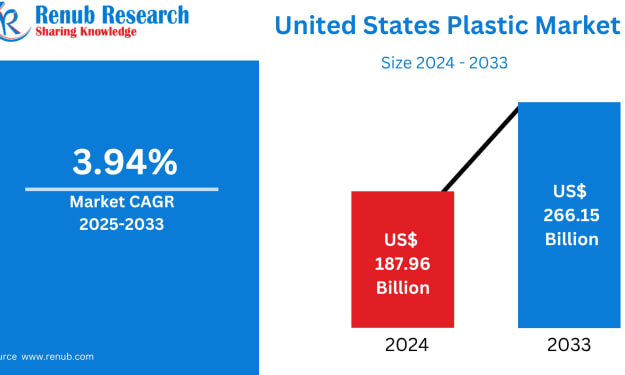
United States Plastic Market: Size and Forecast 2025–2033 The United States plastic market is projected to expand significantly, growing from US$ 187.96 billion in 2024 to US$ 266.15 billion by 2033, reflecting a steady Compound Annual Growth Rate (CAGR) of 3.94% during 2025–2033. This sustained growth is being fueled by rising demand across packaging, automotive, construction, healthcare, and consumer goods industries, alongside rapid innovations in recycling technologies and sustainable polymer development.
By Aaina Oberoi6 days ago in Earth



Comments
There are no comments for this story
Be the first to respond and start the conversation.