
The Carrington Event
When the Sun Lit Up the Night Sky

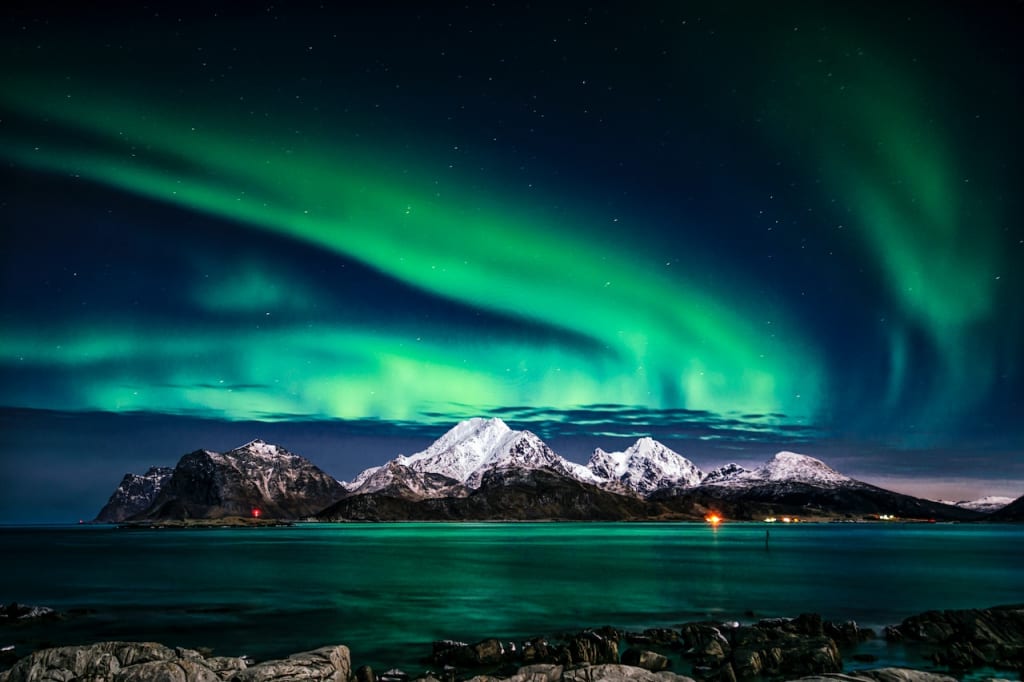
On September 1st, 1859, miners caught up in the Colorado gold rush awoke to what they believed to be another sunny day. However, to their astonishment, they soon realized it was only 1 am, and the sky was illuminated not by the Sun, but by breathtaking curtains of light.
The radiant glow extended as far as the Caribbean, leading people in various regions to speculate that nearby cities were engulfed in flames. Yet, the true cause of this remarkable occurrence, later known as the Carrington Event, was a solar storm—an unprecedented one in recorded history. Solar storms are among the numerous astrophysical phenomena resulting from magnetic fields.
These magnetic fields arise from the movements of electrically charged particles, such as protons and electrons. For instance, Earth's magnetic field is generated by the circulation of charged molten metals within the planet's outer core. Similarly, the Sun's magnetic field is produced by convective movements in the plasma constituting the star. As this plasma swirls, it creates areas of heightened magnetic activity called sunspots.
The magnetic fields that form near these regions often become twisted and strained. When the tension becomes too great, they snap into simpler configurations, releasing energy that propels plasma away from the Sun's surface. These eruptions are known as coronal mass ejections.
The plasma, primarily composed of protons and electrons, accelerates rapidly, quickly attaining speeds of thousands of kilometers per second. A typical coronal mass ejection traverses the distance between the Sun and Earth in just a couple of days, following the magnetic field permeating the solar system. Those that intersect with Earth's path are drawn to its magnetic field lines, entering the atmosphere around the planet's magnetic poles. This influx of high-energy particles excites atmospheric atoms, such as oxygen and nitrogen, causing them to emit photons at various energy levels. The mesmerizing result is the auroras—a magnificent light show.
While this phenomenon is typically visible near the Earth's poles, intense solar storms can introduce a substantial number of high-energy particles, lighting up vast portions of the sky. However, the magnetic fields within our solar system pale in comparison to those found in deep space. Some neutron stars generate fields that are 100 billion times stronger than those found in sunspots. Moreover, the magnetic fields surrounding supermassive black holes emit gas jets that extend thousands of light years. Nevertheless, even weak solar storms on Earth can pose surprising dangers.
While the storms that reach our planet are generally harmless to humans, the influx of high-energy particles into the atmosphere creates secondary magnetic fields. These fields, in turn, generate rogue currents that can disrupt and damage electrical equipment. During the Carrington Event, when the only widely used electrical technology was the telegraph, global telegraph systems suffered malfunctions and equipment combustion. In New York, the entire railway system came to a halt, and fires erupted in the central control building. Comparatively weaker storms in 1989 and 2003 caused power grid disruptions in Canada and damaged multiple satellites. If a storm as potent as the Carrington Event were to occur today, it could devastate our interconnected and electrified world.
Fortunately, we are not defenseless. After centuries of observing sunspots, researchers have discovered that the Sun's magnetic activity follows an 11-year cycle, providing us with a glimpse into when solar storms are most likely to occur. As our ability to forecast space weather has improved, so have our mitigation measures. Power grids can be preemptively shut down in anticipation of a solar storm, and capacitors can be installed to absorb the sudden influx of energy. Many modern satellites and spacecraft are equipped with specialized shielding to withstand the impact of a solar storm. Nonetheless, despite these safeguards, it remains uncertain how our technology will fare during the next major event.
In the face of such uncertainty, we may find ourselves gazing upward, with only the auroras illuminating our path forward.
Henrik Leandro
About the Creator
Henrik Leandro Laukholm Solli
Free thinker, traveler and humanist <3
Keep reading
More stories from Henrik Leandro Laukholm Solli and writers in Earth and other communities.
Unveiling Nature's Remarkable Vipers
We understand that not everyone is fond of snakes. Encountering them in the wild might not be your cup of tea. Each person has their preferences! That's precisely why we're here—to take you on a captivating world tour of some of nature's most incredible snakes, all from the comfort and safety of your home, accompanied by your intrepid guide.
By Henrik Leandro Laukholm Solli3 years ago in Earth
The Universe That Dreams Us
For centuries, humanity believed the universe was expanding. Galaxies drifting farther apart. Space stretching endlessly like an invisible fabric. The theory had been supported by decades of observations, especially from the famous Hubble Space Telescope, which showed distant galaxies moving away from Earth in every direction.
By Abubakar2202 days ago in Earth



Comments
There are no comments for this story
Be the first to respond and start the conversation.