
The Black Hole Paradox: Can It Ever Explode?
The Hawking Radiation Mystery

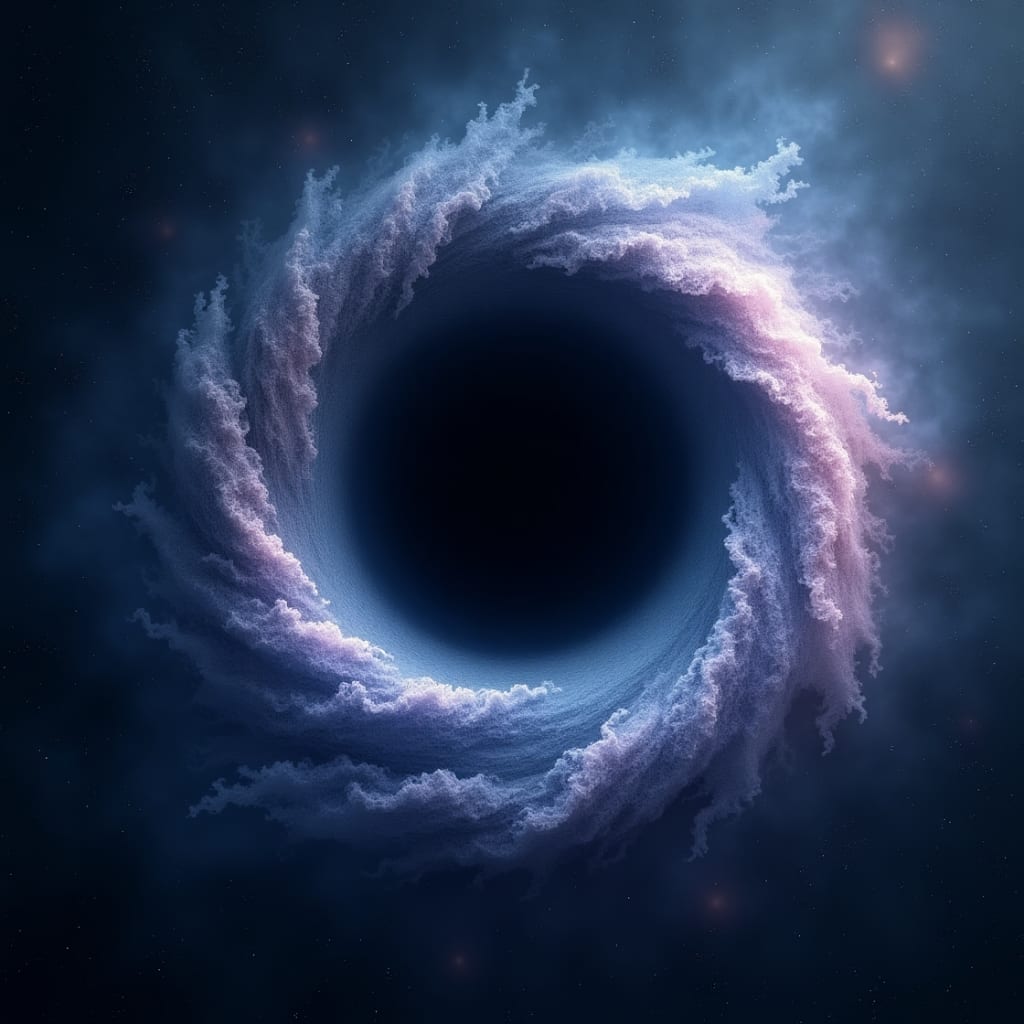
The Mysterious Nature of Black Holes
Black holes are among the most enigmatic and fascinating objects in the universe. When a massive star burns through its nuclear fuel, it can collapse under its own gravity, forming a region in space with an immense gravitational pull—so strong that even light cannot escape. This results in the creation of a black hole, an object with an event horizon that marks the point of no return.
Any star, planet, or cosmic debris that ventures too close to a black hole is inevitably drawn in, stretched, and ultimately consumed by its gravitational force. This has led to the perception of black holes as insatiable cosmic entities with an unending hunger for matter and energy. But what happens to all the material that gets pulled in? Could a black hole, at some point, reach a breaking point and explode?
The Big Bang and the Black Hole Connection
The widely accepted Big Bang theory suggests that the universe originated from an extremely dense and hot singularity—an infinitely small and infinitely dense point—before expanding into the vast cosmos we observe today. Interestingly, the core of a black hole is also thought to be a singularity, a region where gravity is so intense that our current understanding of physics breaks down.
This raises a profound question: If the universe itself emerged from a singularity, could black holes also undergo a similar transformation, leading to an explosive release of energy and matter?
Can a Black Hole Explode?
While black holes are generally known for their ability to consume matter, there are intriguing theories suggesting they might not be entirely one-way destinations. Some possibilities include:
1. Hawking Radiation: The Gradual Evaporation of Black Holes
In 1974, physicist Stephen Hawking proposed that black holes are not entirely black. Instead, they emit a faint stream of thermal radiation, now known as Hawking radiation. This phenomenon arises due to quantum effects near the event horizon, where virtual particle pairs constantly pop in and out of existence. In some cases, one particle falls into the black hole while the other escapes, carrying away a tiny fraction of the black hole’s mass.
Over incredibly long timescales, this process leads to the gradual evaporation of black holes. For small black holes, this evaporation accelerates toward the end, culminating in a final, explosive release of energy. If this theory is correct, it implies that black holes do not last forever but instead slowly shrink and eventually vanish.
2. Black Hole Decay and Potential Explosions
If a black hole continues to radiate energy without any new material falling in, its mass will decrease. As it gets smaller, the intensity of Hawking radiation increases, potentially leading to a final, dramatic burst of energy. Some physicists speculate that this terminal phase could resemble a powerful explosion, dispersing the remaining energy into the universe.
However, this process takes an extraordinarily long time—far longer than the current age of the universe for most black holes. For instance, a black hole with the mass of the Sun would take about years to evaporate completely, making direct observation of this phenomenon nearly impossible.
3. Theoretical Physics and Black Hole Singularities
Some alternative theories in physics suggest that under extreme conditions, black holes might transition into something else rather than merely evaporating. One hypothesis is that the information and energy trapped inside could be released in an event similar to a “Big Bounce,” where a highly compressed state leads to a sudden expansion, possibly giving birth to a new region of space-time.
Another speculative idea is that black holes might eventually convert into white holes—hypothetical objects that expel matter and energy instead of consuming them. If such a transformation were possible, it could mean that black holes serve as cosmic recycling mechanisms, redistributing matter and energy across the universe in ways we have yet to understand.
Conclusion: The Cosmic Fate of Black Holes
While black holes are primarily known for their immense gravitational pull and ability to consume everything in their path, theoretical physics suggests they may not be eternal. Through Hawking radiation, they can slowly lose mass over immense timescales, potentially culminating in an explosive end.
The idea of black holes exploding challenges our understanding of physics and raises deeper questions about the nature of the universe itself. If the Big Bang originated from a singularity, and black holes contain singularities of their own, could they be linked in ways we have yet to comprehend?
For now, black holes remain one of the greatest mysteries of the cosmos, and as our understanding of physics evolves, we may one day uncover whether these celestial giants can truly erupt, reshaping our knowledge of the universe.
About the Creator
Eleanor Grace
"Dream big.Start small.Act now."
Keep reading
More stories from Eleanor Grace and writers in Earth and other communities.
Mother of Elon Musk’s Child Sues xAI Over Grok Deepfakes
Imagine waking up one day to find realistic, sexually explicit images of yourself circulating online—and you never agreed to them. For Ashley St. Clair, the mother of one of Elon Musk’s children, this nightmare became reality. She is now suing xAI, Elon Musk’s AI company, alleging that its chatbot Grok generated harmful deepfake images of her, including depictions of her as a minor and in sexualized contexts.
By Aarif Lashari2 days ago in Earth
Smart phones, Humans and Aliens.
WARNING. I will be tapping into one of your favorite creative tensions: The absurdity of humans worshipping their glowing rectangles as if they were tiny oracles. There’s something deliciously poetic about that contradiction, and it lends itself beautifully to an instructive proviso.
By Novel Allen5 days ago in Poets




Comments (1)
Fascinating paradox! Good work!