
The Big Bang Theory: The Explosive Birth of Our Universe
The Big Bang Theory: The Explosive Birth of Our Universe

Introduction
Imagine everything—every star, planet, galaxy, and even the space between them—compressed into an infinitely dense point. Then, in a split second, an unimaginable explosion takes place, resulting in the birth of time, space, and matter itself. This is the Big Bang Theory, the most widely accepted explanation for the origin of our universe.
But how exactly did scientists come up with this idea? What evidence supports it? And what mysteries still remain? Take a seat as we travel back 13.8 billion years in time to witness the most spectacular event in the history of the universe.
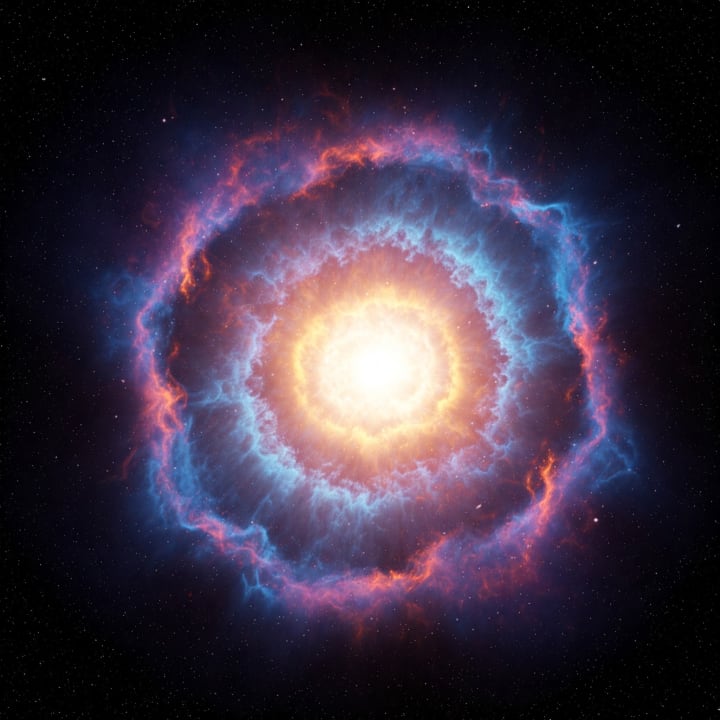
The Birth of the Big Bang Theory
The concept of a universe expanding was not always accepted. The majority of scientists at the beginning of the 20th century held the belief that the universe was immutable and static. That changed in 1927 when Georges Lemaître, a Belgian priest and physicist, proposed that the universe began as a single primordial atom that expanded over time.
Edwin Hubble made a ground-breaking discovery two years later: distant galaxies were retreating faster and further away from us. Now known as Hubble's Law, this observation suggested that the universe was expanding. Reversing time would imply that galaxies were once packed together, suggesting a cosmic explosion if they are dispersing. Astronomer Fred Hoyle, ironically, coined the term "Big Bang" in 1949 in a sarcastic comment made during a radio interview. He preferred the rival "Steady State" theory, but the name stuck, and over time, overwhelming evidence made the Big Bang the leading explanation.
What actually transpired at the time of the big bang?
The expansion of space itself was what caused the Big Bang, not an explosion in space. The earliest moments of the universe are broken down as follows:
1. The Planck Epoch (0 to 10⁻⁴³ seconds)
The universe was smaller than an atom at this point, and its temperatures were higher than 1032 Kelvin. The laws of physics as we know them break down here—quantum gravity would have dominated, but we still lack a complete theory to describe it.
2. The Inflationary Epocalypse (36 to 1032)
The universe experienced rapid exponential growth, expanding from the size of a subatomic particle to that of a grapefruit in a matter of seconds. This provided answers to a number of cosmic mysteries, including the question of why the universe appears to be so uniform.
3. The Hadron Formation and the Quark Epoch
Protons and neutrons were created when quarks combined as the universe cooled. Matter and antimatter annihilated each other, leaving a slight excess of matter—just enough to form everything we see today.
4. 3 to 20 minutes of nucleosynthesis
The first atomic nuclei, mostly hydrogen and helium, were formed when protons and neutrons merged. This primordial soup set the stage for future star formation.
5. Recombination & the Cosmic Microwave Background (380,000 years later)
Light can freely move through neutral atoms when electrons and nuclei combine. This first light is still detectable today as the Cosmic Microwave Background (CMB), a faint glow that fills the universe.
Evidence Supporting the Big Bang
1. The Universe's Continuation Hubble’s observations proved galaxies are moving apart, implying they were once closer together.
2. Cosmic Microwave Background (CMB)
The CMB is the "afterglow" of the Big Bang, and Penzias and Wilson found it by accident in 1965. It matches predictions almost perfectly. Very will write the story all over again. However, for the time being, the most compelling explanation for how everything began, from the stars above to our atoms, is the Big Bang.
3. Numerous Light Elements
The observed ratios of hydrogen, helium, and lithium in the universe align with Big Bang nucleosynthesis calculations.
4. Universe's Large-Scale Structure
Computer simulations of cosmic evolution, based on the Big Bang, accurately predict the distribution of galaxies we see today.
Unsolved mysteries and questions
The Big Bang Theory is successful, but there are still some unanswered questions: What Caused the Big Bang? Was there a "before"? Some theories suggest a multiverse or cyclical universes.
What is Dark Matter & Dark Energy? Together, they make up 95% of the universe, yet we don’t fully understand them.
Did Inflation Really Happen? While widely accepted, we still seek direct proof of cosmic inflation.
Conclusion:
Our Continually Growing Knowledge One of the greatest scientific discoveries of all time, The Big Bang Theory has fundamentally altered our perception of the universe. However, like all scientific theories, it changes as new evidence is discovered. We continue to delve deeper into the origins of the universe by employing cutting-edge telescopes and particle colliders. Who is aware? The narrative might once again be rewritten by the next great discovery. But for now, the Big Bang remains the most compelling explanation for how everything—from the stars above to the atoms in our bodies—came to be.
Therefore, the next time you look up at the night sky, keep in mind that you are witnessing the repercussions of the most powerful explosion ever recorded. We are all, in a way, stardust, born from that amazing beginning.
About the Creator
Keep reading
More stories from writers in Earth and other communities.




Comments
There are no comments for this story
Be the first to respond and start the conversation.