

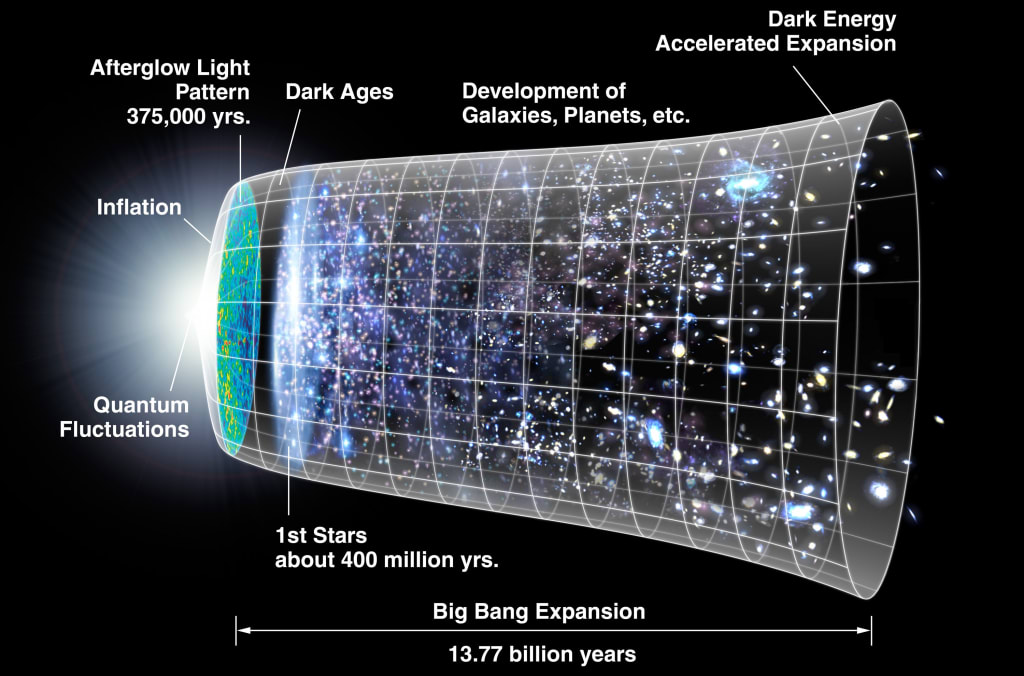
The Big Bang event is a term used to describe the beginning of the universe as we know it. According to the most widely accepted scientific theory, the Big Bang occurred approximately 13.8 billion years ago, and it marked the start of the universe's expansion from a single, infinitely dense point. In this article, we will explore the history of the Big Bang theory, the evidence supporting it, and the ongoing questions and debates surrounding the origins of our universe.
The idea of the Big Bang event first emerged in the early 20th century, when scientists began to observe that distant galaxies were moving away from each other at increasing speeds. This led to the conclusion that the universe was expanding, and if it was expanding, then it must have been smaller in the past. This idea was first proposed by a Belgian astronomer, Georges Lemaître, who suggested that the universe had started as a single point of infinite density, which he called the "cosmic egg."
However, it was not until the 1960s that the Big Bang theory became widely accepted by the scientific community. The discovery of the cosmic microwave background radiation, a faint glow of radiation that permeates the universe, was seen as strong evidence in support of the Big Bang theory. This radiation is thought to be the remnants of the intense heat and radiation that were produced during the early moments of the universe's expansion.
The Big Bang theory describes the universe's evolution from a hot, dense state to its current, cooler, and more diffuse state. According to the theory, the universe underwent a rapid expansion, known as inflation, during the first fraction of a second after the Big Bang event. This period of rapid expansion was followed by a slower expansion, during which the universe began to cool and form the first subatomic particles.
As the universe continued to expand and cool, the first atoms formed, and eventually, stars and galaxies began to take shape. Over time, these stars and galaxies continued to evolve, producing the elements necessary for life to exist. The Big Bang theory also predicts the existence of dark matter and dark energy, which are thought to make up the vast majority of the universe's mass and energy, even though they cannot be directly observed.
Despite the wealth of evidence supporting the Big Bang theory, there are still many questions and debates surrounding the origins of the universe. One of the most significant challenges to the theory is the concept of cosmic inflation, which proposes that the universe underwent a period of extremely rapid expansion during the first fraction of a second after the Big Bang. While there is strong evidence supporting the idea of cosmic inflation, it remains an area of active research and debate.
Another area of ongoing research is the search for evidence of gravitational waves, which are ripples in the fabric of space-time caused by the collision of massive objects, such as black holes. The detection of these waves would provide further evidence in support of the Big Bang theory and help scientists better understand the universe's origins.
In conclusion, the Big Bang event is a critical moment in the universe's history, marking the beginning of the universe's expansion and evolution into the complex and diverse cosmos we observe today. While the Big Bang theory is widely accepted by the scientific community, there are still many unanswered questions and ongoing debates surrounding the origins of the universe. Through ongoing research and observation, scientists hope to gain a deeper understanding of the universe's origins and evolution, unlocking the mysteries of the cosmos and our place within it.
About the Creator
Slaughtering Bread
Providing knowledge in various terms
Keep reading
More stories from Slaughtering Bread and writers in Earth and other communities.
Evolution of the Universe
The universe is a vast and complex entity that has been evolving for billions of years. Scientists have been studying the evolution of the universe for centuries, and our understanding of its history has undergone significant changes as new evidence has emerged. In this article, we will explore the evolution of the universe from its earliest moments to the present day.
By Slaughtering Bread3 years ago in Earth
"That Is a Whole Brigade of Red Flags": Adults Over 30 Reveal the Things Every Younger Person Should Know
Growing up can feel like navigating a maze without a map. Mistakes, missteps, and surprises are part of the journey, but guidance from those who’ve already traveled the path can be invaluable. Recently, a trend has emerged where adults over 30 are sharing the key lessons they wish younger people knew—covering everything from relationships and finances to career choices and personal well-being. The consensus? Life is complicated, but awareness can prevent some of the biggest mistakes. Relationships: Spotting the Red Flags Early One of the most common themes in these shared insights is relationships. Adults repeatedly emphasize the importance of recognizing “red flags” early—behaviors or patterns that signal potential trouble in romantic partnerships or friendships. Comments from social media and discussion threads include advice like: “That person constantly dismisses your feelings? Red flag.” “If someone only shows up when it’s convenient for them, don’t ignore it.” “Pay attention to how someone treats people around them, not just how they treat you.” One adult summed it up bluntly: “That is a whole brigade of red flags. Don’t brush it off because it’s easier to stay.” These warnings highlight that emotional awareness and self-respect are essential skills that often come with experience—but younger people can learn them sooner. Financial Wisdom: Learn It Early Another area where older adults wish they had shared knowledge: money management. Many people over 30 reflect on early financial mistakes, from unnecessary debt to poor saving habits. Key advice includes: Start saving as early as possible, even if it’s a small amount. Understand the impact of credit cards and interest rates. Don’t fall into the “keeping up with friends” trap—lifestyle inflation can be deadly. One adult noted, “I wish someone told me that your 20s are for building security, not impressing people. Your future self will thank you.” The pattern is clear: financial literacy is a skill that pays dividends long before it becomes urgent. Career and Work-Life Balance Adults over 30 also emphasize lessons about work, careers, and ambition. Many regret spending too much time chasing prestige or external validation, rather than finding roles that match their values or talents. Tips shared by experienced workers include: Learn to say no to toxic work environments. Don’t ignore mental health in pursuit of career success. Seek mentorship early, but also trust your own judgment. One common refrain: “Your first job is a learning experience, not a lifetime commitment. Don’t be afraid to pivot.” These insights suggest that career strategy isn’t just about climbing the ladder—it’s about long-term fulfillment and avoiding burnout. Health and Well-Being: Habits Matter Health is another domain where older adults wish they had more guidance in their 20s. Many stress the importance of establishing healthy habits early, rather than assuming youth will protect them indefinitely. Practical advice includes: Exercise regularly, even moderately, to avoid long-term issues. Develop a routine around sleep and nutrition. Address mental health proactively; therapy is not just for crises. An adult shared, “You can’t bank youth. Bad habits compound faster than you think.” These messages reinforce that health is not just physical but also mental, and early attention can prevent decades of struggle. Emotional Intelligence and Communication Another recurring lesson involves emotional intelligence and communication skills. Adults note that misunderstandings, conflict, and resentment often arise from poor communication, something younger people might underestimate. Some advice includes: Learn to express feelings without blame or aggression. Recognize your own triggers before reacting. Practice empathy and active listening—it pays off in friendships, work, and romantic relationships. The emphasis here is clear: emotional maturity can prevent repeated mistakes and improve both personal and professional relationships. Social Media and Perception Many older adults also caution about social media pitfalls. In a world dominated by curated images and constant comparison, it’s easy for younger people to feel inadequate or chase validation. Key tips include: Don’t measure your worth by likes or followers. Take breaks from social media when needed. Remember that people rarely post their struggles online. One reflection captures it perfectly: “Everyone looks like they have it together online, but life isn’t filtered. Don’t let comparison steal your confidence.” The Common Thread: Awareness Saves Time Across these lessons, one theme stands out: awareness is power. Adults over 30 are essentially saying that many mistakes are preventable if younger people pay attention to patterns, trust intuition, and act with foresight. Whether it’s spotting red flags, managing finances, choosing a career, or caring for health, small actions early in life can prevent long-term struggles. The shared wisdom is not about fear or pessimism—it’s about preparing for reality while still enjoying youth. Why Younger People Should Listen Learning from others’ experiences can shorten the trial-and-error period of early adulthood. Younger adults are not expected to avoid mistakes completely, but awareness can: Reduce unnecessary hardship Improve decision-making in relationships, finances, and careers Build emotional resilience Encourage self-reflection and intentional living Adults over 30 often wish they could hand these lessons over like a cheat sheet, highlighting that some knowledge is timeless. Final Thoughts The collective advice from adults over 30 reminds younger people that life is full of lessons—some learned the hard way, others passed down through guidance. Red flags in relationships, financial prudence, career choices, health habits, and emotional intelligence are all areas where early awareness can make a significant difference. In the end, the takeaway is clear: listen, reflect, and take action. Life won’t wait, but the wisdom of those who’ve already lived through its challenges can help younger generations navigate the path more smoothly. By paying attention to the “brigade of red flags” and heeding experienced advice, younger people can make more informed choices, avoid repeated mistakes, and approach adulthood with confidence.
By Muhammad Hassanabout 16 hours ago in Earth
Banyan tree
Early one morning, the forest was alive with an unusual commotion. Birds were chirping frantically, rabbits darted across the undergrowth, and monkeys climbed down from the trees, looking anxiously around. News had spread like wildfire: the oldest and kindest tree in the forest, the venerable Grandpa Banyan, was weak and frail, and it was on the verge of falling.
By Sudais Zakwan7 days ago in Earth
Autonomy Is The Real Privilege
Good morning, freedom-seekers! Today we’re gonna be looking at autonomy. A strange word, I know; one many would probably look at blankly and run away from on sight. We’re gonna figure out what it actually means, consider how it’s achieved, and decipher just how deeply most of us are tangled up in dependence without realising it.
By That ‘Freedom’ Guy7 days ago in Humans




Comments
There are no comments for this story
Be the first to respond and start the conversation.