
The article discusses the recent 7.7 magnitude earthquake in Myanmar and its extensive damage.
earthquake in Myanmar
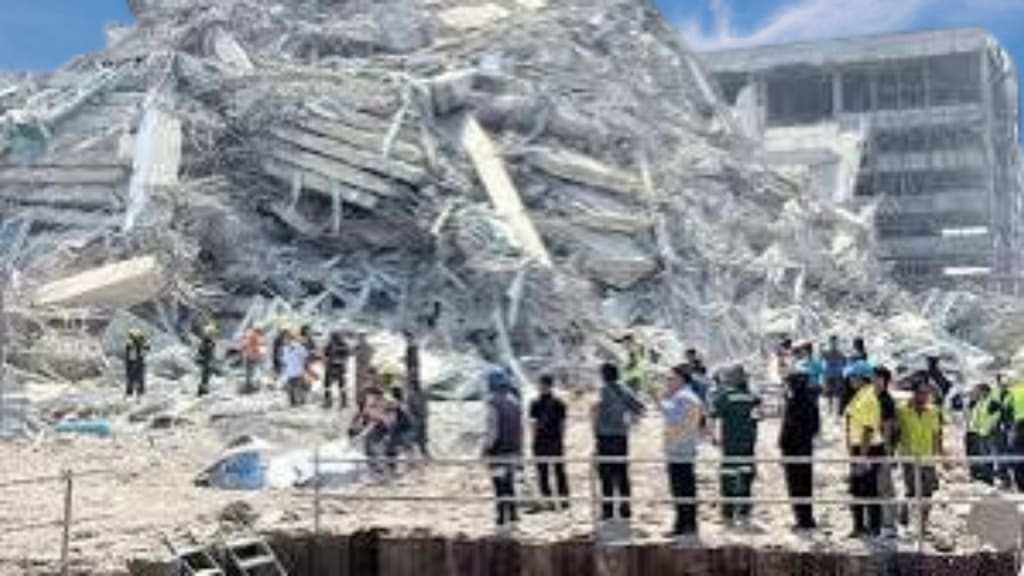
The article discusses the recent 7.7 magnitude earthquake in Myanmar and its extensive damage.
This event has sparked renewed conversations about the possibility of more severe earthquakes in the future.
The largest recorded earthquake happened on May 22, 1960, in Valdivia, Chile, with a magnitude of 9.4 to 9.6. This quake lasted about 10 minutes and triggered tsunamis that impacted countries like Chile, Hawaii, Japan, the Philippines, Australia, and New Zealand, causing an estimated 1,000 to 6,000 deaths.
Another major earthquake was the 2004 Indian Ocean earthquake on December 26, which had a magnitude of 9.1 to 9.3. It generated tsunamis that led to over 227,000 deaths across 14 countries, including Indonesia, Sri Lanka, India, and Thailand.
The article also explores "The Big One," referring to a possible large earthquake along California's San Andreas Fault. Studies indicate that quakes of magnitude 7 to 8 could occur there, posing risks to cities such as Los Angeles, San Diego, and the San Francisco Bay Area. While this scenario is popular in media, seismologists also warn about other regions, like the Himalayas, where the Indian plate meets the Eurasian plate. The largest quake in this area was the 1950 Assam-Tibet earthquake, recorded at 8.7. Some experts predict a megathrust earthquake of 9.0 or more could happen in the Himalayan region, potentially causing widespread destruction in northern India.
Although predicting the exact timing and location of such earthquakes is difficult, studying past seismic activity and monitoring tectonic movements are essential for preparedness and risk reduction.
Here are some key topics related to earthquakes and seismic activity:
1. Largest Earthquakes in History - 1960 Valdivia Earthquake (Chile) – Largest recorded earthquake (9.4-9.6 magnitude). - 2004 Indian Ocean Earthquake & Tsunami – One of the deadliest quakes (9.1-9.3 magnitude). - 2011 Tōhoku Earthquake (Japan) – Caused a massive tsunami and nuclear disaster (9.1 magnitude). - 1964 Alaska Earthquake – Second-largest recorded earthquake (9.2 magnitude).
Potential Future Megaquakes "The Big One" in California – The San Andreas Fault is expected to produce a massive earthquake.
Cascadia Subduction Zone – A possible megathrust earthquake (8.7-9.2 magnitude) could hit the Pacific Northwest.
Himalayan Megaquake – Predictions suggest a magnitude 9.0+ earthquake in the Himalayan region.
Dangerous Fault Lines San Andreas Fault (California, USA)
Cascadia Subduction Zone (USA and Canada)
New Madrid Seismic Zone (Central USA)
Himalayan Thrust Fault
Anatolian Fault (Turkey)
Ring of Fire (Pacific Ocean) – The most seismically active area globally.
Tsunamis Triggered by Earthquakes 2004 Indian Ocean Tsunami (Over 227,000 fatalities)
2011 Japan Tsunami (Caused nuclear meltdowns)
1960 Chilean Tsunami (Waves reached Hawaii and Japan)
Predicting Earthquakes The challenges of predicting earthquakes.
Early warning systems (like ShakeAlert and JMA).
Research on foreshocks and animal behavior before quakes.
Technology for Earthquake Preparedness Seismometers and accelerometers.
Earthquake-resistant buildings.
Tsunami warning systems.
AI and machine learning are being used to predict earthquakes.
Deadliest Earthquakes in History 1556 Shaanxi Earthquake (China) – Deadliest recorded quake (830,000 deaths).
1976 Tangshan Earthquake (China) – Over 240,000 deaths.
2004 Indian Ocean Earthquake – More than 227,000 deaths.
Strange Earthquake Phenomena Earthquake lights (mysterious glowing skies).
Liquefaction (solid ground turning to liquid).
Earthquake swarms and silent earthquakes.
Climate Change and Earthquakes Can melting glaciers trigger earthquakes?
Effects of rising sea levels on seismic activity.
Marsquakes and Other Planets NASA's InSight mission detects Marsquakes.
Do other celestial bodies like the Moon and Venus have seismic activity?
Unique Earthquake Hotspots Japan – Most earthquake-prone due to four tectonic plates.
Iceland – Frequent quakes from tectonic and volcanic activity.
Turkey – Located on two major fault lines, including the North Anatolian Fault.
New Zealand – Situated on the Pacific and Australian plate boundary.
Human Activities and Earthquakes (Induced Seismicity) Fracking and wastewater injection linked to earthquakes.
Dams and reservoirs can trigger seismic activity (e.g., 1967 Koynanagar earthquake, India).
Geothermal energy projects may cause small to moderate quakes.
Mining and explosions can induce earthquakes.
Unusual Earthquakes Deep-focus earthquakes occur hundreds of kilometers underground.
Slow-slip earthquakes release energy gradually.
Doublet and triplet earthquakes involve multiple quakes in a short time.
Earthquake-Proof Engineering Base isolators allow buildings to move independently of ground motion.
Shock absorbers in skyscrapers reduce swaying.
Flexible foundations help withstand shaking.
Traditional designs include ancient Japanese pagodas and Nepalese temples.
Major Earthquake Prediction Failures Haicheng Earthquake (1975, China) – One of the few successfully predicted quakes.
Tangshan Earthquake (1976, China) – Struck unexpectedly, causing mass casualties.
L’Aquila Earthquake (2009, Italy) – Scientists faced legal issues for prediction failures.
Volcanoes and Earthquakes Volcanic tremors may signal eruptions.
Caldera collapse earthquakes can be linked to supervolcanoes.
Could an earthquake trigger an eruption at Yellowstone?
The Role of Subduction Zones Subduction zones can create megathrust earthquakes.
Examples include Chile, Japan, Sumatra, Alaska, and Cascadia.
These earthquakes are typically the most powerful (9.0+).
Earthquake Precursors Changes in radon gas emissions may predict earthquakes.
Animal behavior could indicate impending quakes.
Some studies suggest electromagnetic signals might serve as warnings.
Earthquakes and Time The 2011 Japan earthquake shortened Earth's day by 1.8 microseconds.
The 2004 Sumatra earthquake slightly shifted Earth's axis.
Can earthquakes permanently alter the planet's shape?
Famous Earthquake Survivors Stories of miraculous rescues and heroic efforts during disasters.
Earthquake Myths “California will fall into the ocean” – Not scientifically possible.
“Triangle of Life” theory – Debunked safety method.
Small earthquakes do not prevent larger ones. This is a common misconception.
Seismic Activity in Space Moonquakes recorded during Apollo missions.
Marsquakes detected by NASA’s InSight lander.
Do gas giants like Jupiter and Saturn experience quakes?
AI in Earthquake Science AI-driven seismic monitoring and big data for early warning systems.
Machine learning helps identify patterns in earthquake behavior.
Secondary Effects of Earthquakes Landslides can bury villages (e.g., Nepal 2015).
Liquefaction can cause buildings to sink.
Fires, like those in San Francisco (1906) and Tokyo (1923), are devastating.
Tsunamis are the most destructive earthquake-related disaster.
Future of Earthquake Research Can quantum mechanics aid in predicting quakes?
Are we nearing a reliable early warning system?
How will earthquake science develop in the next 50 years?
About the Creator
Whose Goat Is This?
Pir Sahib was startled when he saw a goat roaming freely in the courtyard of his house. Stroking its neck, he spoke to himself, wondering where the goat had come from and why it seemed so fearless, as if it belonged there. The house door was open, which explained how the goat had wandered inside.
By Sudais Zakwan2 days ago in Earth


Comments
There are no comments for this story
Be the first to respond and start the conversation.