
BRICS and the New World Disorder
In a world on the brink of a multipolar shift, the rise of the BRICS bloc seeks the reshaping of the geopolitical and economic landscape, challenging the dominance of established powers.

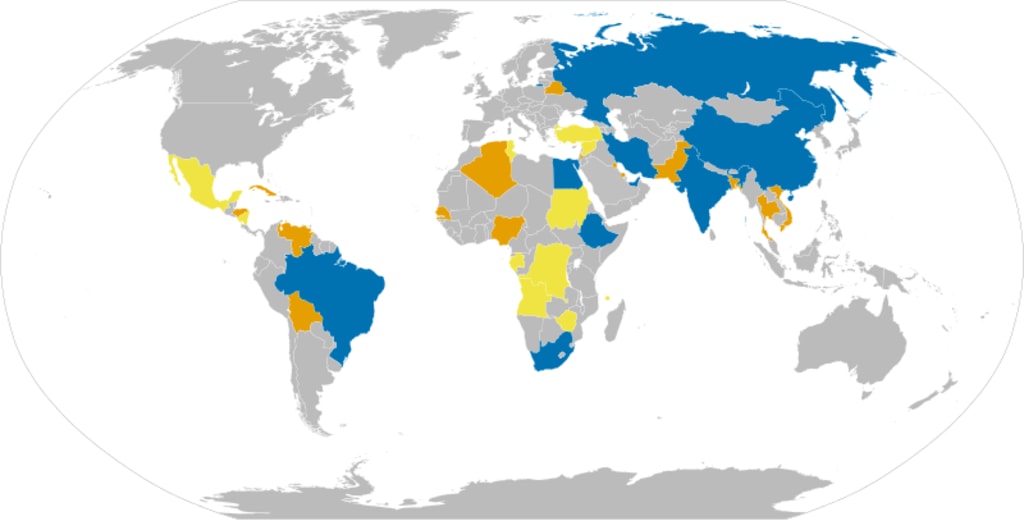
The world is becoming multipolar, and the geopolitical and economic landscape might be fundamentally changing.
At the driving seat of these changes, the BRICS bloc - an emerging economies grouping that brings together Brazil, Russia, India, China, and South Africa - , seeks to confront the G7. Its objective: de-dollarization.
This alliance first took shape in 2009; the expanding membership and its potential threat to the existing international order make it all the more interesting to the rest of the world.
In January 2024 it expanded to include Egypt, Ethiopia, Iran, Saudi Arabia, and the UAE to form a bloc that represents more than 37% of global GDP. This development marked a new fault line in the policymaking fraternity of the West, especially within the EU, NATO, and the G7, who view this newfound cohesiveness of BRICS as an interoperable threat to established economic and political hegemony led by the United States.
BRICS: An Expanding Powerhouse?
New members have joined BRICS, making the alliance tighter but more complex.
Also, BRICS maintains a portfolio of emerging economies with the addition of Saudi Arabia and the UAE in the Middle East, while new members have come on board from Africa in the form of Egypt and Ethiopia.
All these new members are variously endowed with vast energy and financial resources, and strategic importance, thus adding influence to the grouping's global agenda. For example, it adds countries like Saudi Arabia and the UAE to give BRICS more heft in energy markets and, by implication, in international economic bargaining.
But there are also new difficulties in this expanded club. The original BRICS had within its ranks two countries, China and India, that have long regional and political rivalries.
It has now added Iran and Saudi Arabia, both old rivals, making its internal dynamics even more complex. Other concerns, raised by Stewart Patrick with the Carnegie Endowment, surround the heterogeneity of interests that would naturally make consensus difficult on global issues. This is because, whereas the bloc may look quite imposing on the globe, its overall divisions may make acting as a cohesive unit not possible.
These are some of the divergent interests that represent potential weaknesses that western policymakers may seek to exploit.
A Challenge to Western Hegemony?
Despite its own problems and shortcomings, BRICS may serve as a persistently serious challenge to the international order led by the West.
An increasingly influential bloc economically, it is also considered by many as being in direct opposition to institutions such as the G7 and NATO that have, until recently, monopolized global governance.
BRICS remains very critical of the present world economic system, which its members say is angled toward benefiting the West. For that matter, BRICS appeals to a significant number of nations in the Global South. This represents a wider trend in which emerging economies seek to have a louder voice in global processes of decision-making at the expense of established powers and protocols.
This development has been especially disturbing for the EU, given that in recent years it has allowed its relationships with China and Russia to deteriorate. In large part, there are economic and political tensions that have clouded EU relations with China: disputes over trade, human rights, and the future of Taiwan. Meanwhile, its rapport with Russia has all but broken down in the wake of Moscow's 2022 invasion of Ukraine.
With the BRICS expansion, there is growing trepidation that the bloc might eclipse the EU in terms of global economic influence at least, given the fact that it now represents a combined economy more than twice the size of the EU's economy.
Former Italian Prime Minister Enrico Letta has called for Europe to introduce significantly firm measures in economic integration in response to the rise of the BRICS. In a report presented earlier this year, he contended that boosting the single market is critical to the EU not becoming a "colony" of either the United States or China. His comments underline the existential threat that BRICS poses not only to the EU, but to the very Western economic order that for decades has been led by the United States and its allies.
BRICS' Internal Dynamics: Strength in Diversity or Weakness?
While BRICS has the potential to reshape the global economic order, its own internal dynamics pose one of the most serious challenges to this ambition.
The very diversity of the bloc - that at the same time grants it the widest possible representation across the globe - could prove to be an Achilles heel.
The two largest economies within BRICS, China and India, are known to have problematic relations plagued by disputes over the border and economic rivalry. Their rivalry might become one of the obstacles to the ability of the bloc to create a single strategy, at least on issues where the interests of the two countries go different ways.
But the addition of countries like Iran and Saudi Arabia, historic "mortal enemies," as Stewart Patrick put it, makes cohesion even more difficult within the group. Of particular note, these regional rivals' interests go deep, especially in the Middle East, where a series of proxy wars and ideological differences have chiseled out the geopolitical landscape for many years in that part of the world.
Finding a compromise between them will be one of the serious problems the bloc's leadership will face within the BRICS framework.
That issue now assumes a certain degree of complexity with the possible Turkish membership. It is reported that President Recep Tayyip Erdoğan, who since the beginning of the 2000s has been aspiring to place Turkey in the role of a pivot actor in world geopolitics, may align with BRICS.
Inclusion of Turkey into BRICS would be of great importance due to its strategic position, its big and capable military, and historical alignment with NATO and the West.
On the other hand, Turkey's turn to BRICS can be seen as a geopolitical rebuke to the EU, with its consistent rebuffing of Turkish hopes of accession.
The possibility of full membership of BRICS for Erdoğan echoes his wider approach in trying to make Turkey a bridge between the West and the new powers of the Global South. By aligning with BRICS, Erdoğan may further his image as a protector of emerging economies, further distancing himself from policies emanating from the West, which he often criticizes.
This might also complicate things internally for NATO, given that Turkey is one of its key members and has the second-largest army within the alliance. The geopolitical implications of Turkey joining BRICS would surely send ripples across the international order.
The Diplomatic Dilemma of the UN
One of the most contentious issues related to the BRICS summit has been the reported participation of António Guterres, UN Secretary-General.
Guterres' likely participation has been criticized from more than one quarter, specifically from Ukraine and her allies, as an indirect endorsement of the actions of Russia in Ukraine. The foreign minister of Lithuania, Gabrielius Landsbergis, interpreted Guterres' decision to be "unacceptable" and as harmful to the position of the UN as a neutral arbiter in international conflicts.
For Guterres, participation in the summit also means an opportunity for a dialogue that can lead to peace, while being seen as probably giving legitimacy to the policy and action of the Russian President Vladimir Putin. The UN is an international organization whose base of operation would easily be shaken if it were perceived as losing neutrality and credibility.
Guterres may have legitimate diplomatic reasons for attending the BRICS summit, but his going to that summit underlines a growing tension between the job of peacemaker and geopolitical realities in a world divided between East and West.
To many, the presence at the summit of the UN Secretary-General-led by Russia, which is waging war against Ukraine-is an ominous development that will eventually undermine that trust in the UN's ability to mediate conflicts.
Kazakhstan: Between Russia and the West
With geopolitical changes happening inside the BRICS, Kazakhstan finds itself in a precarious position.
The Central Asian nation shares a long border with Russia and is part of EAEU, a Russia-led economic bloc. Astana has duly watched the BRICS summit. But Kazakh President Kasym-Jomart Tokayev made things crystal clear on what the development meant for Kazakhstan: "At this stage, one shouldn't say anything about Kazakhstan's membership to BRICS.".
Kazakstani's reluctance to join BRICS has been partly because of its desire to keep good relations both with the West and with Russia.
Since it has always allied with Russia through various economic and military agreements, Kazakhstan would not like to cross Moscow. On the same note, the country would not like to violate Western sanctions imposed on Russia over the Ukraine war. The result is a balancing policy, placing Kazakhstan between a rock and a hard place by balancing between different poles in the geopolitical arena without antagonizing one or another.
Kazakstan has also been subject to a number of economic pressures applied by Russia, such as the ban on agricultural product imports and periodic interruptions of oil export supplies. Such steps have raised concerns about the country's economic dependence on Russia and further possible blackmail in case the bilateral relationship deteriorates.
Yet, despite all these challenges, Kazakhstan's leadership does not retreat from its course of sovereignty and refusal of involvement in the greater geopolitical conflicts raging around BRICS.
The Future of BRICS and Global Power Shifts
But as BRICS grows larger, and more diverse, its impact upon the global order will be similarly profound. The bloc's growing economic heft, along with its apparent ease of attracting new members, places it as a formidable challenger to Western-led institutions such as the G7 and NATO. Internal divisions within BRICS-forged by historic rivalries and competing national interests-may well hold the organization back from serving as an effective, cohesive geopolitical force.
This expansion of BRICS places in sharp focus some key questions on the future of global governance. Will BRICS be in a position to provide an alternative to the US-led economic order, or will it fall prey to internal tensions that have plagued other international alliances? The geopolitical landscape is becoming increasingly fluid, with shifting alliances very unpredictably-consider countries like Turkey and Kazakhstan weighing their options.
The rise of BRICS is part of the broader trend of emerging economies bidding for their influence to be felt in global governance. Whether this will translate into a more multipolar world or a new era of geopolitical instability, only time will tell. What is, however, not so unclear is that the international order is in flux, and BRICS will be at the center of how it will turn out in terms of the future configuration of global power.
About the Creator
Tanguy Besson
Tanguy Besson, Freelance Journalist.
https://tanguybessonjournaliste.com/about/
Keep reading
More stories from Tanguy Besson and writers in Earth and other communities.
Fraudster DJ Carey Moved to Same Prison Landing as Kinahan Gangsters
Reports that former sports figure DJ Carey, convicted in a fraud case, has been moved to the same prison landing as inmates linked to the Kinahan organized crime network have sparked public discussion about prison safety, inmate classification, and correctional system procedures.
By Aarif Lashari5 days ago in Earth
Frozen Horizons: Inside the 2026 Winter Olympics and the Future of Winter Sport
In the winter of 2026, the world will turn its attention to northern Italy, where snow, stone, and centuries of history will converge under the Olympic rings. The 2026 Winter Olympics, officially known as Milano–Cortina 2026, promise something quietly radical. Not louder stadiums or flashier ceremonies, but a rethinking of what a global sporting event can look like in a fragile era.
By Story Prism2 days ago in Earth



Comments
There are no comments for this story
Be the first to respond and start the conversation.