
The Amber trail – a modern experience. (2014)
The experience


For several years now more and more of our customers have been asking for amber. Unfortunately the new Chinese plastic “amber” has confused the marketplace, and people want real Baltic amber but at Chinese plastic prices. When we tell them real Baltic Amber is expensive they agree and insist that is what they want; yet when we show them what we have to offer they cringe at the price. But some customers kept asking and so we decided to do it.
We started thinking about making a trip to the Baltic region to purchase amber and started researching factories and wholesalers in Latvia, Lithuania and Poland to make appointments when we arrived. Basic research showed that raw Baltic amber was selling for $24,000 USD a kilo. Wow!
We were planning our yearly Czech Button and Bead Tour in May 2014, and decided that we could tack on a side trip to the Baltic region before the tour and also do some geneology research into J-Me’s family at the same time, as that was where her Grandfather came from.
The Ancient Amber Road.

Prehistoric trade routes between Northern and Southern Europe were defined by the amber trade. The Amber Road was an ancient trade route for the transfer of amber from coastal areas of the North Sea and the Baltic Sea to the Mediterranean Sea. As an important raw material, sometimes dubbed "the gold of the north", amber was transported from the North Sea and Baltic Sea coasts overland by way of the Vistula and Dnieper rivers to Italy, Greece, the Black Sea, Syria and Egypt thousands of years ago, and long after.
In Roman times, a main route ran south from the Baltic coast through the land of the Boii (modern Czech Republic and Slovakia) to the head of the Adriatic Sea (modern Gulf of Venice).
Our modern Amber trail.
We decided that we could follow that same route, sort of.
We landed in Prague and drove north through the region we go to on our bead tour and into Poland. Our GPS sent us on small regional back roads and through old villages that were crumbling from decades of communist rule and financial hardship. It was early May and still cold. Like 20 degrees farenheit cold with rain and fog. J-Me wasn’t happy. But hey, we had individual seat heaters and they worked. Besides, we were in a cute little European car on mountain roads with 2 weeks to ourselves on an adventure. I was happy. Actually, so was J-Me. She just needed the weather to improve.
Just before nightfall we found a roadside hotel outside of Warsaw that looked comfortable so we stopped for the night. For about $50 we got a double room with breakfast included. The room was OK but the breakfast ruined us for the rest of the trip. It was the best breakfast spread I have ever seen. The buffet must have been 40 feet long just groaning under the weight of all the different types of food available. Custom made omlettes or egg dishes upon request, coffee, tea, juices and fresh milk. No previous breakfast had ever come close to this one, nor any since. (except when J-me cooks breakfast for me – then that’s the best).
After breakfast we drove on through Warsaw and the rest of Poland, still on back roads. That’s when the speed trap got me. It was a Sunday, no traffic on an open road through a small village when I got pulled over. Apparently travelling 60 kilometers an hour through small deserted villages is dangerous and reckless driving worthy of a 200 zloty ticket, payable in cash to the traffic cop. According to him although it was Sunday and the banks were closed I was lucky because coincidently there was an ATM machine next to the 24 hour gas station next to his speed trap. When I pointed out that I had no ATM cards on me, nor zlotys as I was just driving through Poland and would be in Lithuania in about ½ an hour he reminded me then that I was lucky because I did have a 50 Euro banknote tucked away in my wallet and the 24 hour gas station attendant would be happy to illegally exchange it for 100 zlotys which he would accept as my fine for speeding recklessly and dangerously through his town. He wouldn’t let me off with a warning because he had already written the ticket but I was lucky because he hadn’t written down the fine yet and 100 zlotys would be acceptable as a fine. So I cashed my 50 euro banknote and received a traffic ticket which he proceeded to write out after I paid him. Then we were off and into Lithuania. I wonder how many ancient travellers got nailed by Polish traffic cops for breaking their traffic laws back in the day?
By now we were starting to see large nests with white birds in them. Turns out they were pelican, black & white with a very long orangish red beak. We found out later that they are called Ciconia ciconia) or in layman's term White Stork.…………… who migrated to this area in spring and summer after being in Africa all winter. They were all up and down the roads of Lithuania and Latvia.

Anyway, Lithuania was uneventful and farmland boring except their roadside rest stops were primitive.
Arriving in Jurmula, Latvia we had been following really good road signage all through Lithuania and Latvia which matched our maps we had with us. Our GPS stopped at the Polish/Lithuanian border. (apparently the car rental agency didn’t know Latvia and Lithuania were a part of Europe) and suddenly all road signage vanished. We could not find our 350 year old fishermans cottage we were booked into for the next four days. We eventually stopped next to a speed trap with four or five traffic cops and asked for directions. None of them spoke English and immediately got into their cars and drove away. So then we drove to a police station and J-Me went inside to ask for help. Two cops came out and drove their car to our cottage with us following. Nice. It turned out to be one block away. Go figure.
It was now late dusk, but J-Me insisted on walking the beach. The temperature had to be in the high teens with a strong wind, but nothing would deter her. She had arrived. We walked the beach and I lost feeling in my extremities. My jaw ached. Damn - it was cold. We had arrived during a Baltic storm. J-Me was excited because her grandfather had told her growing up that after a storm he would walk the beach and pick up raw amber that had washed up. That was when he was a small boy. He left Latvia in 1908.
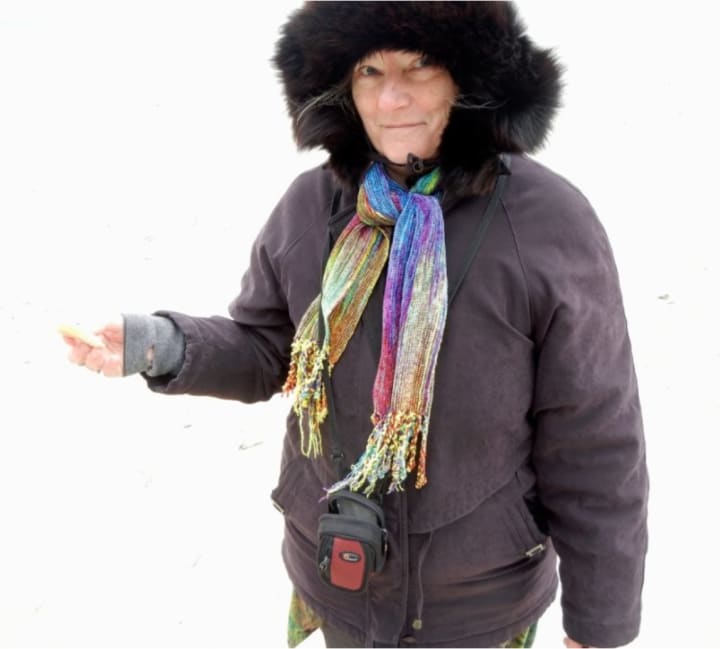
The next morning we walked the beach again. I think it was colder than the night before. We were the only people on the beach. We did not find amber.
Speaking to waiters at restaurants and shop owners at antique stores, they told us that amber was not found on the beach anymore. Maybe back in the day, but not now. To me this made sense, especially if amber was selling for $24,000 a kilo. Anyway, J-Me was determined to continue scouring the beach even if I died of hypothermia
The talk around town was all about Russia and Putin’s grab of the Crimea and possibly the rest of the Ukraine. The fear amongst the ethnic Latvians was that Latvia, Estonia and Lithuania might be next. They had just shrugged off Soviet occupation 14 years previously and did not want to see it return. The ethnic Russians we met didn’t seem to care if Russia came back.
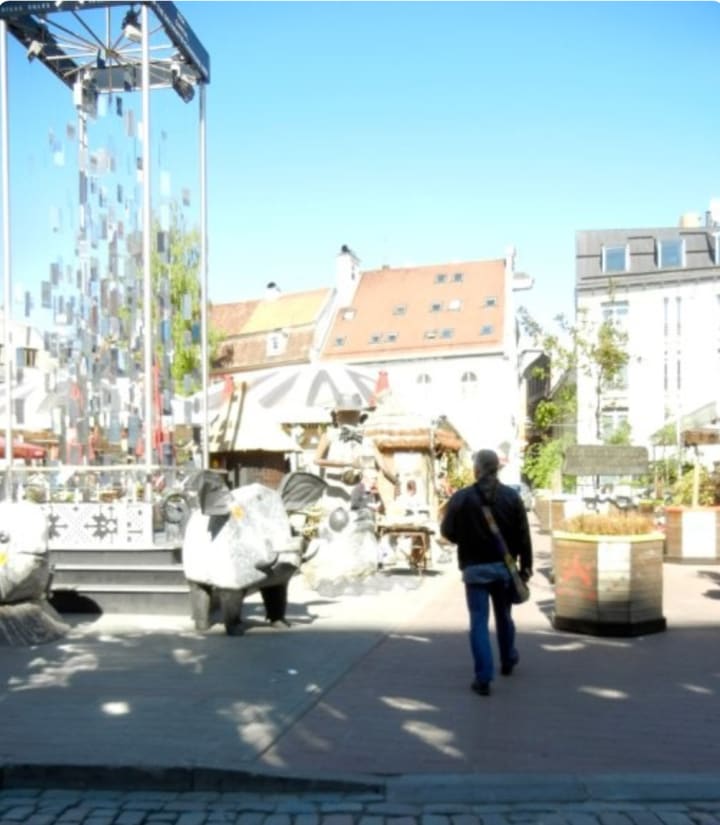
We drove into Riga and toured old town. A smaller version of Prague, it was still just waking up to spring and the invasion of tourists.
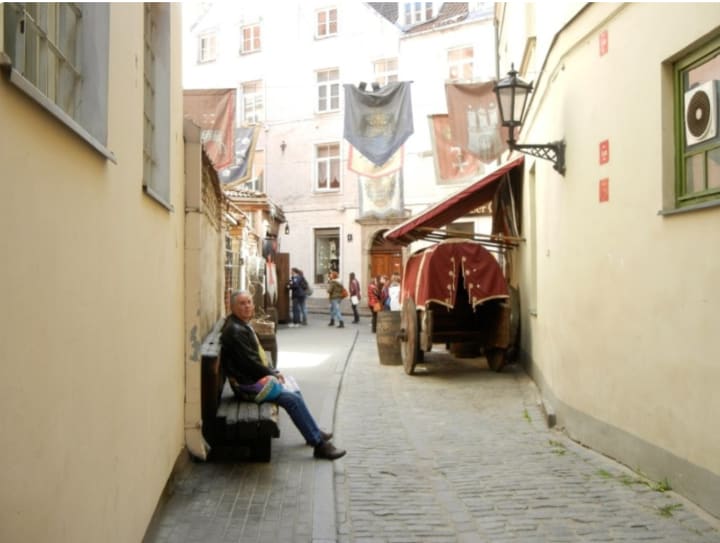
The town was not yet in full swing although we did see some pubs with waiters dressed in period costumes. The street vendors were out, not in force, and not yet hungry enough to negotiate reasonable prices.
We did find amber for sale but nothing we had to have. We did find two amber gallery shops open for business and they were amazing. Full retail at crazy prices. But so beautiful. They would not allow us to take pictures inside the shop of any amber, but their websites had close up pictures of amber jewelry on display in the shop and could easily be copied to our iphoto album from our computer.
On the hunt for amber sources in Riga, we were disappointed.
On the genealogical front, J-Me was able to find traces of her grandfather’s family back to her great great grandfather and mother, as well as great uncles and aunts. We were able to drive around the neighborhood where her great grandfather worked as an engineer in a power plant (Riga’s first) before emigrating to America along with his wife and children, which included J-Me’s grandfather. More work would be needed to find any living relatives, but we would save that project for another day. Oh, goody, another Baltic trip to look forward to.
Back on the hunt for amber, we drove down the coast south of Riga to a stretch of beach at least ten miles long with unblemished white sand where we were the only people in sight.

The storm had ended by morning and it was a beautiful day. No wind and no clouds. Absolutely beautiful. The first thing J-Me found was a large piece of amber about the size of the palm of my hand, weighing approximately 60 grams. At $24,000 a kilo that would be $24 a gram and therefore $1,440. What a find!
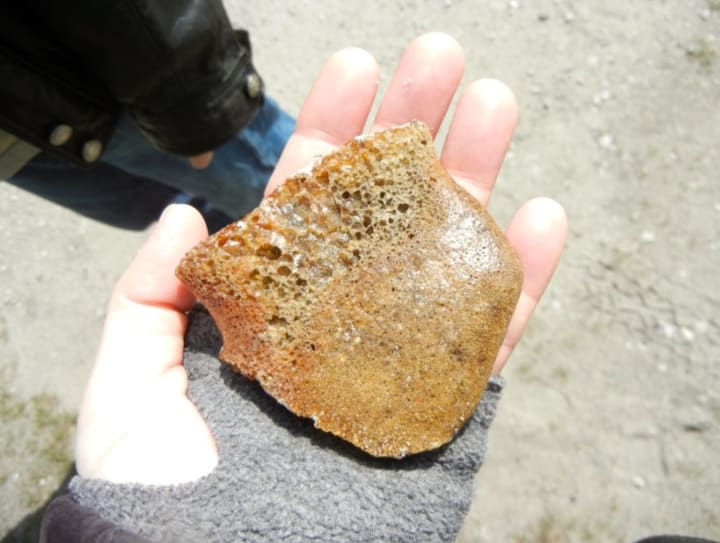
found nothing, but a friend of ours collects sand so I filled a paper bag with a small amount of sand to give to him.
We also found large chunks of what appeared to be butterscotch amber, except it was waxy or soapy and easy to scratch. I didn’t think it was amber, but what was it? Could it be ambergris, a substance more valuable than amber used to make perfume? We collected several pieces to take back to the cottage.

Could it be phosperous which looks like amber but when dries bursts into flame and has been known to cause death and injury to tourists who collect it?
We got on the internet and contacted two companies who purchase ambergris and sent them pictures and descriptions. They told us it was not ambergris. J-Me did not want to throw it away in case it was amber so it stayed in the box in the back of our car for weeks; each day I would look out at the car expecting to see a column of smoke from the phosperous bursting into flame and destroying our car. Good thing it was a rental just in case
Finally it was time to leave Latvia and drive down into Lithuania. We drove along the coast to Palanga, where the Amber Museum was located. Again, fabulous road signs vanished the minute we entered town, and we had to stop a group of about 40 ten to twelve year old school kids on a field trip to ask for directions. A young boy started to talk to us but a really bossy twelve year old girl pushed her way to the front and took over. She gave us great directions in English and we went off and found it. It was about 2pm when we arrived to find the museum building under repair, and we thought “Oh no, we wont be able to see the display”, but there was a small opening in the middle of the construction that told us in Lithuanian that the museum was open for visitors.

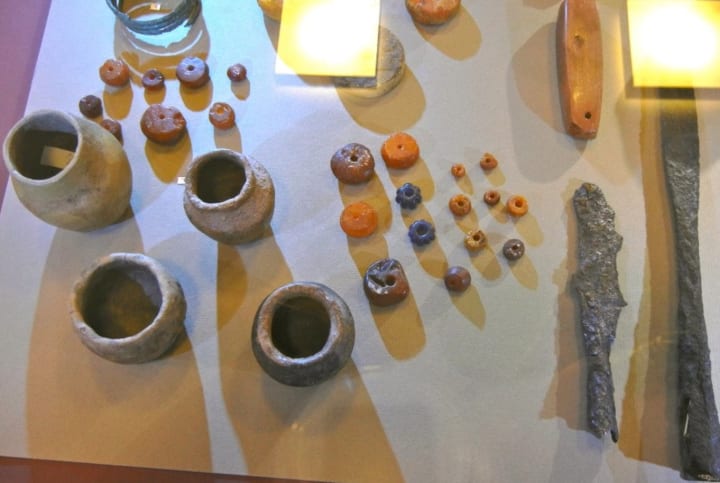
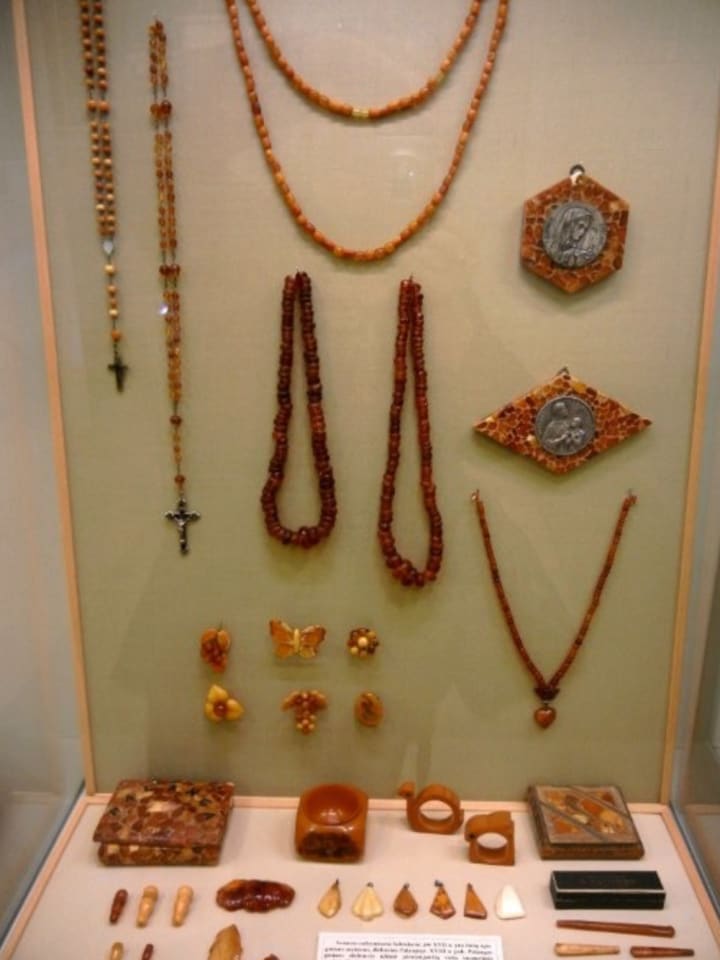
We drove out of town and headed for Kaunas, arriving at the outskirts around 5pm. All signage ceased to exist, and the map downloaded from the hotel’s website when we made reservations became gibberish. Kaunas was huge, and we got lost immediately.
In desperation we pulled up to a gas station where two cops were eating donuts (what can I say) and asked for help. One cop pulled out his phone, typed in the address of the hotel and said follow me. We raced behind the cop car for about 10 minutes through side streets and into neighborhoods until they pulled up to a building. "We are here" we were told and then they drove off, leaving us in front of a crumbling communist style apartment complex. We were horrified. It couldn’t be our hotel, it was supposed to be 4 star. Walking around the corner we found our hotel. It was a 5 star hotel in a neighborhood that looked like a ghetto, hence the 4 star rating. We safely tucked ourselves in for the night.
The next morning was the opening day of the annual International Baltic States Antique Fair, which was the reason we were in town. We were very excited. The hotel receptionist gave me a map with detailed instructions on how to find the Expo Center hosting the fair.
I explained the lack of signage on road intersections, etc… but she waved my concerns away saying it would be very easy to find. It did look easy and close to the hotel.
We started off down the street and ran into a detour sign sending us off in another direction. We got lost. The map was useless. Some how we ended up on the right street but could not find the Expo Center. Directions from a waitress at a road side restaurant showed us we were one block away. We found it!
Billing for this fair was that there were over 1000 vendors from all Baltic States selling antiques; so maybe in the entire history of this event they had an accumulation of 1000 vendors, but for this actual 2014 event there were maybe 100 vendors. OK, so a little letdown, but still exciting.

Like any antique market, we found junk, reproductions and stuff we were not interested in, but we also found stuff we were interested in. And the prices were good. And we found amber. Old amber, at reasonable prices we could resell in the States.

We bought all we could find, bags of it, as well as a few really good trade bead amber that was not cheap but absolutely fantastic and very old and beautiful. Stunning, actually. Some of it was so expensive we left and came back the next day before leaving town to drive back into Poland, and bought it then after thinking about it overnight.

We also bought more strands of the cheaper amber from the same vendors we bought from yesterday. We were happy. They were happy. We sang songs together. (OK, we didn’t do that).
Leaving town was easy – we only got lost once.
Our plans were to go into Gdansk to see the amber shops there. Gdansk is where 90% of the world’s Baltic amber is turned into jewelry. But we really weren’t that interested in finished jewelry, so we made the decision to bypass Gdansk and push on through to Jablonec nad Nisou and prepare for our Czech Button and Bead Tour.
As we were driving towards Poland we had to drive around Kaliningrad, Russia, where probably 90% of the world’s Baltic amber is mined. We really had no interest in seeing this part of Russia, at least not on this trip, not with the Russian aggression happening with the Ukraine, and just Russia in general. So we waved so long at the off ramp to Kaliningrad from the autobahn and kept on going. Once we hit the Polish border our GPS came back on and we had good directions onwards to Czech Republic. This time the directions put us on major highways where I could drive at 130 kilometers an hour on new superhighways comparable or better than any back home. Poland was obviously using their speed trap money well.
So that was our Amber Trail adventure circa 2014. Modern day amber merchants buying amber for resale back home to our customers.
Oh, one last thing. Like any road trip, garbage and weird stuff accumulates in the back seat and the trunk of the car, so at some point you have to clean it up and throw it out. When we got to our hotel in Jablonec I did this. I was still nervous about the box of phosperous/ambergris exploding into flames in the car so I threw it into the trash bin. (let them worry about it). I also threw out the bag of sand. We had bought so much stuff a bag of sand was crazy to carry home in our suitcases. Unbeknown to me J-Me had placed her large amber piece she had found into the bag of sand. Needless to say, the trash bin was emptied that day and the Amber was never found. J-Me still bugs me to this day over that little error.
I wonder what stories those ancient merchants of centuries ago had to tell.
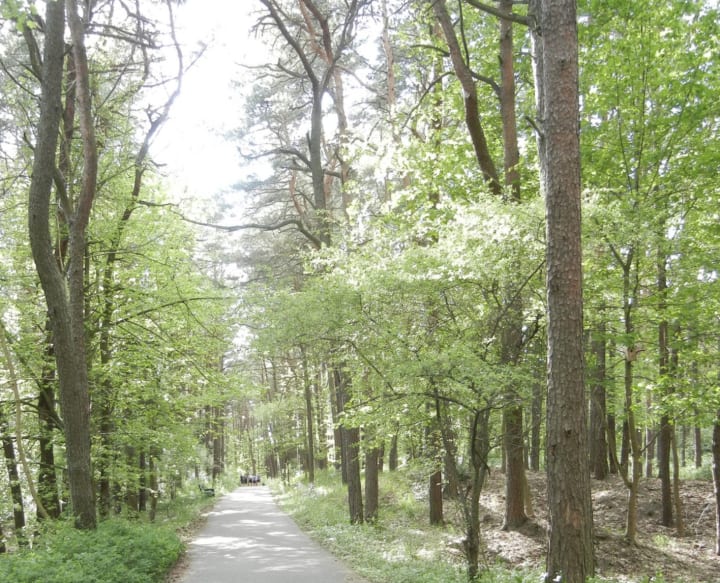
In 2016 we did another tour of Lithuania and Poland for research into an Amber Tour like our Czech Button and Bead Tour. Driving through Poland, we noticed the autobahn had been expanded and improved, except for the many over crossings that went nowhere or ended in dirt roads that were then fenced off. It looked like the engineers had built in preparation of future expansion.
We spent most of our time in Kleipeda, Lithuania, staying in an apartment right on the Dane River in old town.



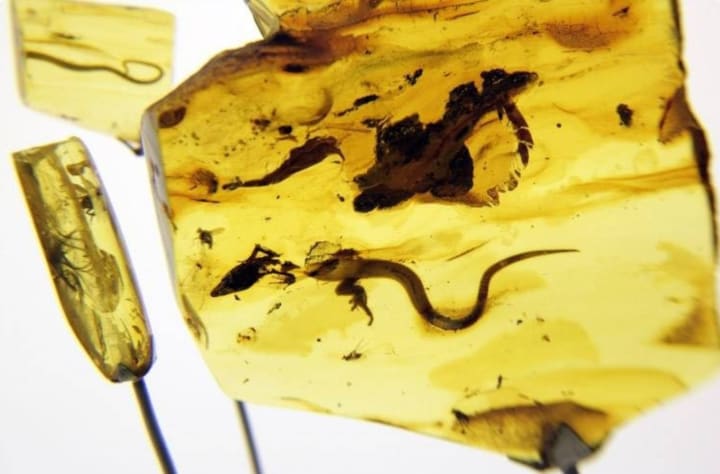
We also visited an amber factory and purchased a large amount of amber beads and specimens with insects embedded inside. It was shipped home as there was too much to carry home in our suitcases.


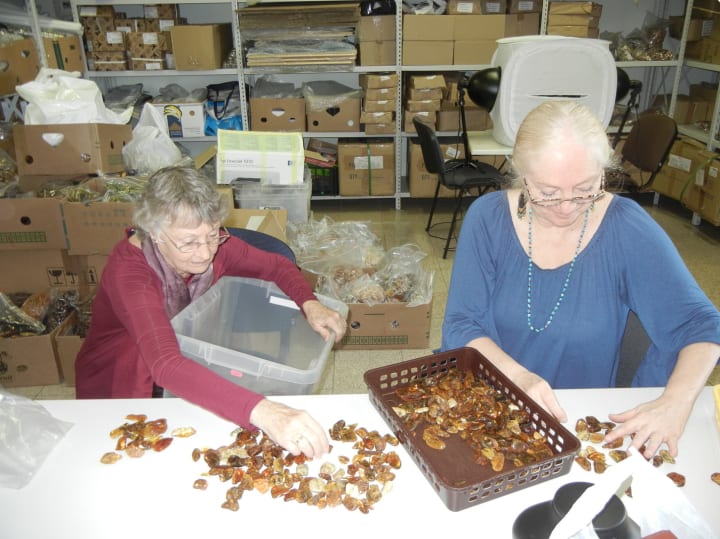
We also found an amber gallery in old town with an incredible museum of amber in the basement. Unfortunately, we weren't allowed to take photos.
The people were fantastic, and very friendly. English was widely spoken. The food was great.
Also in old town was the open market of artisans where we found a 4th generation wood worker who made fabulous amber and wood beads. We wiped him out of all his stock.


After Lithuania we drove back through Poland and had no problems negating the road system. At the Czech Border police were stopping every vehicle looking for refugees from Syria and/or terrorists. All the entry points were heavily staffed by police, but only the Czech police stopped us.
About the Creator
Guy lynn
born and raised in Southern Rhodesia, a British colony in Southern CentralAfrica.I lived in South Africa during the 1970’s, on the south coast,Natal .Emigrated to the U.S.A. In 1980, specifically The San Francisco Bay Area, California.
Man (22) Charged With Murder of English Tourist in Temple Bar
Arrest and Formal Charges A 22-year-old man has been charged with the murder of an English tourist following a fatal incident in Dublin’s Temple Bar area. The charge comes after an intensive Garda investigation into events that unfolded in one of Ireland’s busiest and most popular nightlife districts.
By Aarif Lashari4 days ago in Earth
Flower Bloom 369
FLOWER Bloom 2/25/26 Wednesday By Mariann Carroll Karen had been with Tony for 7 years. Tony started acting strangely after her surgery. He would mow the lawn in the rain and be on his cellphone. He started pushing Karen away. Tony came clean about seeing someone. Karen moved out two months later. Karen moved in with a friend. She felt betrayed.
By Mariann Carroll5 days ago in Fiction


Comments
There are no comments for this story
Be the first to respond and start the conversation.