
Telescopes
Gadgets to explore the Mysteries of the Universe

Remember to look up at the stars and not down at your feet
- Stephen Hawking
Telescopes are essential instruments used to observe the celestial bodies in the night sky. They allow us to observe objects that would otherwise be impossible to see with the naked eye, and have played a crucial role in the development of astronomy and our understanding of the universe. In this article, we will discuss the main types of telescopes, their designs, and their applications.
Types of Telescopes
There are two main types of telescopes: refracting and reflecting telescopes. Refracting telescopes use lenses to bend the light, while reflecting telescopes use mirrors to reflect the light.
Refracting Telescopes
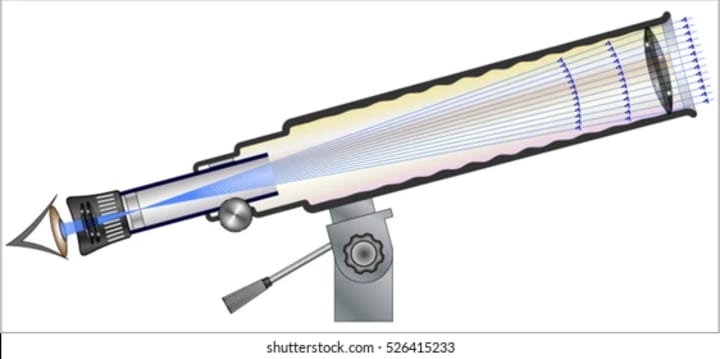
Refracting telescopes have a long history, dating back to the 17th century. They were first used by astronomers such as Galileo Galilei and Johannes Kepler to observe the planets and stars. Refracting telescopes have a simple design, with a long tube containing a lens at the front and an eyepiece at the back. The lens at the front collects the light and bends it, forming an image that is magnified by the eyepiece.
Reflecting Telescopes
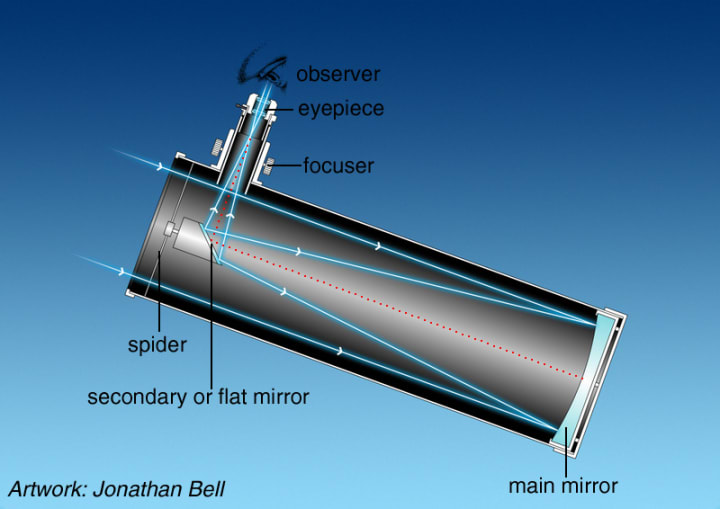
Reflecting telescopes, on the other hand, were first invented in the 18th century by Sir Isaac Newton. They use a curved mirror instead of a lens to reflect the light and form an image. Reflecting telescopes have several advantages over refracting telescopes, including a larger aperture and better image quality.
Designs of Telescopes
Telescopes come in a wide range of sizes and designs, from small handheld models to massive observatory telescopes. The size of a telescope is determined by its aperture, which is the diameter of the objective lens or mirror. The larger the aperture, the more light the telescope can gather, allowing for better image quality and the ability to observe fainter objects.
Telescope Accessories
In addition to the telescope itself, there are several accessories that can enhance your viewing experience. One of the most important accessories is an eyepiece, which magnifies the image produced by the telescope. Eyepieces come in a range of sizes and magnifications, and choosing the right one can make a big difference in your viewing experience.
Other useful accessories include a finderscope, which helps you locate objects in the night sky, and a tripod or mount, which provides stability and support for your telescope. Some telescopes also come with computerized tracking systems that allow you to automatically locate and track objects in the sky.
Telescope Maintenance
To ensure that your telescope continues to provide clear, sharp images, it's important to take proper care of the instrument. This includes regular cleaning of the lenses or mirrors, as well as proper storage and handling of the telescope. It's also important to avoid exposing the telescope to extreme temperatures or moisture, as this can damage the instrument.
Applications of Telescopes
Telescopes are used for a wide range of astronomical observations, including observing planets, stars, galaxies, and nebulae. They are also used to study the properties of light, such as its wavelength and polarization, and to search for signs of extraterrestrial life.
Conclusion
Throughout history, telescopes have been instrumental in advancing the field of astronomy and expanding our knowledge of the universe. The ability to observe and study celestial objects in detail has led to countless breakthroughs and discoveries in the field. From the invention of the first telescopes in the early 1600s to modern-day technology, telescopes have played a vital role in shaping our understanding of the cosmos.
For professional astronomers, telescopes are essential tools that allow them to make observations and gather data for their research. They are used to study a range of celestial objects, from planets and stars to galaxies and black holes. Observations made with telescopes have led to important discoveries, such as the discovery of the first exoplanet, the mapping of the cosmic microwave background radiation, and the identification of gravitational waves.
Telescopes are not just for professional astronomers, though. Amateur stargazers can also benefit from the use of telescopes to explore the night sky. With the help of a telescope, amateur astronomers can observe celestial objects in detail and even make their discoveries. Whether it's observing the craters on the moon, tracking the movements of planets, or watching meteor showers, a telescope can provide a fascinating and rewarding glimpse into the mysteries of the cosmos.
In addition to scientific research and amateur stargazing, telescopes have other practical applications as well. They are used in industries such as defense and aerospace for remote sensing and surveillance. Telescopes also play a crucial role in satellite communication and navigation systems, allowing for the transmission of data across long distances.
Overall, telescopes have played a vital role in the development of astronomy and our understanding of the universe. They have allowed us to observe and study celestial objects that would otherwise be impossible to see and have led to countless discoveries and breakthroughs. Whether you are a professional astronomer or an amateur stargazer, a telescope can provide a fascinating and rewarding glimpse into the mysteries of the cosmos.
About the Creator
Keep reading
More stories from writers in Earth and other communities.
World Spends $30 Destroying Nature for Every $1 Spent Protecting It
The world is at a crossroads when it comes to environmental protection. A shocking new analysis reveals that for every $1 spent protecting nature, humanity spends roughly $30 destroying it. This staggering imbalance underscores a harsh reality: economic development, industrial growth, and resource exploitation continue to take precedence over the planet’s ecological health.
By Muhammad Hassan7 days ago in Earth
10 Times Rotten Tomatoes and I Disagreed
***Disclaimer*** I will be ranking these movies in the following manner: The greater the divide between Rotten Tomatoes and I, the higher up on the list (and I am referring to the critic's score, not the audience score). I will also show Rotten Tomatoes' score on each one in addition to my score. I am curious to know what everyone thinks, please let me know in the comments below!
By Madison "Maddy" Newton5 days ago in Geeks
Killing him slowly
There’s an intruder in my house again. He stumbles through the door, wet carrier bags in hand. He’s bought me offerings. I show my appreciation, letting him caress my beautiful body. He wants to touch me. I rub myself against his legs. He sighs, dropping the bags. He can’t resist touching me. Running his hand slowly down my spine, I arch my back towards his caress, let out a low purr. It’s what we both need.
By N J Delmas3 days ago in Horror



Comments
There are no comments for this story
Be the first to respond and start the conversation.