Sustainability
Heat Pump Water Heater Upgrade in Victoria (via VEU scheme)
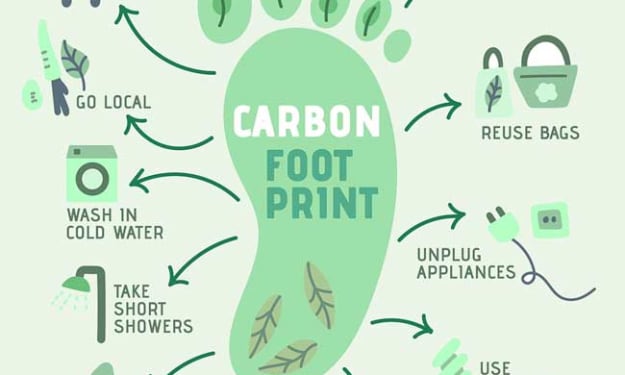
Hot Water Upgrade (backed by government rebates) in Victoria Water heating contributes to 25% of the total energy cost in Australian businesses. This number rises up to 30% if you're living in colder regions of Australia. The energy cost arising from water heating also depends on the type of water heater you've installed.
By Ecofin Solutions ForU3 years ago in Earth
Sustainable Living and Eco-Friendly Practices
Sustainable living and eco-friendly practices are becoming increasingly important in our modern world. As the population continues to grow and the planet's resources become more scarce, it's vital that we take steps to live more sustainably and reduce our impact on the environment. In this article, we will explore the importance of sustainable living and eco-friendly practices, and provide tips on how you can implement these practices in your own life.
By Brianna Smith3 years ago in Earth
What can be done about climate change?
Climate change is one of the greatest challenges facing humanity today. It is caused by the increasing concentration of greenhouse gases in the atmosphere, largely from the burning of fossil fuels. The consequences of climate change are already being felt around the world, from rising sea levels to more frequent and intense heatwaves, droughts, and storms.
By Martin Hennig3 years ago in Earth
CARBON CAPTURE TECHNOLOGY
In the year 2030, the world had changed dramatically. Climate change had become an even greater threat, and countries around the globe had come together to form the Global Climate Alliance, an organization dedicated to reducing carbon emissions and mitigating the effects of climate change. It was against this backdrop that the world was introduced to a new technology that promised to change everything.
By Mikail Raji3 years ago in Earth
Decoding the Secrets of Mars: Unraveling the Enigmatic Red Planet
Mars, the fourth planet from the sun and our closest planetary neighbor, has long fascinated scientists and the public alike. Known as the "Red Planet" due to its distinctive reddish appearance in the sky, Mars has been the subject of intense study and speculation for centuries. In this article, we'll explore some of the mysteries and curious facts of Mars that continue to captivate us today.
By Luisa McKenzie3 years ago in Earth
Top 3 Garden Tool Musts of 2023
As we move into 2023, the importance of gardening and sustainable living has become more apparent than ever before. Gardening provides numerous benefits, from improving mental and physical health to reducing carbon footprint by producing our own food. Whether you are an experienced gardener or just starting, having the right tools can make all the difference in the success of your garden. In this article, we will discuss three essential gardening tools that are a must-have in 2023: the Collapsible Folding Outdoor Utility Wagon with Cover Bag, Gardening Gloves with Deerskin Leather, and Seat Foldable Garden Bench. These tools will not only make gardening more efficient and convenient but also provide comfort and durability for a more enjoyable experience.
By Andrew Sikma 3 years ago in Earth
SOME WONDER LAKES IN THE WORLD PART 1
There is an area in Russia's vast central regions, near the south Ural mountains, that the country wishes never existed. A lake that once existed in this area had a maximum size of 110 acres, or 83 football fields. However, it wasn't the lake's size or even depth that made it a living nightmare; rather, it was what was inside of it. So make yourself comfortable, settle in, and get ready for a tale so gloomy you'll wish it weren't true.The horrifying factual story of LAKE KARACHAY. The first nuclear bomb ever used as a weapon was dropped on Hiroshima, Japan, by the Americans in 1945. It leveled 5 square miles of the city and killed up to 180,000 people, with tens of thousands dying instantly. And in the days and months that followed, an additional 100,000 people perished as a result of deadly radiation. The single most lethal weapon ever created was this one. It also drew the attention of foreign leaders. Stalin was one of them. The Soviet Union's then-president makes the decision to take on the US. He gave the go-ahead to build several highly classified nuclear plants in a place that was out of enemy sight. These will be dedicated to producing the materials necessary to create nuclear weapons. He settled in this area of central Russia, under the Southern Urals, far enough from the border and other population centers to hide the project from the rest of the world. From 1945 to 1948, the Mayak nuclear facility was built in secret on the shores of Lake Kyzyltash, and over 70,000 of his prisoners of war from 12 labor camps were forced to build the massive facility. It was also used to build a nearby town that will house 10,000 new factory workers and their families. This was about 60 miles from the nearest city, Chelyabinsk. As such, it was known simply by the last digit of the postal code, Chelyabinsk-40 or city-40. The government has promised its citizens that they will have no shortage and a high standard of living. It sounds like a dream, but all plans for the town and its environs had to be kept secret.Anyone who declined this offer was exposed to classified security information and could go directly to a concentration camp. Sent. So they didn't have many options. City-40's gate was guarded day and night. It was surrounded by fences and walls covered with barbed wire. And unless citizens had special permission from the government, they were not marked on any map of the Soviet Union, and no one was allowed to enter or leave City-40. , which began production of weapons-grade plutonium soon after it was completed. By 1949, the Soviet Union had developed the first plutonium bomb called First Lightning. This success prompted them to produce even more nuclear weapons, and about 44 cities similar to City-40, colloquially called closed cities, were established in the Soviet Union. Some of the ancillary facilities hosted all sorts of nuclear research efforts, from plutonium production to uranium enrichment, but the Soviets were not the first closed city inventors. And the idea came from the US city of Richland, which was secretly built around the Handford nuclear power plant. The same facility that supplied plutonium for the atomic bomb dropped on Hiroshima. Soviet spy circles intercept plans for the city, so Stalin decides to use this information to follow in the footsteps of the United States. That wasn't the only secret they stole, but most of the Soviet nuclear research had been stolen by nuclear spies involved in the Manhattan Project. The mission that developed the first atomic bomb, but didn't get it all. This, combined with huge gaps in Soviet knowledge of nuclear physics and pressure to save money, forced plant managers to make many safety cuts in worker training, and radiation monitoring staff became poorly protected. , pollution was an afterthought. And to my horror, the workers were cleaning up the radioactive spill with their bare hands. They only stopped functioning when their noses bled as a side effect of their bodies being corroded by lethal levels of radiation. But that was the least of her problems. Mayak's seven main reactors used open-cycle water cooling systems to prevent the reactors from overheating. Here, water from Lake Kyzyltash and the nearby He Techa River was pumped into the reactor core itself, after which the water was pumped back to the same source without being treated or decontaminated. That means millions of gallons of contaminated water leaked into the water City-40 residents drank and bathed in. And it wasn't just the City 40 villages along the Techa that depended on the river as their main source of water. That means another 28,000 of his people were unknowingly dependent on deadly contaminated water sources. Little did they know they lived in a dangerous, radioactive area, but that was only the beginning of Mayak's troubles. In their quest to get plutonium production up and running as soon as possible. They did not consider the extensive requirements necessary to store all radioactive waste. During his first three years of operation, this was essentially non-existent, with workers simply diluting large amounts of waste and dumping it into the Techa River. Until 1951, and even after it was discovered that this was causing enormous environmental damage. They decided it would be safer to dispose of all the waste in a puddle of Lake Karachay. It wasn't until 1953, five years after Mayak opened, that he began storing high-level radioactive waste in stainless steel tanks. In total, these 20 tanks can hold up to 1,600,000 gallons of radioactive waste, more than two Olympic-sized swimming pools. They were buried underground, surrounded by concrete casings five inches thick, and cooled by an external water cooling system. All these elements are designed to prevent the active waste from overheating. Over time, the equipment used to monitor the tank failed, but could not be repaired due to excessive radiation levels in the area. Ultimately, the waste in the tank boiled at 662 degrees Fahrenheit. Then, at 16:20 on September 29, 1957, disaster struck. An explosion with a force of 100 tons of TNT shook Mayak his complex. His 5-inch concrete lid that covered the tank was blown over 80 inches. And 80 tons of radioactive waste began to erupt at an alarming rate. The radioactivity released by this first explosion is estimated to be less than half the radioactivity measured in the famous Chernobyl explosion less than 30 years later. Fortunately, 90% of the waste was liquid and only irradiated nearby facilities, while the remaining 10% was drawn into a radioactive plume over 800 m high and began drifting northeast. rice field. Within 11 hours, radioactive particles in clouds were detected in the city of Tyumen, more than 200 miles away from Mayak. In just a few days, about 9,000 square miles of land covering 217 towns and villages with a population of over 270,000 were contaminated with lethal doses of radiation. This was the disaster of Kishtim. He has had only two nuclear accidents in history more serious than Chernobyl and Fukushima. As water supplies become increasingly polluted by runoff. The government panicked. They calculated that the villages of Berdianish, Saltykovka and Galikaeva downstream of the disaster site would receive enormous cumulative doses within a month. At that time, the amount of absorbed radiation was measured in rads. While as little as 5 rads are enough to potentially and irreversibly damage human chromosomes, residents of these villages would receive cumulative radiation doses of up to 300 rads. This meant severe radiation damage, as well as bone marrow and bowel destruction. Ten days later, these villages of about 1,500 inhabitants were evacuated. The village itself was destroyed and cremated if possible, but nothing was said to the survivors. Fortunately, follow-up studies showed no long-term radiation damage among survivors, but they weren't the only ones left homeless. Eight months later, he had another 6,500 people evacuated from her 23 other villages. During that time, they ate contaminated plants, drank contaminated water, and lived on contaminated land, but suspiciously, no registry was ever established to track their medical history. A year after the accident, all pine trees within a 12.5 mile radius of the affected area were dead. Instead of declaring a radioactive disaster, the Soviet government simply covered up the incident. No one knew the full extent of Kishtim's tragedy for more than thirty years, but the horror did not stop there. The huge amount of untreated radioactive waste dumped into Lake Karachay means that 120 million curies of radioactivity have accumulated over time. For comparison, the Chernobyl disaster released a total of about 185 million curies of radioactivity. But the radioactive isotope Cesium-137, responsible for long-term contamination of soil, was 40 times higher in him in Lake Karachay than in Chernobyl. This means that lakes and surrounding areas will remain polluted for much longer. It also meant that anyone who decided to visit the most polluted part of the lake in less than an hour, or simply dip their feet in the water, would receive a lethal dose of over 500 rads. You would think this would destroy his leg. Depending on how the radiation works, it may shrink, melt, or even grow a few toes. But in practice this leads to acute radiation sickness. Upon exposure, all cells in the body begin to be destroyed rapidly. how fast? After 30 days he has a 95% chance of dying. Now, around 1960, Lake Karachay appeared to be drying up. In 1967, after a hot summer and a dry winter, the remaining water evaporated. This was originally seen as a blessing, but in reality it was more like a curse. This meant that all the still radioactive sediments were contained in the dry dust layer at the bottom of the lake. It only took a gust of wind to kick it up and cause another radioactive accident.But there were no gusts in the area. A storm is coming. Deposits spread throughout the area, bombarding civilians and the environment with another lethal dose of radiation. Only in 1973 did the Soviet government begin the painstaking process of backfilling the lake with tens of thousands of concrete blocks to keep the remaining sediment from moving. After decades of work, the lake was finally filled in in 2015. One might think that during this time the Soviet Union did everything in its power to warn and protect its citizens of danger, but it was surprising. 1989, three years after the Chernobyl meltdown Until now, there was no information about the event in the Southern Urals, where it was finally declassified. After the collapse of the Soviet Union in 1991, City 40 was officially recognized by the new government and renamed Ozersk. Descendants of the original population still live there. And today, residents are getting everything the government promised in his 1940s. But now citizens are aware that their children are likely to be born with serious health problems. that their water is polluted; Many of the beautiful areas around them are off limits. And their life expectancy is much shorter than in other countries. Meanwhile, the story of Lake Karachay and the Kishtim disaster haunts the Russian history books. It is not the only lake in the country known to be irreversibly and irreversibly polluted. There is another lake in the city of Karabash, about 26 miles from Karachay. Like much of the surrounding land and forest, the water is a polluted reddish-orange color. Karabash became the site of a copper smelting plant in 1910. Over 180 tons of sulfur dioxide and heavy metals were released into the environment from this site each year. Although it closed in 1989, it still contains 500 times the concentration of heavy metals such as iron and copper oxide. Swimming in this mud for hours may not help immediately. May cause heavy metal poisoning if swallowed. Although they get pretty ill in the short term, long-term residents of the region have higher rates of skin diseases, cancer, stroke, and birth defects than other regions.
By Jennifer Chigbundu 3 years ago in Earth
Antimatter the most expensive substance on Earth
Let's find out what anti-matter is and how we may utilize it to completely upend our lives. Deep inside the cosmos, there lies a mysterious and powerful force that is waiting to be released. This force might revolutionize the world as we know it. Scientists have been investigating antimatter for more than a century. It is the science fiction dream come true that you may have heard about in Star Trek and Star Wars, but what is it precisely and how is it different from conventional matter? So let's start with the fundamentals. You probably already know that protons, neutrons, and electrons are the smallest particles that make up an atom. these elements It may have been mentioned in Star Trek and Star Wars, but antimatter is a genuine phenomenon that scientists have been researching for more than a century. To understand antimatter and how it differs from ordinary matter, let's start with the fundamentals. You probably already know that matter, which is what we are all made of and what makes up everything around us, is made up of tiny particles called protons, neutrons, and electrons. Antimatter is similar to matter, but with a twist. Instead of protons, antimatter atoms have something called antiprotons; neutrons have antineutrons; and electrons almost have positrons almost.A proton has a positive charge, while an antiproton has a negative charge, and while an electron has a negative charge, an anti-electron, also known as a positron, has a positive charge. In general, antimatter is made up of particles with the opposite charge, spin, and other properties of regular matter. get it If you ever wanted to know what it's like to live in a world where everything is made of the opposite, this would be your answer, and here's the best part: when the antimatter and matter particles collide. Antimatter is kind of like the evil twin of regular matter. It's the mirror image of everything that we're all familiar with, just like Batman has the Joker. If you've ever wondered what it would be like to live in a world where everything is made of the opposite, matter has antimatter, and here's the best part: when antimatter and matter particles collide, they essentially annihilate each other, releasing a tremendous amount of energy at the same time. You might be wondering where all the antimatter is or why we don't have more of it. We still don't know why it happened when they started destroying each other, but regularity ultimately prevailed by a hair. It makes you wonder what our universe would look like if regular matter disappeared, but that's a discussion for another day. Antimatter is regarded as one of the most fascinating things in science. It has the potential to revolutionize our understanding of the universe and, of course, possibly provide a new source of energy. Imagine a fuel that could power a spaceship to the stars. If we can solve this puzzle, we can get enough antimatter for an entire city. But how was antimatter discovered, especially given that there was nothing left of it at the beginning of the universe? Well, scientists were able to discover it in a very clever way. First, we have to go back to the early 20th century, when a physicist by the name of Paul Dirac predicted the existence of antimatter. We can obtain enough energy to power an entire city if we can solve this puzzle, but how was antimatter even discovered, especially considering that there was nothing left of it at the beginning of the universe? Scientists were able to discover it in an electron, which was the first known antimatter particle. This discovery was a huge breakthrough in science. Scientists soon discovered more anti-particles, which opened up a whole new field of study called antimatter physics. We're still learning about it today. We can make antimatter in laboratories right now using supercool machines called particle accelerators. The most famous one is Cern's Large Hadron Collider, which is the biggest and most famous collider in the world. These machines shoot tiny particles at super high speeds; it's kind of like a cosmic game of billions when these particles collide. Scientists look for antimatter in space by searching for cosmic rays that are made up of antimatter particles. Now that antimatter has been discovered, we can change the entire world. Scientists estimate that even a small amount of it, such as a couple of ounces, can produce the same amount of energy as burning millions of gallons of gasoline, which means that even with the smallest amount of it, you could power an entire city for a year. Because of this, the scientific community is working to find ways to use this superpower to improve our lives. They want to use it to create things like flying cars and spacecraft. Imagine a rocket that could take us to the furthest reaches of the galaxy, powered by the energy of antimatter. Even a small amount of it could power a spacecraft for a very long time, and that's not all. Antimatter can also be used in medicine; scientists are trying to use it to fight cancer and make images of the inside of our bodies. It's like a super tool that can help doctors in many ways. In short, antimatter is a super substance that has the potential to power spaceships. It takes a lot of energy to create even a tiny bit of antimatter, which makes it very expensive to produce in large quantities. There are also some other issues, such as how to store our tiny amount of antimatter once we have it, since antiparticles are extremely unstable and attract regular matter like a magnet attracts a refrigerator. Fortunately, scientists have developed some inventive ways to store it, such as the triangular resonance structure. Even though producing antimatter is a tremendous scientific challenge, the potential rewards are enormous. For this reason, scientists are currently working to find ways to produce and store it in a more efficient and cost-effective way, and if they succeed, it could become the new ultimate energy source. Antimatter is an enormous scientific challenge, but even though creating it is an enormous scientific challenge, the potential rewards are huge. It's possible that in the future we could be able to use antimatter to power our houses and automobiles, which would be amazing. Antimatter research is an exciting topic that is constantly developing.Let's find out what anti-matter is and how we may utilize it to completely upend our lives. Deep inside the cosmos, there lies a mysterious and powerful force that is waiting to be released. This force might revolutionize the world as we know it. Scientists have been investigating antimatter for more than a century. It is the science fiction dream come true that you may have heard about in Star Trek and Star Wars, but what is it precisely and how is it different from conventional matter? So let's start with the fundamentals. You probably already know that protons, neutrons, and electrons are the smallest particles that make up an atom. these elements It may have been mentioned in Star Trek and Star Wars, but antimatter is a genuine phenomenon that scientists have been researching for more than a century. To understand antimatter and how it differs from ordinary matter, let's start with the fundamentals. You probably already know that matter, which is what we are all made of and what makes up everything around us, is made up of tiny particles called protons, neutrons, and electrons. Antimatter is similar to matter, but with a twist. Instead of protons, antimatter atoms have something called antiprotons; neutrons have antineutrons; and electrons almost have positrons almost.A proton has a positive charge, while an antiproton has a negative charge, and while an electron has a negative charge, an anti-electron, also known as a positron, has a positive charge. In general, antimatter is made up of particles with the opposite charge, spin, and other properties of regular matter. get it If you ever wanted to know what it's like to live in a world where everything is made of the opposite, this would be your answer, and here's the best part: when the antimatter and matter particles collide. Antimatter is kind of like the evil twin of regular matter. It's the mirror image of everything that we're all familiar with, just like Batman has the Joker. If you've ever wondered what it would be like to live in a world where everything is made of the opposite, matter has antimatter, and here's the best part: when antimatter and matter particles collide, they essentially annihilate each other, releasing a tremendous amount of energy at the same time. You might be wondering where all the antimatter is or why we don't have more of it. We still don't know why it happened when they started destroying each other, but regularity ultimately prevailed by a hair. It makes you wonder what our universe would look like if regular matter disappeared, but that's a discussion for another day. Antimatter is regarded as one of the most fascinating things in science. It has the potential to revolutionize our understanding of the universe and, of course, possibly provide a new source of energy. Imagine a fuel that could power a spaceship to the stars. If we can solve this puzzle, we can get enough antimatter for an entire city. But how was antimatter discovered, especially given that there was nothing left of it at the beginning of the universe? Well, scientists were able to discover it in a very clever way. First, we have to go back to the early 20th century, when a physicist by the name of Paul Dirac predicted the existence of antimatter. We can obtain enough energy to power an entire city if we can solve this puzzle, but how was antimatter even discovered, especially considering that there was nothing left of it at the beginning of the universe? Scientists were able to discover it in an electron, which was the first known antimatter particle. This discovery was a huge breakthrough in science. Scientists soon discovered more anti-particles, which opened up a whole new field of study called antimatter physics. We're still learning about it today. We can make antimatter in laboratories right now using super cool machines called particle accelerators. The most famous one is Cern's Large Hadron Collider, which is the biggest and most famous collider in the world. These machines shoot tiny particles at super high speeds; it's kind of like a cosmic game of billions when these particles collide. Scientists look for antimatter in space by searching for cosmic rays that are made up of antimatter particles. W .
By Sandisiwe Nkomazana3 years ago in Earth
Rain is Nature
Rain is a natural phenomenon that has been present on our planet since the beginning of time. It is a crucial component of the water cycle, providing the earth with much-needed moisture that sustains life. Rain is a subject that has fascinated poets, artists, and writers for centuries, and for good reason. The sound, smell, and feel of rain have an undeniable charm that is hard to resist.
By Shahroz Nasir3 years ago in Earth