Science
Unsolved question
What is the universe made of? .. The universe is made up of a variety of things, including matter, energy, and various physical fields. The exact composition of the universe is still a mystery and a topic of ongoing research in astronomy and physics. We do know that the universe is composed primarily of dark matter and dark energy, which make up about 95% of the universe's total mass and energy. The remaining 5% is made up of "normal" matter, which includes everything we can see, such as stars, galaxies, and planets. It is also thought that the universe contains various other forms of energy, such as electromagnetic energy and gravitational energy, which are associated with physical fields such as the electromagnetic field and the gravitational field.
By Pratham Singh3 years ago in Earth
Human's make things
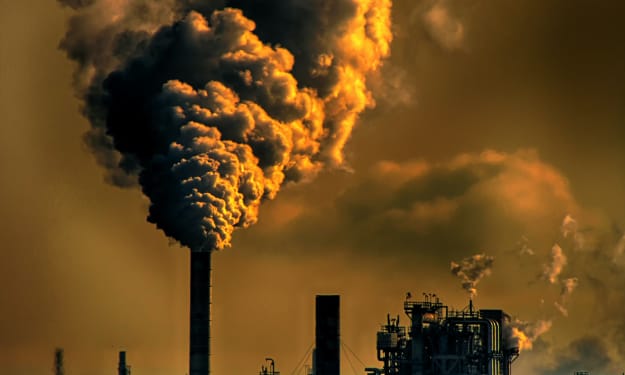
Introduction Global warming refers to the long-term warming of the planet due to the increase in greenhouse gases in the Earth's atmosphere. These greenhouse gases, such as carbon dioxide and methane, trap heat from the sun and cause the Earth's average temperature to rise. The main cause of global warming is the burning of fossil fuels, such as coal, oil, and natural gas, which releases large amounts of carbon dioxide into the atmosphere. Other human activities, such as deforestation and the use of certain industrial processes, also contribute to the increase in greenhouse gases.
By Gokulgandhi3 years ago in Earth
ten potential benefits of using compressed stabilized earth blocks (CSEBs) in building construction
Cost-effectiveness: "Lower costs and greater affordability with CSEBs" CSEBs are often cheaper to produce than traditional building materials such as clay bricks or concrete blocks. CSEBs' cost-effectiveness is influenced by various aspects, including:
By Mark Edburg3 years ago in Earth
10 Fascinating Facts About the Cosmos
The universe is estimated to be around 13.8 billion years old. This age is calculated using several methods, including the observation of the cosmic microwave background radiation and the measurement of the expansion rate of the universe. There are an estimated two trillion galaxies in the observable universe, each containing billions of stars. In fact, it is estimated that there may be as many as 100 billion planets in our own Milky Way galaxy alone. The largest known structure in the universe is the "Great Wall," a massive supercluster of galaxies that stretches for over 500 million light-years. The concept of a black hole was once thought to be purely theoretical, but they have since been observed and studied extensively. Black holes are regions of space where the gravitational pull is so strong that nothing, not even light, can escape from them. The surface of Venus, the planet closest to Earth in size and composition, is hot enough to melt lead due to its thick atmosphere which traps heat from the sun. In contrast, the surface of Mars is cold and dry, with an average temperature of about -80 degrees Fahrenheit (-62 degrees Celsius). The concept of dark matter, which is thought to make up a significant portion of the mass in the universe, was first proposed in the 1930s to explain the observed movements of galaxies. However, despite numerous efforts to detect it, dark matter has yet to be directly observed. The nearest star to Earth, aside from the sun, is Proxima Centauri, which is about 4.2 light-years away. If you were to travel to Proxima Centauri at the speed of light, it would take you over four years to get there. The most distant object ever observed is a galaxy called GN-z11, which is located about 13.4 billion light-years away from Earth. This means that the light we see from GN-z11 left the galaxy just 400 million years after the Big Bang. The largest known planet in the universe is TrES-4, a gas giant located about 1,400 light-years from Earth. TrES-4 is about 1.7 times the size of Jupiter, the largest planet in our solar system. The surface of the moon is covered in a layer of fine dust called lunar regolith, which was formed over millions of years as meteorites struck the moon's surface and pulverized the rock. The moon's surface is also dotted with impact craters, which were formed by the same process. The first spacecraft to visit another planet was NASA's Mariner 2, which flew by Venus in 1962. Since then, humans have sent spacecraft to every planet in our solar system, as well as several asteroids and comets. The sun is not the only star with planets orbiting around it. In fact, as of 2021, there have been over 4,000 exoplanets – planets that orbit stars outside of our solar system – discovered by astronomers. The International Space Station (ISS) is the largest man-made object in space. It weighs over 990,000 pounds (450,000 kilograms) and is about the size of a football field. The ISS is home to a crew of astronauts from different countries who conduct experiments and research in microgravity. The surface of Mars has features that suggest the planet may have had liquid water in the past. These features include valleys, deltas, and channels that are similar to those found on Earth. Some scientists believe that Mars may have once had a much thicker atmosphere and a stable climate that could have supported life. The Crab Nebula, a supernova remnant located about 6,500 light-years from Earth, is expanding at a rate of about 1,500 kilometers per second. This means that the material from the explosion is spreading out into space at a speed that is over 4 million miles per hour.
By Jackson Kasi3 years ago in Earth
Coronavirus Outbreak in US: All you need to know!
Phase 1. The coronavirus outbreak in the United States has been an ongoing health crisis and pandemic. The first U.S. case was reported on Jan. 21, 2020, and since then, the virus has spread rapidly, resulting in more than 28 million infections and more than 500,000 deaths.
By Yinusa Jamiu3 years ago in Earth