Science
Fear and Bravery
Once upon a time in a small town nestled among rolling hills, there lived a young girl named Lily. She had always been captivated by the beauty and power of nature, but there was one force she feared the most: thunderstorms. The booming thunder, flashing lightning, and torrential rain turned her into a trembling bundle of nerves.
By Kurt Kodak3 years ago in Earth
A World Unseen
Emily sat on the bench, her fingertips gently caressing the leaves of a nearby tree. The rustling sound brought a smile to her face, a sound she had come to love. Despite her visual impairment, she found solace in nature's embrace. The soft caress of a gentle breeze, the scent of blooming flowers, and the vibrant songs of birds became her window to the world.
By Akindoyin Abdul-Azeez 3 years ago in Earth
The link between climate change and extreme weather
Ladies and gentlemen, distinguished guests, and fellow advocates for a sustainable future, Today, I stand before you with a heavy heart, burdened by the undeniable truth that we are facing a global crisis of monumental proportions. Climate change, a force that knows no borders, is ravaging our planet, leaving behind a trail of devastation and despair.
By Stories for you3 years ago in Earth
First Nations People team up with scientists to build a seed bank for kelp
Note: See the citation for this article down below Found in all temperate shorelines worldwide, kelp forests provide food, nursery areas, shelter, and protection from predators and storms. It is a habitat for threatened species such as sea otters, grey whales, rockfish, and juvenile Chinook salmon (Mesa, 2023). Indigenous people of the Pacific Northwest have valued the large brown algae species as a traditional food source for centuries. It’s also one of the most common algae species to be cultivated on a commercial level.
By Jenna Deedy3 years ago in Earth
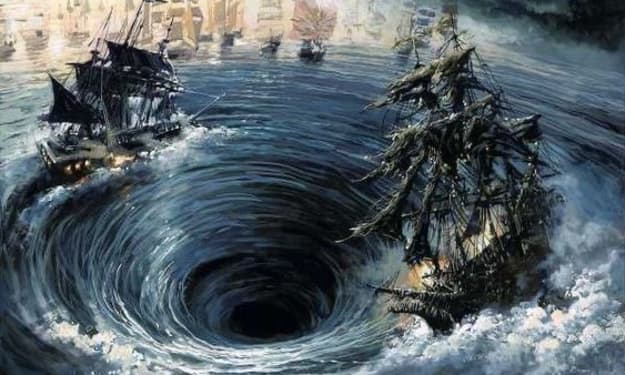
Bermuda Triangle:
Introduction: The Bermuda Triangle, also known as the Devil's Triangle, has captivated the imagination of people around the world for decades. Situated in the western part of the North Atlantic Ocean, this area has gained notoriety due to numerous reported disappearances of ships and aircraft. The mysterious nature of these incidents has led to a wide range of theories and speculations. In this article, we will delve into the Bermuda Triangle phenomenon, examining the facts, debunking myths, and shedding light on the truth behind the enigma.
By 🌺🌺Pamela~the~mysterious🌺🌺3 years ago in Earth
Love. Content Warning.
In a small, quiet town, there lived a young artist named Lily. She possessed an extraordinary talent for capturing the essence of love on her canvases. With every brushstroke, she infused her artwork with raw emotion, evoking a profound sense of connection and vulnerability in those who beheld her creations.
By Bethel onyema3 years ago in Earth
A change in the weather: Warmer but wetter
As the planet continues to warm due to climate change, one noticeable change in the weather pattern is the increase in temperatures accompanied by more frequent and intense precipitation events. This phenomenon is often referred to as "warmer but wetter" weather.
By Matt Smith3 years ago in Earth
Biodiversity Conservation. Content Warning.
Introduction : Biodiversity, the variety of life on Earth, is essential for the health and stability of ecosystems and the well-being of all living organisms. Biodiversity conservation encompasses the protection and preservation of plant and animal species, their habitats, and the intricate ecological interactions that sustain life. This comprehensive note explores the significance of biodiversity, the threats it faces, the importance of conservation efforts, and the strategies required to safeguard the precious web of life.
By Adamu Hafizu Chiroma3 years ago in Earth
Health Benefits Of Nuts
In a quaint little town nestled among rolling hills, there lived an elderly couple named James and Emily. They had spent their entire lives in this peaceful corner of the world, cultivating a deep love for nature and the simple joys it brought. Their days were filled with tending to their garden, walking hand in hand along the riverbank, and savoring every moment together.
By Bethel onyema3 years ago in Earth
Are We Alone In The Universe? Here's The Answer**
9 years ago, my favorite movie director, Christopher Nolan made a movie, Interstellar. Where on a big screen, we visited other planets of the universe. Planets where waves are bigger than mountains, strange terrains, black holes and their secrets too. Whenever I watch a space documentary, I read about the missions of ISRO, or see such mind-blowing images of NASA's James Webb Telescope, so I ask myself a question, when will we be able to travel in space? Let us explore the possibilities in today's video. Let's think, if it is possible to travel in space in our lifetime or not? Can we travel in space? The question is quite simple, but quite complex too. So let's divide this question into three small and logical questions. First question, how fast can we travel? Second question, how do we want to go? Third question, what do we do when we get there? So, let's start the journey of the future with history. On 20th July 1969, something happened that changed the way we look at space Neil Armstrong and Buzz Aldrin became the first two humans in the world, to set foot on the moon. Whenever we see such 3D images or videos of Earth and moon, it seems that the moon is not that far from us, but what is the reality? Well, the truth is that there is so much distance between Earth and moon that you can easily fit all the planets of our solar system. The moon is far away. And think, NASA reached the Moon when it had less processing power than our smart phones. Today, technology has reached far ahead. Let's see at the fastest object made by humans. This is Parker Solar Probe. A rifle's bullet travels at 2,700 kmph. This probe runs at 6,90,000 kmph. Imagine, this probe, at this speed, will take only 3 minutes to circle our Earth. Here, we get the answer to our first question. How did this probe reach this speed? What kind of fuel did it use? The answer is gravity. This spacecraft passes near Venus. As soon as it approaches Venus, because of the gravity of Venus, it quickly pulls towards Venus. At that moment, it changes its direction. This is called gravity assist maneuver. Gravity, that is, the same thing that keeps us connected to the Earth helps us achieve more speeds in space. Let us imagine how long it will take for this fastest man-made object to reach the nearest star. This is Proxima Centauri, which is 4 light years away from the Earth. It is the closest star outside our solar system. A light year is a unit to measure large distances. Basically, a photon is the fastest object in the world. Nothing can travel faster than light. The distance that a light can travel in the vacuum of space in 1 year is called 1 light year. Like this star is 4 light years away from us. If we want to travel interstellar, we have to at least reach this star. If Parker Solar Probe continues its max speed forever, it will take 6,596 years to reach Proxima Centauri. Means, if we launch this probe today, by the time it reaches our closest star, it will be year 8619. The fun part is that this solar probe is an unmanned probe. That is there is no human in it. The ships that take humans are big. There are more complications in them and most importantly, their speeds are quite low. When we watch any space videos or photos, the space appears to us a bit like this. But actually, interstellar space is something like this. Space is empty. Here, despite having trillions of planets, stars, moons, the interstellar space between two stars is largely empty, there is only darkness in between. To survive for 6,000 years, we need a space city, not a spaceship. Where astronauts will have to make a family, get married, have children. They have to raise those kids, and train them to become astronauts. This chain of events will continue for generations. Then we will finish the journey of 6,000 years and reach our closest star. Now the question is, what will we do after reaching there? Where will we land? Let's move on to the second question. Today, we have discovered more than 5,000 exoplanets. Exoplanets, means those planets that are outside our solar system. Our Earth's distance from the Sun is ideal for water to form. And where water can be in liquid form, there can be life. By the same logic, out of 5,000 exoplanets, NASA has identified some 59 habitable exoplanets. Habitable, means, they come in their star's Goldilocks zone like the earth does. It can be that such planets can be our future dream destination. Or maybe there is already alien life on such planets. If you want to see a detailed video on Aliens, then tell us in the comments. Let's come back to the topic. To install Exoplanets. The closest habitable exoplanet to us is 12 light years away. Means to get there, even with today's most advanced technology it will take us almost 20,000 years. If we have to leave our solar system and go on a long journey, then when should we leave? This confusion is called the walk-wait dilemma. Imagine, if you are standing at a bus stop and no bus arrives for a long time. Then should you start walking towards your destination or wait for the bus? You started walking and if the bus came, then? It will overtake you. So what is the point of walking? Instead, better wait for it. Every year, technology advances. If with today's technology, a ship carries a lot of frozen embryos and leaves for a 12-light years journey, and tomorrow if our technology advances more, and we are able to travel at more speed, then we will move ahead leaving this ship behind . So, what is the point of setting the first ship to sail? Elon Musk is a visionary. He wants to take us humans to interstellar. There can hardly be a more optimistic person than him. But even he believes that we cannot travel interstellar in our lifetime. But we can take some steps to become an interstellar species. Our solar system is quite big and it has many secrets. We can explore them. Technology wise, the first step will be nuclear attacks on Mars. Yes, you heard it right. Elon Musk believes that we must carry nuclear attack on Mars. So that Mars' temperature increases and we make it artificially habitable. Then we start all our missions from there. This process is called terraforming. Where by changing the composition of an entire planet it can be made habitable. The asteroid belt that lies between Mars and Jupiter in that asteroid belt, there are a lot of metals hidden in it. They can be mined and brought to Mars. And then work can start by making spaceships from there. This is Elon's belief. Why is this important? Let me explain with an example. Suppose a spaceship has to go from Earth to Mars, it takes the same amount of fuel to travel from Earth's surface to Earth's orbit as it does later to reach Mars, 290 million kilometers from Earth's orbit. That is, every time we spend maximum energy only for the first 400 kms. But if we do not have to take this journey again and again, then our energy expenditure will be greatly reduced. That's why the International Space Station is being built. In the coming time, such outposts will be built. And instead of launching the rocket from Earth, we will launch it from such a planet where the gravity is less than Earth. Now coming to our last and most important question, What is the objective of space travel? A few years ago, we saw billionaires like Jeff Bezos and Richard Branson going out of space. Famous scientist Stephen Hawking has also been to space. That is, in today's time, even without being an astronaut, some VIPs, some special people can go to space. If we keep the dream of landing on any planet a bit away, then space travel is possible. But it is worth a thought that if space or the earth is to be seen only through a glass, then what is the need to go to space for that? There are YouTube videos for that. The main attraction here is to feel weightless. As if there is no gravity Do we need to go to space even to feel weightless? The answer is no. This music video is shot in a reduced gravity aircraft. When this aircraft dives down from above, you feel as if there is no gravity. This aircraft does not go to outer space, but staying here, makes you feel like you are in space. After all, it is an experience just like space travel. In fact, if the objective of space travel is only to touch other stars, then we do not need to even go outside our home. Just need to touch yourself like this Let me tell you a fact that may blow your mind. The oxygen in our lungs, the carbon in our muscles, the calcium in our bones, the iron in our blood, all of these are formed in a star. Only hydrogen and helium were formed in the Big Bang. All the other heavier elements were born in a star. Then when that star exploded, these elements traveled around and came to Earth. Today they are part of your body. You don't need to become an interstellar traveller. You are already the result of an interstellar journey. You are literally stardust. Space is fascinating. To install Space is scary. Space is overwhelming. Space is beautiful. In the beginning of the video, we talked about the Parker Space Probe. In today's time, this is the fastest man-made object we have made. But our second fastest object is also quite interesting. This is Voyager 1, which was launched in 5th September 1977. The initial plan was to pass through Jupiter and Saturn. Will send important data to NASA. But then later it was left on an interstellar journey. In 2012, it left Pluto behind and entered interstellar space. Today it is 23 billion km away from us. It took 45 years to reach this far. Why are we making this video? Because of this one image. In February 14th, 1990, Voyager 1 Space Probe took a photo of space. Can you see this tiny dot? This is us. This is our earth. These are all our countries. These are all our civilizations. These are all our conflicts. These are all our religions. This is us. When we look at our world from 6 billion km away, we understand that all those things which we consider important today, for which we laugh, for which we cry, for which we get angry, all those are just a small thing for this whole universe. All your problems, all your sorrows and pains, are just this much. Personally, when I find any challenge big enough, I look at this image. When we look at our world by stepping two steps away from ourselves, then our world starts appearing smaller, and so does our ego. When the confidence is low, remind yourself that you are stardust and when you become overconfident, remind yourself that you are dust. may be that you are not at all interested in space. It may be that all the things heard in this video are very new to you But when we give ourselves some space and take our selfie from space, then we get a new perspective to look at this world. Conveying this important thing to you makes a difference to me.
By Dilip kumar padi3 years ago in Earth
Overactive Bladder (OAB): Symptoms, Causes, and Treatment
Introduction Anyone who frequently wakes up at night to use the bathroom or has to make multiple stops during a road trip knows how inconvenient and frustrating it can be to constantly feel the need to urinate. This could be a symptom of overactive bladder syndrome (OAB), which is more common than many people realize. According to the Urology Care Foundation, up to 30% of men and 40% of women in the United States experience symptoms of OAB [^1]. In this article, we will explore what overactive bladder is, its symptoms, causes, and available treatment options.
By satish Kumar3 years ago in Earth