Science
How small is the electron? If the Earth shrinks to the size of an electron, how big would the universe be?
In the macroscopic world, the earth moves around the sun, while in the microscopic world, electrons move around the nucleus of an atom. Although the two move in very different ways, we often associate the earth with electrons, so the question arises: If the earth shrinks to the size of an electron, how big would the universe be after shrinking in the same proportion? To answer this question, first, we need to know the size of the electron.
By Baudamolova3 years ago in Earth
The Yellowstone volcano, which is a great threat to humans, has been unusually active in recent years, and will humans become extinct once it erupts?
Introduction: With the advancement of technology, humans can master more and more things. But the only thing that is beyond human control is nature, and humans can only predict the occurrence of natural disasters. Once a natural disaster occurs, the consequences will be unimaginable. Today we are talking about the most terrible kind of natural disaster, that is, volcanic eruptions. One of the largest supervolcanoes in the world is known as the "Yellowstone Volcano". Even known as the active volcano in big brother, its area reached more than eight thousand square kilometers, larger than some small countries. Once the Yellowstone volcano eruption, human beings are very likely, in danger.
By Deljewitzki3 years ago in Earth
Can humans live forever? Scientists calculate the limit of human life expectancy, the results are disappointing
Every creature living in nature has a certain life span because everything in nature cannot be immortal, this is the law of nature, man can not change, however, the life span of various creatures, including humans, is determined by a variety of factors, such as genetic survival environment and a series of factors.
By Hitchinson Metz3 years ago in Earth
International Space Station found "unidentified flying object", users: aliens are spying?
British media had a report, their International Space Station (International Space Station) in the outdoor live broadcast, inadvertently spotted a regular rectangular unidentified flying object body in the clouds.
By Apostolakis3 years ago in Earth
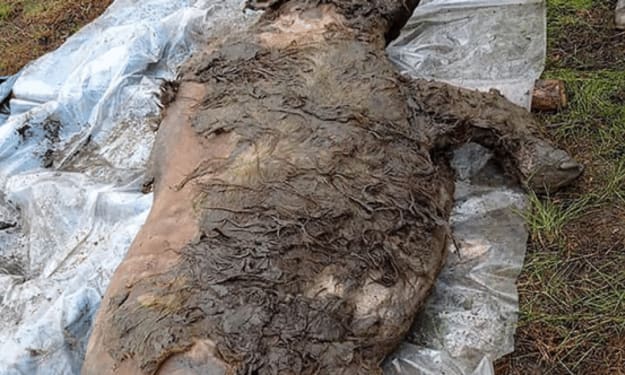
This is a danger signal! Siberian animal carcasses reappear, Arctic ecology on the brink
Late last year, Current Biology published a paper that featured the carcass of a gray wolf, which is 57,000 years old now. To the surprise of scientists, the carcass was preserved intact, and it has great scientific value, which may give us clues to study the evolutionary history of ancient creatures.
By Kalmi kovova3 years ago in Earth