Advocacy
The Man Ibn Battuta
Ibn Battuta, a Muslim explorer, embarked on extensive travels throughout the medieval world. His journey took him from Morocco to China and back, where he encountered a wide array of individuals and immersed himself in diverse cultures. Along the way, he had encounters with Mystics, maniacs, princes, and Pirates, and went through the process of marrying and divorcing 10 times. His remarkable adventures spanned over 40 modern countries over a period of 30 years, establishing him as a prominent figure in the Islamic world and beyond. One of the key highlights of his explorations was his pilgrimage to Mecca, known as the Hajj, which held significant religious importance. Ibn Battuta set out on the Hajj seeking fame and fortune, enjoying the Imperial and Divine protection that travelers on this sacred journey were often granted. His departure on the Hajj took him through Morocco and eventually to the trading Hub of Clemenson. During this time, there were challenges to Islamic leadership and the emergence of new powers, leading to a shift from local power concentration to the rise of regional warlords. This period of turmoil resulted in reconquests by Christians and the ascension of powerful Islamic empires.
By Isaac Ekow Anyidoho2 years ago in Earth
ENVIRONMENTAL HAZARDS
The sun set over the African savannah, painting the sky in shades of orange and pink. An old ranger, Elijah, stood at the edge of the wildlife reserve, looking out over the vast expanse of land that had been his home for over forty years. The acacia trees cast long shadows across the plains, and the distant roar of a lion echoed in the air. But Elijah's heart was heavy with sorrow, for he had seen the land change, and not for the better. The animals he had once protected with his life were disappearing, one by one, leaving behind an eerie silence that gnawed at his soul.
By Ugochi Onwudinjo2 years ago in Earth
Our Native American Brothers and Sisters
The era of Native American boarding schools represents a dark period in American history, characterized by the policy of assimilation. The goal was to eradicate all aspects of native culture. The infamous motto was to 'kill the Indian and save the man'. Native children made desperate attempts to flee from these institutions, often left confused about their own identities. They were forced to conform to Anglo standards (British led) and others coming from Mainland Europe, with their hair long dark cut especially the young females which goes against their native customs and beliefs, and traditional clothing such as animal skin, fiber, and woven cotton was replaced by unknown European military-style uniforms. The impact of European explorers on Native American life was profound, ill, and unwelcome by far and large, leading to a shift in governance and cultural practices which were vanishing by every passing week. Richard Henry Pratt's assimilation ideology paved the way for the establishment of harsh Indian boarding schools, such as Carlisle in Pennsylvania, Haskell in Kansas, and Sherman in California.
By Isaac Ekow Anyidoho2 years ago in Earth
Stranded in the storm
## Stranded in the Storm: The Emotional Impact of Hurricane Beryl on the Indian Cricket Team In early July 2024, as the Indian cricket team was gearing up for an anticipated series in the West Indies, nature had other plans. Hurricane Beryl, a rapidly intensifying storm, was on a collision course with the Caribbean. What was supposed to be a routine tour turned into an emotional odyssey that tested the resilience and fortitude of the players and staff.
By Drake molb2 years ago in Earth
The Lost Ancient Red-Paint People
The search for the secrets of the vanished red-paint civilization continues. Unearthing clues in Maine and Labrador sheds light on ancient societies in North America. The ancient culture near the Arctic Circle challenges preconceived notions about Native American history. Speculations by antiquarians on the origins of ancient stone ruins and mounds in America led to theories of a lost civilization. Historian Hamlin proposed that these ruins could have been constructed by Europeans before Columbus, potentially the Lost Colony of the Vikings. In the 19th century, antiquarians developed theories about an advanced civilization in America based on the sophisticated mound builders. Moorhead's discoveries and hypotheses significantly influenced the understanding of the red-paint people. Despite the absence of skeletal evidence, Moorhead's findings contributed to the acknowledgment of a highly developed culture. His prediction of long-distance trade was eventually validated with the uncovering of the stone source in Rama Bay. The rediscovery of artifacts belonging to the Red Paint People in Maine, particularly at the Nevin site in Blue Hill Bay, showcased bone artifacts embellished with intricate geometric patterns.
By Isaac Ekow Anyidoho2 years ago in Earth
Weather's condition
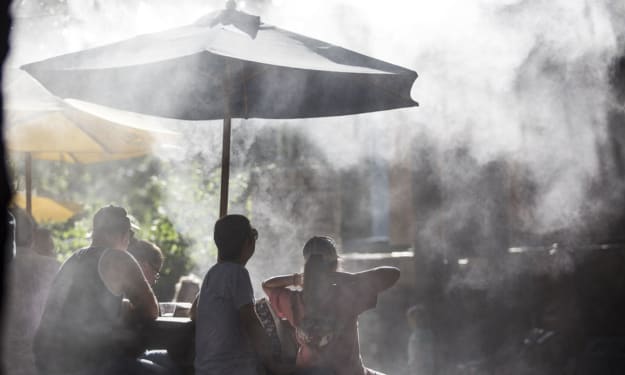
### Enduring the Heat: Houston's Summer Struggle In the heart of Houston, the summer of 2024 arrived with a vengeance. The city was already bracing for the season's notorious heat, but nothing could have prepared its residents for the intensity that came with it this year. The relentless sun seemed to hang perpetually at its zenith, casting an oppressive heat that gripped the city in a relentless embrace.
By Drake molb2 years ago in Earth
Pollution Due to Urbanization
Urbanization, which is the rapid expansion of urban areas, has resulted in profound changes in our environment. While it offers opportunities for economic advancement and improved living standards, it also poses significant challenges, particularly in terms of pollution and resource management.
By Alyce Willow2 years ago in Earth
On The Wild Lawn
Introduction I am not a gardener, not even slightly proficient, so all I say in this piece needs to be taken with a large pinch of salt. I have lived here for close to twenty-five years and in that time, after the initial relaying, the lawn has never been re-laid. You can see what it was like after I mowed it on July 7th 2024 in the main image.
By Mike Singleton 💜 Mikeydred 2 years ago in Earth
The Riskiest Jobs In the World
Workers around the globe put their lives at risk to produce the goods we use every day. In Indonesia, laborers mine sulfur from an active volcano, exposing themselves to toxic gases. The daily wages, the personal protective clothes, other basic supplies, and drinking water have been an issue in these places for decades now. As such small and deep cut injuries have occurred and when it does it's never reported. The government and NGO with other civil organizations in each respective country know about it yet turn a blind eye to processes and events from time to time. The government is pretending not to see, and the mine owners are also pretending the mine is not theirs, and if even it is theirs, the mines aren't working for them. The poor miners work hard as the rich countries and individuals reap the blessings and benefits of their sweat.
By Isaac Ekow Anyidoho2 years ago in Earth
Heat Advisory
TODAY It is roaring roasting, roaring heat. 93 to 95°F in an area of the country that is considered very hot when it’s 85 outside. Our plants and bodies are not used to this. I know it’s hotter elsewhere but this heat is unusual here although it is becoming the norm!
By Andrea Corwin 2 years ago in Earth