Advocacy
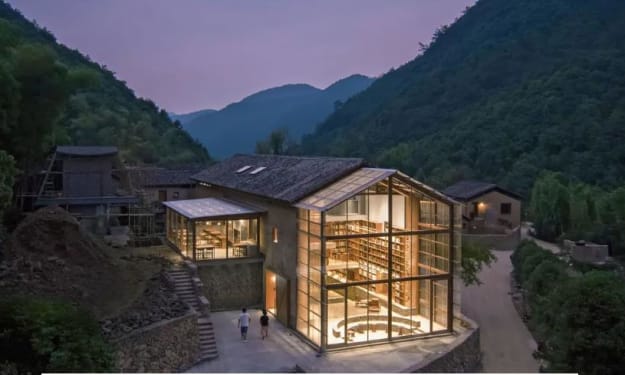
Designed to Last: 10 of the world's most ingenious buildings
"The shifts in how we live and work have radically altered our cities," writes Ruth Lang in new Gestalten book Building for Change: The Architecture of Creative Reuse. "The spatial demands of working patterns have been utterly transformed over the past 50 years." Many of our buildings could last for 50, or even 100, years; yet "fashion and changing patterns of use often curtail this lifespan, which sometime barely stretches to a decade". Instead of abandoning these structures, however, designers are developing innovative solutions "which find value in the buildings that have been left behind… in place of our obsession with newness".
By Gu Wei Di Qi3 years ago in Earth
October Garden Jobs To Keep You Busy!
With the weather having noticeably cooled, and the clocks going back at the end of the month we're moving quickly towards winter! Frosts become a possibility depending where you are but it's still a lovely season for spending time in your garden!
By Jordan Catto3 years ago in Earth
How did the pocket wolf go extinct?
The pocket wolf used to be the largest marsupial carnivore that survived into modern times. Although its skeletal structure and physical appearance are similar to those of the gray wolf, and the pattern of its back fur resembles that of the tiger, taxonomically speaking, the pocket wolf belongs to neither the canine nor the feline family, and it is different from any of the extant carnivores in the northern hemisphere. Kangaroo wolves belong to the marsupial order, Kangarooidae. As we know, the wombat (koala), wombat, and various kangaroos living in Oceania are its "close relatives". The reason why the appearance of wolves and tigers is similar to that of wolves and tigers is that they reproduce in a similar natural environment, resulting in the phenomenon of "convergent evolution".
By Richard Shurwood3 years ago in Earth
Living through Ian. Top Story - October 2022.
My home is on Fort Myers Beach but I rode out the storm at my daughter's place in north Fort Myers. I am devastated, grateful beyond words, distraught, happy, sickened, relieved and overwhelmed. We lost so much and we have so much left. Time stands still, and time rushes by. The rollercoaster of emotions rocks you into sleep and back out. We are out of homes and jobs, but we are ALIVE. Barring a couple of acquaintances, everyone has checked in safe and ALIVE. Hence, the happy part. Many cannot say the same. Thinking of those that were not as lucky is the crippling sadness part. So many lives forever changed. So many lost. Lifetimes of treasures and keepsakes gone forever. For tens of thousands of people, memories are all that remain. For thousands of people, anticipation of happy news and fear of bad news still dominates their every thought. There is a strange mixture of hope and rebirth constantly overshadowed by fear, grief and uncertainty. It makes me feel guilty to feel happy and grateful, knowing how many don't get to feel that way right now.
By Bonita L Peterson3 years ago in Earth
Arctic temperatures are rising so fast? How will humans be affected by those in the future?
The Arctic region is warming at a rate more than twice as fast as average. The average global temperature is rising 1.4 degrees Celsius in the last 100 years, but the Arctic has warmed at nearly five times that rate. We need to take immediate action to prevent severe weather and rising sea levels, which could affect coastal areas and low-lying landmasses such as Bangladesh.
By Flagler Danzig3 years ago in Earth
Italy's plan to save Venice from sinking
enice is a stunning oddity. It is a city built atop around 120 islands, crisscrossed by 177 canals, and is best explored – when on foot at least – via the use of its 391 bridges. It is a watery maze of a city, full of tiny footpaths and tucked away squares, hidden museums and secluded, centuries-old churches.
By Seamons Mahall3 years ago in Earth