
"Sunrise A Symbol of Beauty, Science, and Culture"
Exploring the Aesthetics, Significance, and Symbolism of the Sunrise in Human Experience

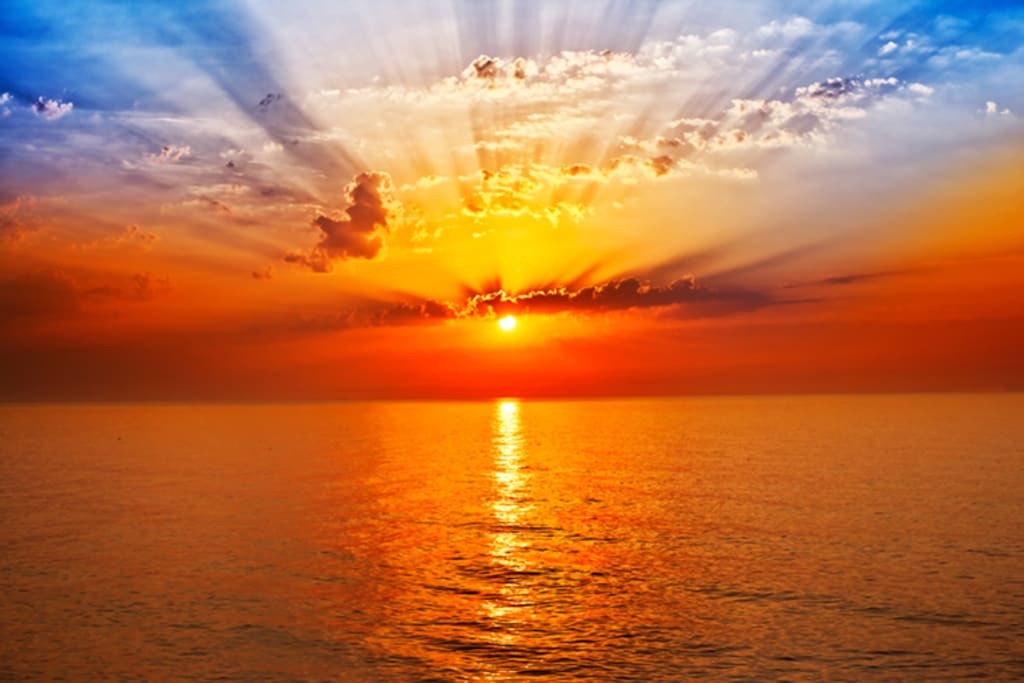
Sunrise is the moment when the sun first appears on the horizon in the morning, marking the beginning of a new day. The time of sunrise varies depending on the season, latitude, and longitude of the observer's location, as well as the local topography and weather conditions.
The sunrise is a beautiful and awe-inspiring natural phenomenon that has been the subject of poetry, art, and spiritual practices for thousands of years. It represents the promise of a new day and the renewal of hope and possibilities. Many people find it calming and grounding to watch the sunrise and to start their day with a sense of wonder and gratitude for the beauty of the world around us.
In addition to its aesthetic and symbolic value, the sunrise also has important practical implications for life on Earth. The sun is the primary source of light and warmth for our planet, and its daily cycle of rising and setting regulates many aspects of our environment, such as temperature, climate, and the behavior of plants and animals. The sunrise also plays a role in human health and well-being, as exposure to natural light is important for regulating our circadian rhythms and promoting a healthy sleep-wake cycle.
The timing of the sunrise and sunset varies depending on the time of year and the location of the observer. At the equator, the sun rises and sets at roughly the same time every day, while at higher latitudes, the length of daylight can vary dramatically between summer and winter. In some regions, such as the polar regions, the sun may not rise at all for part of the year, while in others, such as the tropics, the sunrise and sunset may be obscured by clouds or other weather conditions.
Despite its cultural and scientific significance, the sunrise is often taken for granted in our modern, fast-paced society. Many of us are accustomed to waking up before the sun rises, or working indoors all day without ever seeing the light of day. However, taking the time to appreciate the beauty and significance of the sunrise can help us connect with the natural world and cultivate a greater sense of wonder, joy, and gratitude in our lives.
The sunrise is also an important symbol in many cultures and religions. In ancient Egypt, the sun god Ra was believed to rise from the underworld each morning and travel across the sky in a boat, representing the cycle of birth, death, and rebirth. In Hinduism, the sunrise is associated with the god Brahma, who is believed to create the world anew each day. In Christianity, the sunrise is often associated with the Resurrection of Jesus Christ, as the Gospels describe how the women who visited his tomb at dawn on the third day saw the sun rise as a symbol of his triumph over death.
The beauty and significance of the sunrise have also inspired countless works of art, literature, and music. Artists such as J.M.W. Turner, Claude Monet, and Vincent van Gogh have captured the rich colors and atmospheric effects of the sunrise in their paintings, while poets such as Emily Dickinson, Langston Hughes, and William Wordsworth have used the sunrise as a symbol of hope, renewal, and spiritual awakening in their writing. Composers such as Ludwig van Beethoven, Igor Stravinsky, and Claude Debussy have also been inspired by the beauty of the sunrise, using it as a theme or motif in their music.
Overall, the sunrise is a complex and multifaceted phenomenon that has inspired human culture and imagination for millennia. Whether we appreciate it for its aesthetic beauty, its scientific significance, or its spiritual and cultural meanings, the sunrise remains a powerful symbol of hope, renewal, and the cyclical nature of life.
About the Creator
Global Polyethylene Market Size and Forecast 2025–2033: Growth Driven by Packaging, Infrastructure, and Sustainable Innovation
Introduction Polyethylene, the world’s most widely produced plastic polymer, continues to play a crucial role in modern industrial and consumer economies. From food packaging and construction materials to agricultural films and automotive components, polyethylene is deeply embedded in everyday life. Its lightweight nature, durability, versatility, and cost-effectiveness make it indispensable across numerous industries.
By Marthan Sira day ago in Earth
Why Greenland Matters for a Warming World
Greenland, the world’s largest island, often conjures images of endless ice, rugged landscapes, and isolation. Yet in the era of climate change, Greenland has become far more than a frozen wilderness—it is a critical player in understanding global warming, rising seas, and even geopolitical strategy. As scientists, policymakers, and nations increasingly focus on Greenland, the island offers a stark lesson: what happens in the Arctic does not stay in the Arctic. Its ice sheets, ecosystems, and resources affect the planet in ways that are profound, urgent, and far-reaching. Greenland’s Ice Sheets and Global Sea Levels The most visible and alarming aspect of Greenland’s global impact is its melting ice sheets. Greenland contains roughly 8% of the world’s fresh water, stored in massive ice sheets covering more than 1.7 million square kilometers. Over the past two decades, studies have shown that Greenland is losing ice at accelerating rates. According to NASA and the European Space Agency, Greenland’s ice loss contributes about 0.7 millimeters per year to global sea level rise. That might seem small, but every millimeter counts. If Greenland’s ice sheets were to melt completely—a scenario scientists consider extreme but possible under prolonged warming—sea levels could rise by over 20 feet, inundating coastal cities and displacing hundreds of millions of people worldwide. The ice melt also affects ocean currents and weather patterns. Freshwater from Greenland flows into the North Atlantic, disrupting the Atlantic Meridional Overturning Circulation (AMOC), a crucial component of the global climate system. Changes here could mean more severe storms in Europe, shifting monsoons in Asia, and hotter summers in North America. A Rapidly Warming Arctic Greenland is warming twice as fast as the global average. Scientists attribute this to Arctic amplification, where ice and snow loss reduce the Earth’s reflectivity (albedo), causing more heat absorption. The resulting feedback loop accelerates melting and affects local wildlife, indigenous communities, and global climate systems. Polar bears, Arctic foxes, seals, and migratory birds all face habitat changes, while Greenlandic communities see challenges in fishing, hunting, and infrastructure. Roads, airstrips, and settlements are increasingly vulnerable to permafrost thaw, floods, and landslides. For climate scientists, Greenland acts as a bellwether of global change, providing early warnings of trends that could eventually affect all continents. Greenland’s Geopolitical Significance Beyond climate, Greenland is gaining strategic attention from nations worldwide. Its location between North America and Europe, combined with its ice-free ports emerging in summer, makes it a hub for shipping, scientific research, and military strategy. The United States has historically maintained a military presence at Thule Air Base and monitors Greenland’s importance in Arctic defense. China has expressed interest in Arctic shipping lanes and mining opportunities, signaling potential economic and strategic competition. Denmark and Greenlandic authorities are navigating autonomy, resource development, and environmental protection, balancing sovereignty with global pressures. The melting ice, paradoxically, opens opportunities for mineral exploration, shipping, and scientific access, even as it poses serious environmental risks. Greenland has large deposits of rare earth minerals, uranium, and iron, all increasingly valuable in the global transition to clean energy and technology. Local Communities and Indigenous Voices The Greenlandic Inuit and other local communities are directly experiencing climate change. Traditional hunting and fishing practices are affected by shifting ice patterns, changing animal migration, and unpredictable weather. While global attention often focuses on ice melt and global impact, local voices emphasize sustainability, cultural preservation, and adaptive strategies. Many communities are exploring renewable energy, eco-tourism, and sustainable fisheries as ways to protect livelihoods while mitigating climate risks. Greenland and Global Climate Policy Greenland’s situation highlights the urgency of global action on climate change. The island illustrates several key lessons: Mitigation Matters: Reducing greenhouse gas emissions is critical to slowing ice loss and protecting sea levels. Adaptation Is Essential: Coastal cities worldwide must prepare for rising waters and changing weather patterns driven by Arctic changes. Scientific Research Is Vital: Greenland serves as a natural laboratory for studying climate, ice dynamics, and ocean circulation. Understanding its trends allows for more accurate modeling and forecasting worldwide. International collaboration, including research partnerships and climate agreements, is essential to ensure that Greenland’s ice sheets do not become a catastrophic tipping point. The Global Ripple Effect It’s easy to think of Greenland as distant, but its fate touches everyone: Rising seas threaten cities from New York to Tokyo. Ocean currents shifting from ice melt influence global climate patterns. Economic implications arise from shipping routes, resource access, and disaster mitigation costs. Greenland is not just an Arctic concern—it’s a global responsibility. How countries respond to its changes will influence the world for decades to come. Conclusion: Why the World Should Watch Greenland Greenland matters because it is a microcosm of our planet’s challenges. Its melting ice sheets remind us that climate change is already here. Its mineral wealth and strategic position show that human interests will increasingly collide with environmental imperatives. Its communities illustrate the human cost of warming and the resilience needed to adapt. For a warming world, Greenland is both a warning and a guidepost. Protecting its environment, respecting its people, and monitoring its ice are not just Arctic issues—they are global imperatives. The world cannot afford to ignore Greenland. Its future is inextricably linked to the health of our planet and the security, prosperity, and safety of populations everywhere.
By Muhammad Hassan6 days ago in Earth


Comments
There are no comments for this story
Be the first to respond and start the conversation.