
Submerged Village Resurfaces in Greece as Lake Water Levels Continue to Decline
Extensive Cracked Soil Encircles the Remnants of the Submerged Village of Kallio

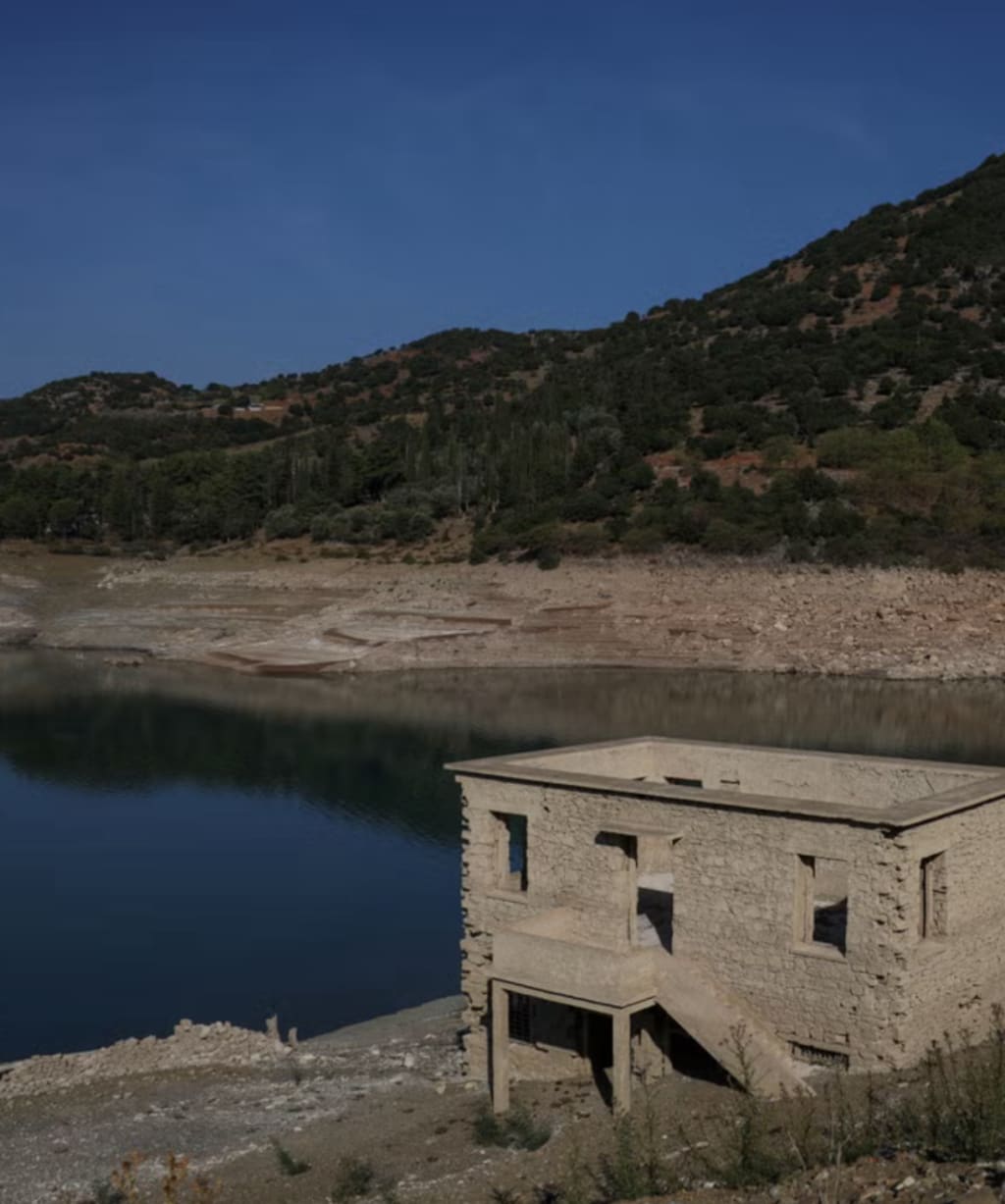
A village that had long been submerged has now reappeared.
From beneath the diminishing waters of Lake Mornos in central Greece, the muddied outlines of homes are becoming visible nearly 45 years after the village disappeared beneath the surface.
Unprecedented temperatures and extended drought conditions in Greece have revealed a submerged village in Athens' primary reservoir for the first time in 30 years.
The village of Kallio was inundated in the late 1970s when the Mornos dam was constructed 200 kilometers west of the capital, creating an artificial lake fed by the Mornos and Evinos rivers.
According to the state water operator EYDAP, lake levels have decreased by 30% in recent months, leading to the emergence of the ruins of a school and several houses.
“The level of Lake Mornos has fallen by 40 meters,” noted 60-year-old Yorgos Iosifidis, who was forced to leave his home as a young man, along with other villagers, when the area was flooded.
“You can see the remnants of my father-in-law's two-story house, and beside it, what's left of my cousins' home,” said Mr. Iosifidis, who now resides higher up the hill.
Drought conditions have intensified this year in a Mediterranean country that is already familiar with summer heat waves. After experiencing the mildest winter on record, Greece also recorded its hottest July, according to preliminary data from the national observatory, following similarly extreme temperatures in June.
This change follows a winter with very little snowfall, a summer characterized by intense heatwaves, and several months of drought that have affected much of Greece. The expansive man-made lake, which provides water for almost half of the Greek population, has now dropped to its lowest level in decades.
“Day by day, the water continues to recede,” stated Dimitris Giannopoulos, the mayor of the Dorida municipality, noting that such a phenomenon hadn’t occurred in 33 years.
Surrounding the ruins of the submerged village of Kallio, which was flooded in 1980 to create Lake Mornos to address the growing water demands of Athens, are extensive stretches of cracked soil. Amidst the remnants, bricks are scattered among mounds of seashells, further illustrating the village's forgotten past.
Greece's dry Mediterranean climate has rendered it especially vulnerable to the impacts of global warming, exacerbating summer wildfires, including those that reached the outskirts of Athens last month. According to scientists, the extreme weather conditions associated with climate change are contributing to the diminishing levels of the lake.
“It serves as a warning,” stated Efthymis Lekkas, a professor of disaster management at the University of Athens.
“We are uncertain about what lies ahead in the near future. If we experience a winter without rain, the situation will become increasingly challenging.”
Giannopoulos points to Mount Giona, which looms over the lake and was once capped with snow, but did not receive any last winter, the warmest on record for Greece. Along the lake's shrinking edge, the trees have developed a yellowish tint.
“They are suffering from a lack of water. This is unprecedented,” he remarked.
Wells in the region are running dry, and nearby villages that do not draw water from the lake experienced water shortages this summer, he noted. The local fire chief indicated that the increasing dryness of the forests raises the risk of wildfires.
According to satellite images released by Greece's National Observatory, the surface area of the lake has decreased from approximately 16.8 square kilometers in August 2022 to just 12.0 square kilometers this year.
The water reserves in the lake, along with those in the three other reservoirs that supply Attica—home to 5 million residents of Athens—have fallen to 700 million cubic meters in August, down from 1.2 billion cubic meters in 2022, according to the environment ministry.
In response, the state-run Athens water company EYDAP has begun to supplement the network with additional water sources.
Former residents of Kallio expressed surprise at the village’s reappearance but felt sorrow over its condition.
“I remember seeing it full and thinking of it as a beach. Now, all that’s visible is dryness,” remarked 90-year-old Konstantinos Gerodimos.
His 77-year-old wife, Maria, added, “If this keeps up, the entire village will come into view, all the way down to where the church and our home once stood.”
About the Creator
Trina Tuthill
Journlaist and radio presnter, podcast host - Passionate about social justice, feminism, family issues, culture, and music opinions and reviews.
Tips welcome
Keep reading
More stories from Trina Tuthill and writers in Earth and other communities.
Mortgage rates: Five ways to save money.
The Bank of England unexpectedly raised interest rates by more than 0.5 percentage points. As a result, both current mortgage customers and prospective home buyers pay higher rates for their mortgages. The reason behind this decision is to prevent inflation from negatively impacting the economy. By raising interest rates, borrowing becomes more costly, which ultimately reduces loan demand. Consequently, this decrease in demand helps to lower inflation by reducing interest rates.
By Trina Tuthill3 years ago in Education
Trump’s Message to Norway: A Controversial Diplomatic Signa
**Trump’s Message to Norway: A Controversial Diplomatic Signal** In January 2026, a written message sent by former U.S. President Donald Trump to Norway’s Prime Minister Jonas Gahr Støre sparked widespread political debate and media attention. The message quickly became a topic of discussion across the United States and Europe, not because it announced a formal policy change, but because of its tone and implications. It reflected Trump’s personal view of international recognition, his frustration over the Nobel Peace Prize, and his broader vision for American power and security in a changing world.
By America today about 5 hours ago in Earth
Pretty Privilege vs. Pretty Punishment
In today’s image-driven world, beauty is often described as a superpower. Attractive people are believed to get more opportunities, more attention, and more advantages in life. This phenomenon is commonly called pretty privilege. But there is another side of this story that is discussed far less often — pretty punishment.
By Aarif Lashariabout 11 hours ago in Earth




Comments
There are no comments for this story
Be the first to respond and start the conversation.