
"Storm Strikes Islamabad: Heavy Rain and Thunder Rattle the Capital"
"Authorities on alert as heavy rain disrupts life and sparks safety warnings."

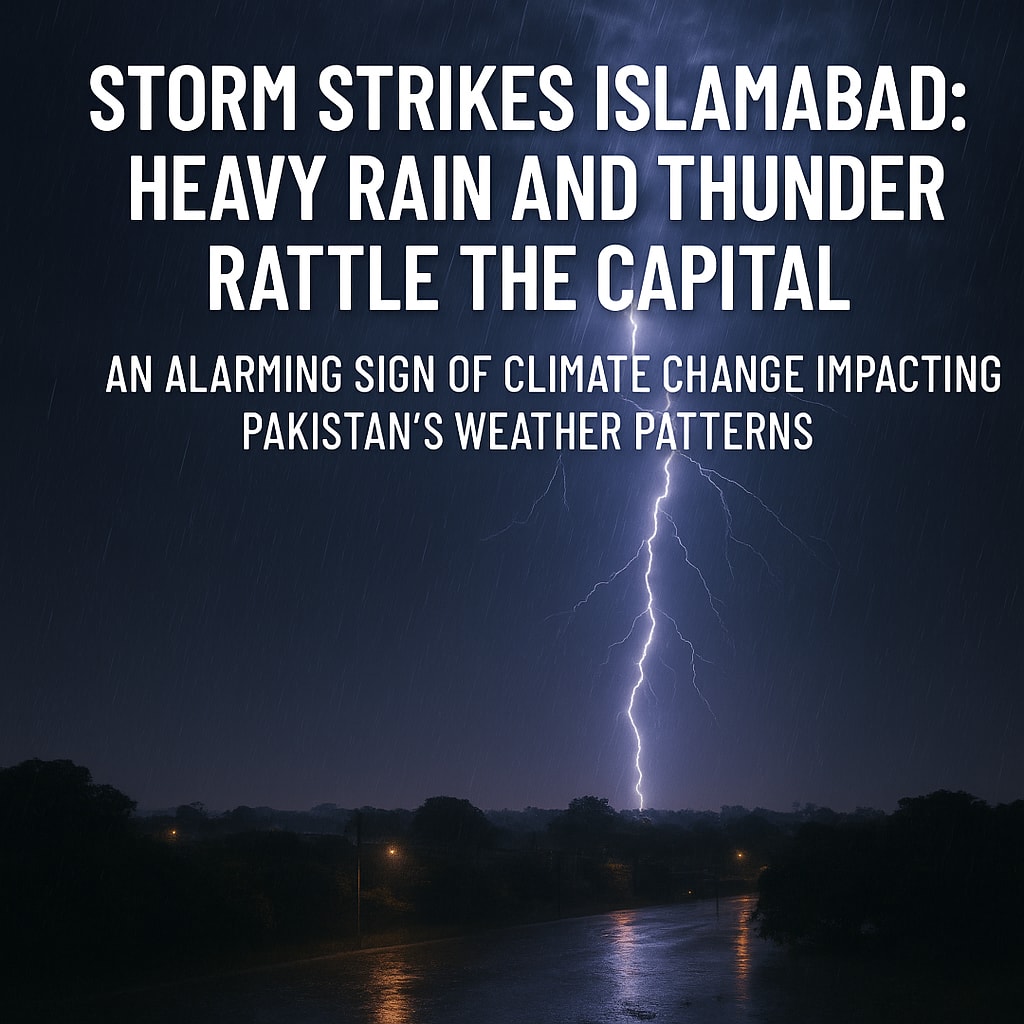
Storm Strikes Islamabad: Heavy Rain and Thunder Rattle the Capital
Power outages, traffic jams, and flooding reported across various sectors after the unexpected weather event.
Islamabad, April 17 — The federal capital was gripped by chaos and disruption on Wednesday night as a sudden and intense thunderstorm rolled across the city. Accompanied by torrential rain, strong winds, and frequent lightning strikes, the storm caught many citizens off guard, exposing gaps in urban preparedness and raising concerns about climate unpredictability in the region.
The storm began around 9:30 PM with distant rumbles that quickly escalated into deafening thunder and bright flashes of lightning illuminating the night sky. Within minutes, heavy rain began pouring down, lashing rooftops, flooding streets, and knocking down trees and power lines in several neighborhoods. Residents from sectors F-6, G-10, I-8, and parts of Bahria Town reported prolonged power outages, while major roads like Srinagar Highway and Islamabad Expressway experienced massive traffic slowdowns due to poor visibility and waterlogging.
A City Unprepared
Despite previous weather forecasts hinting at a possible light rain, the scale and intensity of the storm surprised both citizens and local authorities. Islamabad’s usually serene environment turned into a scene of distress as vehicles stalled in knee-deep water and emergency services scrambled to respond to calls from affected areas.
"I was driving home from Blue Area when the rain hit," said Saad Ali, a 32-year-old resident of G-11. "Within ten minutes, the roads were flooded. My car got stuck and I had to push it to the side. There was no traffic police, no help — just chaos."
Many parts of the city reported flooding in basements, especially in older buildings lacking proper drainage systems. Social media was flooded with images and videos showing water gushing through residential areas, fallen trees blocking roads, and lightning bolts lighting up the skyline.
Infrastructure Under Strain
The storm laid bare Islamabad’s vulnerabilities, particularly its outdated drainage systems and fragile electricity infrastructure. WAPDA officials stated that several grid stations tripped due to lightning and moisture, leading to blackouts in multiple sectors. Restoration efforts continued late into the night and resumed the following morning.
"The problem is not just the rain; it's our infrastructure that cannot cope with even short bursts of heavy weather," said urban planning expert Dr. Shahid Mehmood. "Islamabad is expanding rapidly, but our systems remain decades behind."
Authorities from the Capital Development Authority (CDA) acknowledged the damage and began clean-up operations early Thursday morning. However, many residents expressed frustration over the lack of timely response.
Climate Patterns Changing?
While rainstorms are not uncommon in Islamabad, the recent event signals an alarming trend — the growing frequency and intensity of extreme weather events in the region. Meteorologists have pointed to shifting climate patterns that are causing sudden and more violent weather shifts across Pakistan.
"This is part of a larger global pattern of climate change," said Met Office spokesperson Anam Tariq. "We’re seeing more intense storms, less predictability, and rainfall occurring in short, destructive bursts rather than over steady periods."
Environmental experts are calling for greater investment in resilient urban infrastructure, especially as the monsoon season approaches. Without adequate planning and community awareness, such storms could result in even more severe consequences.
Human Impact
Beyond infrastructure and inconvenience, the storm had a real human cost. Emergency services reported at least 11 injuries across the city, including two children who were hit by falling debris. Fortunately, no fatalities were reported as of Thursday morning, but several families were displaced due to flooding in low-lying areas.
In hospitals, a brief surge of patients suffering from minor injuries, panic attacks, and asthma-related complications was noted. The Pakistan Red Crescent Society dispatched volunteers to assist in relief efforts, distributing emergency kits in some of the worst-hit sectors.
"I haven’t seen lightning like that in years," said 60-year-old Naeem Abbasi, a resident of Rawal Town. "The windows were shaking. My grandchildren were terrified. We spent the whole night in the dark."
A Call for Preparedness
The storm has once again highlighted the need for robust disaster preparedness, both at the individual and institutional levels. Experts recommend that residents keep emergency kits at home, avoid unnecessary travel during storm alerts, and ensure drainage around their homes is kept clear.
City authorities, meanwhile, have pledged to take stronger action. CDA officials stated they will be working with NDMA (National Disaster Management Authority) and the Met Office to improve real-time alerts and create a more responsive urban emergency plan.
While Islamabad recovers from the shock of this storm, the broader questions remain. Are we doing enough to prepare our cities for a changing climate? How can public infrastructure be strengthened to protect citizens from such unpredictable events?
Until those questions are answered with action, the residents of Islamabad — like those in many rapidly growing urban centers — will remain vulnerable to the next sudden strike of nature.
"Storm Strikes Islamabad: Heavy Rain and Thunder Rattle the Capital"
An Alarming Sign of Climate Change Impacting Pakistan’s Weather Patterns
About the Creator
Faiq Ahmad
Am experienced Field Security Officer working on the Engro Enfrashare Telecom Project.
I actively earn through various online platforms.This reflects my adaptability, tech skills, and commitment to continuous learning and financial growth.
Keep reading
More stories from Faiq Ahmad and writers in Earth and other communities.
Climate Change and Conflict: The War-Driven Environmental Crisis in the Middle East
The Middle East, a region already grappling with severe climatic challenges, is witnessing an escalating environmental crisis, exacerbated by ongoing conflicts. While climate change is a global issue, its effects are particularly pronounced in the Middle East, where wars have not only deepened political instability but have also intensified the environmental degradation of the land. The destructive consequences of armed conflict, when coupled with climate change, create a vicious cycle of instability that affects millions of people, particularly in countries like Syria, Iraq, Yemen, and others.
By Faiq Ahmad9 months ago in Earth
M&S Reveals 500 ‘Wish List’ Locations for New Stores as It Unveils Huge Expansion Plans – Could One Be Coming to a Town Near YOU
Marks & Spencer (M&S), the iconic British retailer, has unveiled plans to expand its store footprint dramatically, revealing a “wish list” of 500 potential locations for new shops across the United Kingdom. The move marks one of the most ambitious growth strategies in the retailer’s recent history and signals a renewed confidence in high-street shopping after years of online retail disruption. For shoppers, this announcement raises an exciting question: Could an M&S be coming to a town near you? The expansion strategy suggests that the company is targeting a mix of urban, suburban, and regional locations to strengthen its presence and reach new customer bases. The Expansion Plan M&S has long been a staple of British retail, but the company has faced challenges in recent years, including declining footfall in traditional high streets and competition from online retailers. The 500-location wish list represents a proactive attempt to revitalize the brand and reconnect with communities. Key points of the expansion strategy include: Targeting underserved areas where M&S currently has limited presence Optimizing store size to match local demand, ranging from smaller convenience stores to larger food and clothing outlets Focusing on food-led stores, reflecting the success of M&S’s food offerings and growing demand for premium groceries The company hopes that expanding its footprint will not only boost sales but also strengthen brand visibility across the country. Why M&S Is Betting on Expansion Now Several factors have prompted M&S to take this bold step: Resilience of Brick-and-Mortar Retail: Despite the rise of online shopping, physical stores remain crucial for customer experience, especially for groceries, fresh produce, and clothing. Strong Performance in Food: M&S’s food division has consistently outperformed expectations, driving growth even when other segments lag. Expanding stores with a focus on food could capture new markets and increase footfall. Brand Heritage and Loyalty: M&S remains one of the most trusted and recognized brands in the UK. Expanding stores leverages this brand equity to reach more customers. Post-Pandemic Opportunities: Many towns and cities are seeing renewed interest in high-street shopping, creating openings for retailers willing to invest in local communities. By combining these factors, M&S aims to position itself as both a modern and traditional retailer, appealing to diverse consumer preferences. Potential Locations and Community Impact The company has not yet disclosed the exact towns or neighborhoods for the new stores, but analysts suggest that smaller towns and suburban areas may feature prominently. This is because many larger cities already have significant M&S coverage, whereas smaller communities are underserved. For local economies, an M&S opening can provide several benefits: Job creation in retail, logistics, and support services Boost to high streets, attracting shoppers to nearby businesses Increased choice for consumers, particularly for premium groceries and ready-to-eat meals Communities can expect M&S to adapt store formats to local needs, ensuring that smaller locations focus on food, while larger outlets may include clothing, homeware, and other categories. Customer Excitement and Expectations The announcement has generated excitement among shoppers, especially those in towns that currently lack an M&S presence. Social media platforms are buzzing with speculation, with users asking whether a store might be opening within commuting distance. M&S has acknowledged the curiosity, encouraging communities to stay tuned as it finalizes lease agreements and site preparations. The company has also indicated that it will engage with local councils and residents to ensure smooth openings. Challenges Ahead While the expansion plan is ambitious, it comes with challenges: High Rental Costs: Securing prime high-street locations can be expensive, particularly in urban areas. Competition: Other retailers, including Tesco, Sainsbury’s, and Aldi, are also vying for market share, making it essential for M&S to differentiate through product quality and customer experience. Supply Chain Management: Scaling up to 500 locations requires robust logistics and inventory management to maintain the freshness and quality of food offerings. Changing Shopping Habits: While footfall is recovering, many customers continue to shop online. M&S must balance physical expansion with digital integration to remain competitive. Successfully navigating these challenges will be crucial to turning the expansion wish list into long-term profitable stores. Strategic Focus on Food and Convenience A key feature of the expansion strategy is M&S’s food-first approach. The retailer has seen strong growth in its ready-to-eat meals, premium groceries, and convenience items, which cater to busy lifestyles and local tastes. Smaller-format stores, often located in suburban or high-street settings, are expected to focus primarily on food and everyday essentials, while larger flagship locations will continue offering clothing, homeware, and specialty products. This strategic differentiation allows M&S to tailor offerings to local demographics while maximizing sales potential. Expert Opinions Retail analysts have praised the move as timely and strategic, highlighting M&S’s strong brand recognition and food expertise as competitive advantages. Claire Thompson, a retail analyst, commented: “Expanding into underserved towns and suburbs allows M&S to capture new customers while reinforcing its position in the premium segment. The challenge will be execution — ensuring that new stores meet local needs without overextending resources.” Analysts also note that the expansion could signal renewed confidence in the high street, especially as other major retailers continue to consolidate or reduce their physical presence. Looking Ahead M&S’s ambitious expansion plan demonstrates a clear commitment to strengthening its presence in the UK. With 500 potential locations on the wish list, the company is poised to redefine accessibility and convenience for customers while supporting local economies. Shoppers can expect phased rollouts over the coming years, with announcements on specific towns likely to follow. For communities eager for a local M&S, the future may hold new jobs, new food options, and a boost to the high street experience. Final Thoughts Marks & Spencer’s announcement of 500 potential new store locations represents one of the boldest expansion plans in recent British retail history. By focusing on food-led stores, targeting underserved towns, and leveraging its iconic brand, M&S is betting on a reinvigorated high-street presence. For shoppers across the UK, this could mean a new M&S store just around the corner, bringing convenience, quality, and the familiar British retail experience to towns that have long awaited it. As the company executes its vision, communities and consumers alike will be watching closely — eager to see which locations make the wish list a reality.
By Muhammad Hassan3 days ago in Earth
Microbiota, microbiome or microflora: how to speak correctly and why it is for health.
You've probably heard the phrase, "We are what we eat." But modern science says more precisely: we are also those who live in us. Until 2016, it was believed that there are many times more bacteria in our body than our own cells. The latest calculations by mathematicians show that we divide the body with our microorganisms by about 50/50: about 30 trillion of our cells versus 38 trillion bacterial ones.
By Yaroslav Gorohov3 days ago in Earth



Comments (2)
very nice bro👍
Nice, thanks for sharing