
Stages of Human Civilization
The Different stages of human civilization
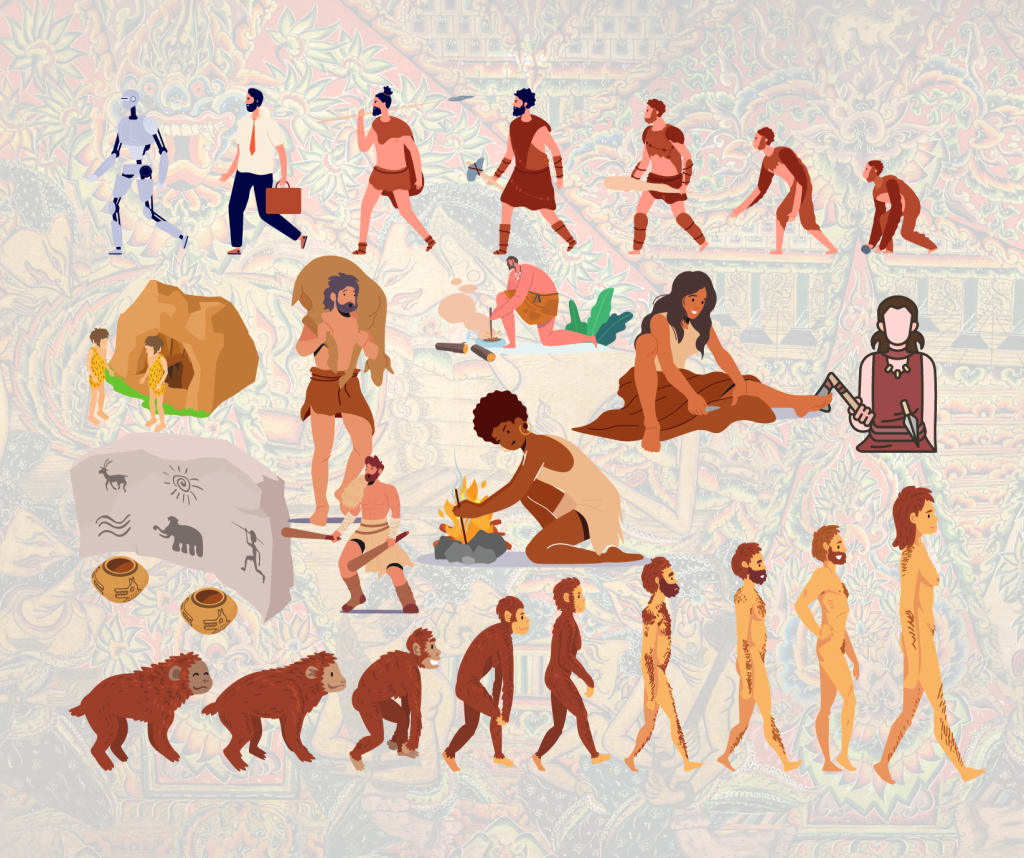
1.THE FIRST STAGE: The first stage of human civilization is generally considered to be the Neolithic Revolution, which occurred around 10,000 BCE. During this time, humans transitioned from a nomadic, hunter-gatherer lifestyle to a settled, agricultural way of life. This change allowed for the development of permanent settlements, the domestication of plants and animals, and the rise of complex social structures.
- This change led to the development of permanent settlements, the domestication of plants and animals, and the rise of complex social structures. Agriculture was a major development during this time, allowing for a steady and reliable food supply, which led to a population explosion and the formation of larger settlements. New technologies and advancements such as pottery, textile production, and metalworking also emerged, allowing for the storage and transport of food, the creation of clothing and shelter, and the production of tools and weapons. This stage laid the foundation for more advanced societies that would follow.
- One of the most significant developments of the Neolithic Revolution was the invention of agriculture, which allowed for the steady and reliable production of food. This, in turn, led to a population explosion and the formation of larger settlements.
- As human populations grew and settled in one place, new technologies and advancements were developed, such as pottery, textile production, and metalworking. These developments allowed for the storage and transport of food, the creation of clothing and shelter, and the production of tools and weapons.
- As a result of these developments, early human societies became more complex, with social hierarchies and specialized roles emerging. Religion and art also played a significant role in these early civilizations, as evidenced by the existence of elaborate burial sites and ceremonial structures.
- The first stage of human civilization laid the foundation for the development of more advanced societies that would follow, with the emergence of written language, city-states, and empires.
- This was a brief overview of the first stage of human civilization, the Neolithic Revolution. The book can be further divided into various chapters, covering different aspects and regions of the world where the Neolithic revolution took place.
2.THE SECOND STAGE: The second stage of human civilization is typically considered to be the Bronze Age, which began around 3300 BCE and lasted until 1200 BCE. During this time, the use of bronze, an alloy of copper and tin, became widespread, leading to significant advancements in metallurgy and metalworking.
- The Bronze Age saw the rise of complex societies and early civilizations, such as those in Mesopotamia, Egypt, the Indus Valley, and China. These civilizations were characterized by their large cities, monumental architecture, and sophisticated systems of government and religion.
- Writing systems also developed during this time, allowing for the recording of history, laws, and religious texts. Trade networks expanded, leading to the exchange of goods, ideas, and technologies across vast distances.
- The Bronze Age also saw the emergence of powerful empires, such as the Akkadian Empire, the Egyptian Empire, and the Shang and Zhou dynasties in China. These empires were often characterized by their military conquests, complex bureaucracies, and monumental architecture.
- The Bronze Age was a time of significant advancements and cultural development, laying the foundation for the subsequent Iron Age and the rise of classical civilizations.
- This is a brief overview of the second stage of human civilization, the Bronze Age. The book can be further divided into different chapters, covering the different regions, their civilizations and their cultural, technological and political advancements.
3.THE THIRD STAGE: The third stage of human civilization is typically considered to be the Iron Age, which began around 1200 BCE and lasted until the beginning of the Common Era (CE). During this time, the use of iron became widespread, leading to significant advancements in metallurgy and metalworking.
- Iron Age civilizations were characterized by their large cities, monumental architecture, and sophisticated systems of government and religion. This period saw the rise of powerful empires and kingdoms, such as the Persian Empire, the Greek city-states, the Roman Republic and Empire, and the Han dynasty in China. These empires were often characterized by their military conquests, complex bureaucracies, and monumental architecture.
- The Iron Age was a time of significant advancements in science, philosophy, literature, art and architecture, laying the foundation for the subsequent development of the modern world.
- Also, the invention of coinage, the development of sea-faring and the establishment of trade routes across the Mediterranean and beyond. Iron tools, weapons and armor allowed for more efficient agriculture and warfare, leading to increased productivity and territorial expansion.
- This is a brief overview of the third stage of human civilization, the Iron Age. The book can be further divided into different chapters, covering the different regions, their civilizations and their cultural, technological and political advancements.
4.THE FOURTH STAGE: The fourth stage of human civilization is generally considered to be the era of Classical Civilizations, it began around the end of the Iron Age and lasted until the fall of the Western Roman Empire in the 5th century CE. This period saw the rise of classical civilizations such as ancient Greece and Rome, which had a profound and lasting impact on Western culture.
- During this time, the Greeks and Romans made significant contributions in the fields of philosophy, science, literature, art, and architecture. The Greek city-states, particularly Athens, were centers of learning and culture, and the Greeks developed the first democratic government. The Roman Republic and later the Roman Empire, also developed complex systems of government, law, and engineering.
- This period also saw the spread of Christianity, which emerged as a major religion in the Roman Empire, and the decline of the traditional polytheistic religions.
- The fall of the Western Roman Empire marked the end of the classical period, but the legacy of classical civilization continued to influence Western culture in the centuries that followed.
- This is a brief overview of the fourth stage of human civilization, the era of Classical Civilizations. The book can be further divided into different chapters, covering the different regions and civilizations, their cultural, technological and political advancements and their impact on the present.
5.FIFTH STAGE: The fifth stage of human civilization is generally considered to be the Middle Ages, which began around the fall of the Western Roman Empire in the 5th century CE and lasted until the beginning of the Early Modern period in the 16th century.
- During this time, Europe underwent significant political, economic, and social changes. The collapse of the Roman Empire led to the rise of feudalism, a political and social system based on the ownership of land and the obligation of service to a lord. The Catholic Church played a dominant role in medieval Europe and exerted significant political and cultural influence.
- The Middle Ages also saw the emergence of powerful states and empires, such as the Islamic Caliphate, the Byzantine Empire, and the Holy Roman Empire. The Vikings, Magyars and Moors also made significant impacts in different parts of Europe.
- This period also saw the spread of Christianity throughout Europe, the growth of monasticism and the development of the university system. The Middle Ages also saw significant advancements in agriculture, architecture, and technology, such as the invention of the heavy plow, water mills and windmills.
- The end of the Middle Ages is marked by the beginning of the Early Modern period, which was characterized by the rise of nation-states, the growth of trade and commerce, the emergence of the scientific revolution and the beginning of the colonial period.
- This is a brief overview of the fifth stage of human civilization, the Middle Ages. The book can be further divided into different chapters, covering the different regions, civilizations, and their cultural, technological, and political advancements and their impact on the present.
6.THE SIXTH STAGE: The sixth stage of human civilization is generally considered to be the Early Modern Period, which began in the 16th century and lasted until the late 18th century. This period saw the rise of nation-states, the growth of trade and commerce, the emergence of the scientific revolution and the beginning of the colonial period.
- During this time, Europe underwent significant political, economic, and social changes. The formation of nation-states and the growth of trade and commerce led to increased prosperity and the rise of a new class of merchants and capitalists. The Scientific Revolution, which began in the 16th century, led to a profound transformation in the understanding of the natural world and laid the foundation for the development of modern science.
- This period also saw the Age of Exploration and the beginning of the colonial period, which had a profound impact on the Americas, Africa, and Asia. The colonial powers of Europe, such as Spain, Portugal, the Netherlands, France, and England, established colonies and trading posts around the world and brought new technologies, ideas, and religions to the colonized peoples.
- The end of the Early Modern period is marked by the French Revolution and the beginning of the Industrial Revolution in the late 18th century.
- This is a brief overview of the sixth stage of human civilization, the Early Modern Period. The book can be further divided into different chapters, covering the different regions, civilizations, and their cultural, technological, and political advancements and their impact on the present.
7.THE SEVENTH STAGE: The seventh stage of human civilization is generally considered to be the Modern Period, which began in the late 18th century and continues to the present day. This period is characterized by the Industrial Revolution, the rise of capitalism and democracy, as well as significant advancements in science, technology, and medicine.
- The Industrial Revolution, which began in the late 18th century, brought about a profound transformation in the way goods were produced and led to increased productivity and economic growth. The development of new technologies, such as steam power and the spinning jenny, led to the mechanization of industry and the rise of mass production.
- The rise of capitalism and democracy led to the emergence of a new class of industrial capitalists and the growth of a consumer culture. The liberal political ideologies of the Enlightenment, such as individualism and political rights, became dominant.
- This period also saw significant advancements in science and technology, such as the discovery of electricity, the development of the internal combustion engine, and the invention of the telephone and the computer. Medical advancements, including the germ theory of disease, led to improvements in public health and the development of modern medicine.
- The late 19th and early 20th century also saw the rise of imperialism, colonialism, and nationalism movements leading to the First World War and the Second World War. The world has been shaped by these events and the aftermath of these wars, including the Cold War, decolonization, and the rise of the United States and the Soviet Union as superpowers.
- The Modern period is still ongoing and it's continuously changing, it's marked by events like the Cold War, the fall of Soviet Union, and the development of the internet and globalization.
- This is a brief overview of the seventh stage of human civilization, the Modern Period. The book can be further divided into different chapters, covering the different regions, civilizations, and their cultural, technological, and political advancements and their impact on the present.
8.THE EIGHTH STAGE: The concept of an "eighth stage of human civilization" is not a commonly recognized or agreed-upon idea within the academic community. The classification of human civilization into specific stages is a topic of ongoing debate, and different historians and scholars may use different criteria and periodization. However, if we were to speculate on the next stage of human civilization it could be seen as a stage characterized by advancements in technology, specifically in the field of Artificial Intelligence and its impact on society. It could also be marked by the increasing urgency of addressing global challenges such as climate change, and a shift towards more sustainable and equitable economic and political systems.
- This theoretical eighth stage of human civilization would be marked by the increasing integration of advanced technology into every aspect of daily life and the economy. Autonomous vehicles, smart cities, and the Internet of Things would become more prevalent, leading to changes in transportation, urban planning, and energy systems. Additionally, the development and widespread use of artificial intelligence would bring about new opportunities and challenges in areas such as healthcare, education, and employment.
- This stage would also be defined by the need for global cooperation to address the pressing issues of climate change and environmental degradation, as well as the need for economic and political systems that promote equity and sustainability. The increasing interconnectedness of the world would require new approaches to international relations and diplomacy.
- This is a speculative overview of an eighth stage of human civilization, it's important to note that this is not a widely accepted concept and it's based on current trends and future possibilities. The book can be further divided into different chapters, covering the different regions, civilizations, and their cultural, technological, and political advancements and their impact on the present.
9.THE FINAL STAGE: As with the concept of an "eighth stage of human civilization," the idea of a "ninth stage" is not a commonly recognized or agreed-upon concept within the academic community. The classification of human civilization into specific stages is a topic of ongoing debate, and different historians and scholars may use different criteria and periodization. However, as with the previous answer, if we were to speculate on the next stage of human civilization it could be seen as a stage characterized by the increasing integration and development of technology, with a focus on, for example, space exploration, biotechnology, and genetic engineering, and their impact on society.
- This theoretical ninth stage of human civilization would be defined by the increasing exploration and colonization of space, as well as the development of new technologies to sustain human life in space environments. Advancements in biotechnology and genetic engineering would lead to new opportunities and challenges in areas such as medicine, agriculture, and environmental conservation.
- This stage would also be defined by the need for global cooperation to address the pressing issues of climate change, environmental degradation and the depletion of natural resources. The increasing interconnectedness of the world would require new approaches to international relations and diplomacy, and a shift towards more sustainable and equitable economic and political systems.
- This is a speculative overview of a ninth stage of human civilization, it's important to note that this is not a widely accepted concept and it's based on current trends and future possibilities. The book can be further divided into different chapters, covering the different regions, civilizations, and their cultural, technological, and political advancements and their impact on the present.
About the Creator
Workers Recover 15,000 Crabs After Lorry Crashes Into Field
An extraordinary scene unfolded when a lorry carrying an estimated 15,000 live crabs crashed into a field, spilling its cargo across farmland and prompting a large-scale recovery effort. The unusual accident quickly drew attention from local residents, emergency services, and animal welfare groups, as workers scrambled to rescue as many crabs as possible before they succumbed to exposure.
By Aarif Lashari5 days ago in Earth




Comments
There are no comments for this story
Be the first to respond and start the conversation.