
Spinning Toward Life: The Hidden Role of Earth's Rotation
Why We Have Oxygen

We often take Earth’s rotation for granted — the sun rises, the sun sets, and the days pass. But what if the speed at which Earth spins was actually a key reason life exists at all? New research suggests that Earth’s slowing rotation, billions of years ago, may have helped fill our atmosphere with oxygen — a change that allowed complex life, including humans, to evolve.
Without that gradual slowdown, the story of life on Earth might have looked very different.
A Faster Earth
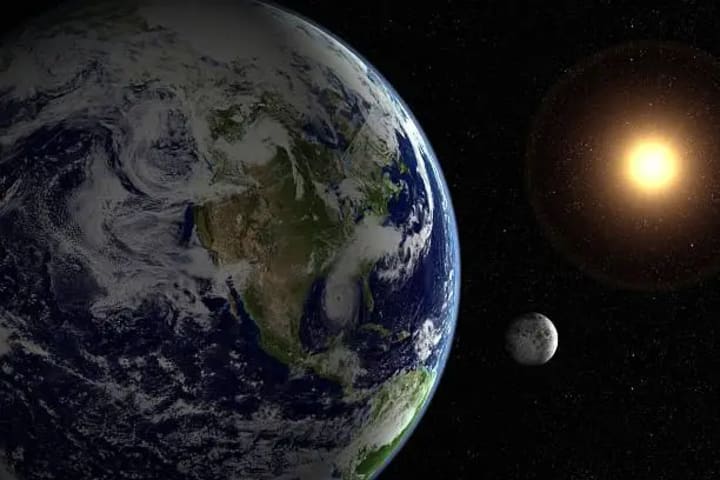
When Earth first formed about 4.5 billion years ago, it spun much faster than it does today. A single day could have lasted just 6 to 8 hours. Over time, gravitational forces, especially from the Moon, caused the planet to slow down. Today, one full rotation takes about 24 hours — and Earth's day continues to lengthen by about 1.7 milliseconds every century.
At first glance, that small change might not seem important. However, it had a significant impact on the environment, particularly on the formation of oxygen, the gas that powers the majority of living things today. The Great Oxidation Event
Around 2.4 billion years ago, a major transformation called the Great Oxidation Event (GOE) occurred. Before this time, Earth's atmosphere contained almost no oxygen. After that, oxygen started to build up, paving the way for more advanced organisms to develop. Scientists have long wondered: why did oxygen suddenly appear in large amounts?
The answer may lie in Earth's lengthening days. Days became longer as the planet's rotation slowed, giving photosynthetic microbes, primarily cyanobacteria, more time to perform photosynthesis each day. These tiny organisms use sunlight to produce energy and release oxygen as a byproduct.
There was more time for photosynthesis and, as a result, more oxygen production during longer daylight hours. This oxygen began to accumulate in the atmosphere slowly but surely. Why Longer Days Matter
Microbes were also able to produce more oxygen when the days were longer. They also helped balance Earth's natural systems. Other chemical reactions may consume oxygen at night, when photosynthesis ceases. If nights were too long compared to days, the oxygen created during the day would have been quickly used up.
Photosynthesis, on the other hand, outpaced nighttime oxygen loss as the Earth's rotation slowed and days got longer. This allowed oxygen to gradually accumulate, eventually crossing a critical threshold that changed Earth's atmosphere permanently.
Life as we know it might never have been possible without that balance. Lessons Beyond Earth
This discovery has major implications for the search for life beyond our planet. Until now, scientists mainly looked for exoplanets within a "habitable zone," where temperatures could allow for liquid water. However, Earth's history demonstrates that a planet's rotation rate and day length may also be crucial for supporting life. It's possible that photosynthesis-producing processes won't have enough time to really have an effect on a planet that is spinning too quickly. In the search for alien life, day length might be another critical clue.
Earth’s Spin Today
Today, Earth's spin continues to slow, though the effects are so tiny that we don't notice them. In millions of years, days will be even longer. While this ongoing change doesn’t affect modern life, it reminds us that even something as subtle as the length of a day can have a huge impact on a planet’s destiny.
The next time you watch a sunset or glance at the clock, remember: the simple act of Earth turning slower and slower helped create the air you breathe — and made yourexistence possible.
About the Creator
Keep reading
More stories from Chistopher and writers in Earth and other communities.
The Science of Music's Power to Move Us
Music has a special way of affecting our emotions. It can make us happy, nostalgic, relaxed, or even make us cry. But why does music have such a strong impact on us? Scientists have spent years studying this question, and their research shows that music affects both our brains and emotions in deep and fascinating ways.
By Chistopher9 months ago in Humans



Comments
There are no comments for this story
Be the first to respond and start the conversation.