
Spiders, Spiders Everywhere
All about the Colorado tarantula "mate-gration"

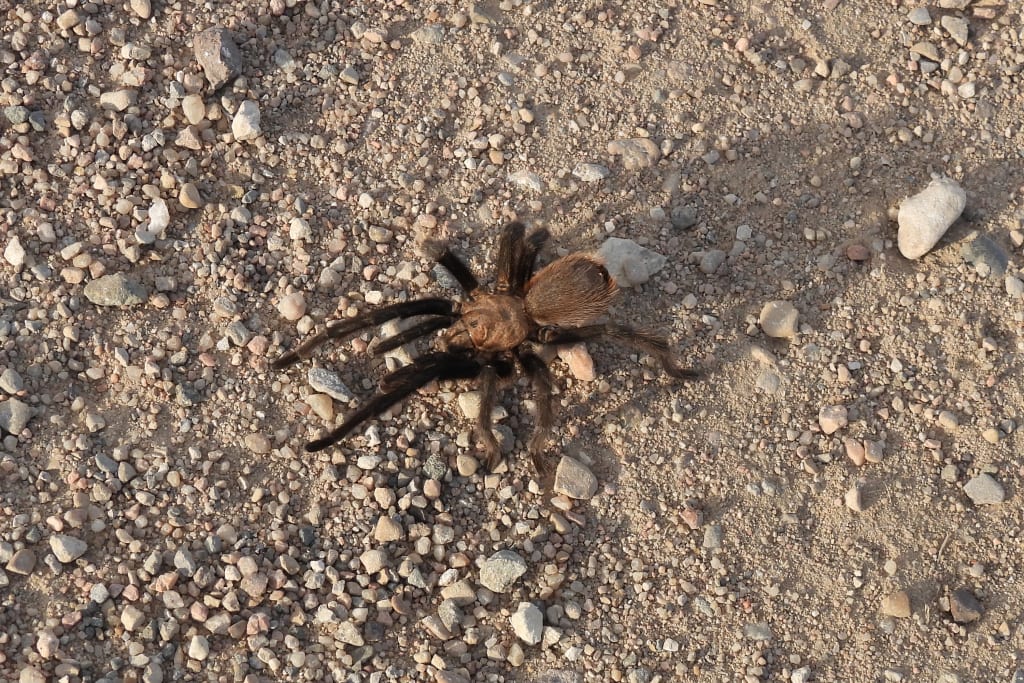
Every autumn, the plains of southeastern Colorado become the stage for one of nature's most curious spectacles: the Colorado tarantula trek. Often (incorrectly) referred to as a "migration," this annual event sees thousands of mature male tarantulas emerge from their burrows to embark on a solo journey to search for a mate. For observers, it is a fascinating glimpse into the lifecycle of one of North America's largest and most docile spiders, the Oklahoma brown tarantula and its close relatives, the Colorado brown tarantula.
This tarantula trek is not a true migration, which typically involves a mass movement to a different geographical area or climate, but rather a "mate-gration" undertaken solely by adult males.
The process is initiated by the changing seasons. As the air cools in late August and September, an instinctual urgency drives the mature males to action. These males have spent the better part of a decade in or near their burrows, growing and molting until they reach sexual maturity. Unlike the females, which can live for up to 25 years and rarely leave the safety of their underground homes, the male's life is tragically short after his final molt. Once mature, his primary, and final, life mission is to reproduce.
During the trek, these large, hairy arachnids can travel up to a mile, driven to find the burrows of receptive females. They locate their partners not by sight, which is poor, but primarily through pheromones that the females deposit in their silk near their burrow entrances. Upon finding a suitable burrow, the male will "drum" his appendages, called pedipalps, on the ground to announce his presence. If the female is willing, she will emerge, and a cautious mating ritual ensues.
Here is a video of a male approaching a female's burrow and drumming:
Credit: Peak DirtWorks on YouTube
The act of romance is fraught with danger for the male. Though the male uses specialized hooks on his legs to hold the female's fangs at bay, she remains a formidable predator, and post-coital cannibalism is a real risk. Those who survive the encounter will wander onward, searching for more mates, until the first hard freezes of late fall bring their life cycle to a close.
Where to Witness the Arachnid Assembly
The annual trek is concentrated in the vast, undisturbed prairies of southeastern Colorado, where the arid grassland provides the perfect habitat for the spiders' burrows. The epicenter of this phenomenon is the area around the town of La Junta and the expansive Comanche National Grassland.
Comanche National Grassland: This is the ideal viewing location. The Grassland's undeveloped terrain is the tarantulas' natural home.
Highway 109 South of La Junta: This stretch of road is frequently cited as the best place to see tarantulas crossing, particularly in the vicinity of the Grassland.
U.S. Highway 350: Driving this highway between La Junta and Timpas also offers excellent viewing opportunities.
Vogel Canyon: A popular recreation area within the Comanche National Grassland, Vogel Canyon offers trails and facilities, making it a good, accessible option for families or novice viewers. Tarantulas are often spotted making their way across the open areas near the trails and picnic shelters.
Timpas Picnic Area & Sierra Vista: These sites along Highway 350 also provide accessible public land for observation, away from the immediate dangers of the busier highways.
Timing is Everything
To maximize your chances, plan your visit for mid-September through early October. The tarantulas are most active in the late afternoon and early evening, with peak viewing occurring in the hour before sunset. They prefer warm, dry, and relatively still days, as cold temperatures and strong winds tend to keep them tucked away.
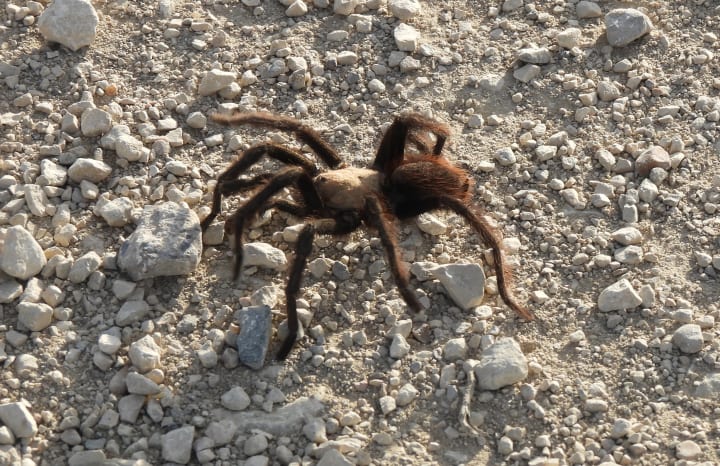
I went on September 27th, and I saw a total of 39 tarantulas, all on the roads to a few different sites known to be good for spotting them (Vogel Canyon picnic area and Withers Canyon). Be sure to plan in extra time and drive slowly. They are very visible on every surface I drove on, from dusty roads to thick gravel to asphalt.
The local community of La Junta often celebrates the event with a "Tarantula Fest," which can be a great resource for up-to-date sightings, educational information, along with food and entertainment.
Safety and Respect
Observing the tarantula trek is a privilege and requires a strong commitment to safety, respect for nature, and the creatures themselves.
These brown tarantulas are famously docile and non-aggressive. Despite their intimidating size, their venom is mild, often compared to a bee sting, and rarely poses a serious threat to humans, save for a severe allergic reaction. They will only bite if provoked or physically constrained.
- Do Not Handle the Wildlife: Never attempt to pick up or handle a tarantula. Handling them stresses the spider and risks injury to both you and the arachnid. Tarantulas defend themselves by flicking tiny, barbed, irritating hairs (urticating hairs) from their abdomen. These hairs can cause a painful rash, itching, and irritation, especially if they get into your eyes.
- Give Them Space: Observe from a distance. Let them continue their purposeful journey. A tarantula's survival is precarious enough without human interference.
The single greatest threat to the male tarantulas is the vehicle. Thousands are killed each year attempting to cross roads.
- Watch the Road: Drive slowly and remain alert, especially during the peak viewing hours around dusk. If you see a tarantula, pull completely and safely off the road to observe. Never stop in the middle of a highway.
- Do Not Harass or Redirect: Resist the urge to "help" a tarantula cross the road by picking it up or shooing it. Their path is driven by scent and instinct. Interference can cause stress and disorient them, ultimately hindering their chances of a successful mating.
- Leave No Trace: You are visiting a national grassland. Adhere to the principles of Leave No Trace. Take all trash with you, stay on designated trails and public land, and be mindful of private property boundaries.
The Colorado tarantula trek is a spectacular, if quiet, display of reproductive instinct in the natural world. By understanding the life-and-death stakes of the male's final walk and by committing to respectful and cautious observation, visitors can help ensure this unique and fascinating annual event remains a vibrant part of the Colorado plains ecosystem for years to come.
About the Creator
Erica J.
Chronic-pain sufferer just trying to be healthy and enjoy life while bird lurking and photographing nature. Purchase photo prints and read birding blogs: https://linktr.ee/erica80hd
Greenland: New Shipping Routes, Hidden Minerals – and a Frontline Between the US and Russia?
Once seen as a remote and largely isolated Arctic territory, Greenland is rapidly emerging as a focal point of global geopolitics. Climate change, melting ice, and technological advances are transforming the island into a strategic hub defined by new shipping routes, vast mineral resources, and growing rivalry between major powers, particularly the United States and Russia. As the Arctic opens up, Greenland’s geographic position and untapped potential are pushing it to the center of international attention, raising questions about security, sovereignty, and sustainable development. Melting Ice and the Opening of New Shipping Routes One of the most visible impacts of climate change in the Arctic is the reduction of sea ice, which is making previously inaccessible waters navigable for longer periods each year. New Arctic shipping routes, including passages near Greenland, promise shorter travel times between Europe, Asia, and North America. Compared to traditional routes like the Suez Canal, Arctic pathways can reduce shipping distances by thousands of kilometers, cutting fuel costs and emissions. For global trade, this could be transformative. Greenland’s coastal waters are increasingly important as potential transit corridors and support hubs for these routes. However, the expansion of Arctic shipping also raises concerns about environmental risks, maritime safety, and the lack of robust emergency infrastructure in the region. Hidden Mineral Wealth Beneath the Ice Beyond shipping, Greenland holds significant reserves of critical minerals, many of which are essential for modern technologies and the global energy transition. These include rare earth elements, lithium, graphite, uranium, and other strategic resources used in electric vehicles, wind turbines, batteries, and defense systems. As demand for these materials grows, Greenland is being viewed as a potential alternative to existing supply chains dominated by a small number of countries. This has increased interest from Western governments seeking to diversify mineral sourcing and reduce strategic dependencies. However, mining in Greenland is controversial. Local communities and policymakers must balance economic opportunities with environmental protection and cultural preservation. Greenland’s harsh climate and fragile ecosystems make resource extraction both technically challenging and politically sensitive. The United States’ Strategic Interest in Greenland The United States has long considered Greenland strategically vital, largely due to its location between North America and Europe. The US already maintains a military presence at Pituffik Space Base (formerly Thule Air Base), which plays a key role in missile warning systems and space surveillance. In recent years, Washington has renewed its focus on Greenland, emphasizing Arctic security, infrastructure investment, and cooperation with Denmark, which oversees Greenland’s foreign and defense policy. US interest is driven by several factors: protecting transatlantic security routes, countering rival powers in the Arctic, and ensuring access to critical minerals. Greenland is increasingly viewed as a frontline in maintaining Western influence in the High North. Russia’s Arctic Ambitions Russia, meanwhile, sees the Arctic as central to its economic and military strategy. It has invested heavily in Arctic military bases, icebreaker fleets, and energy projects, particularly along its northern coastline. Although Greenland is geographically distant from Russia’s main Arctic territories, Moscow closely monitors developments there. The island’s proximity to key Arctic sea lanes and North Atlantic routes makes it strategically relevant in any broader confrontation between Russia and NATO. As tensions between Russia and the West remain high, Greenland’s location places it near the intersection of competing security interests, increasing its geopolitical significance. Greenland Between Global Powers The growing attention from major powers puts Greenland in a delicate position. While the island seeks greater economic independence and development, it must navigate complex relationships with Denmark, the United States, and other international actors. Greenland’s government has emphasized the importance of maintaining control over its resources and ensuring that development benefits local populations. At the same time, geopolitical competition risks turning Greenland into a strategic chessboard rather than a partner in decision-making. This balancing act is becoming more difficult as Arctic competition intensifies. Environmental and Social Challenges Greenland is on the front lines of climate change. Melting ice sheets contribute to global sea-level rise, while local communities face changes to traditional livelihoods such as fishing and hunting. The expansion of shipping and mining could bring jobs and infrastructure, but it also threatens fragile ecosystems and raises concerns about pollution, habitat disruption, and long-term sustainability. Any future development in Greenland will require careful regulation, international cooperation, and meaningful engagement
By Aarif Lashari3 days ago in Earth
Top Australian Writers’ Festival Cancelled After Palestinian Author Barred
One of Australia’s most respected literary festivals has been cancelled following a fierce backlash over the decision to bar a Palestinian author from participating. What began as a programming dispute quickly escalated into a national debate about free speech, cultural inclusion, and political pressure in the arts. The cancellation has sent shockwaves through Australia’s literary community, raising urgent questions about whose voices are allowed on public platforms and at what cost.
By Aarif Lashari4 days ago in Earth




Comments (1)
That would be something to see from a safe and respectful distance of course!