

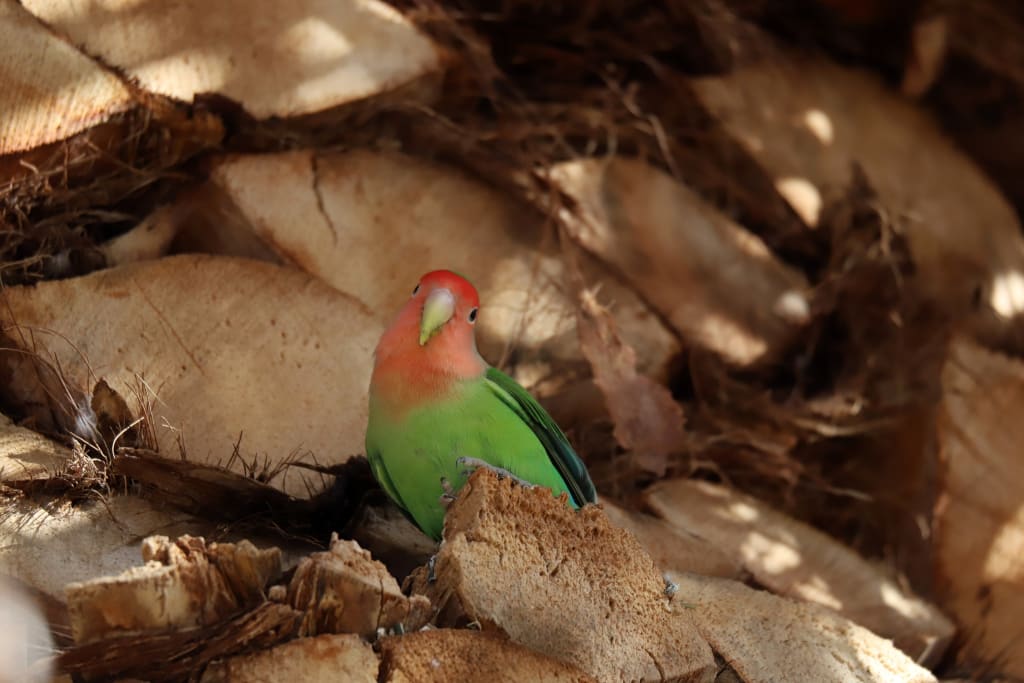
The first time I visited my mom in Arizona, I was delighted by the diversity of avian life that I could observe simply from her porch. Arizona has a wide range of ecosystems, from deserts to forests, providing homes for many bird species, and with year-long warm weather and an abundance of food and water sources, the state is not only a welcome stop for migratory birds, but a long-term home to some species.
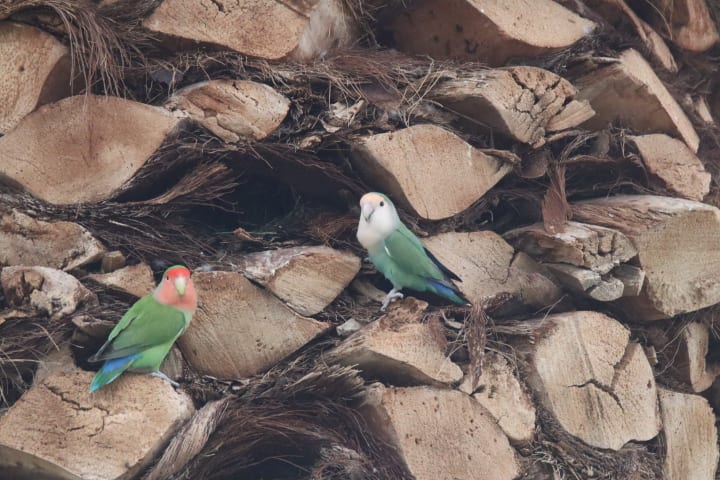
One the species I was surprised to see was the rosy-faced lovebird, especially after reading that the native habitat of the rosy-face lovebird is the Namibian savanna woodlands in Africa. I was sure I must've misidentified the birds I saw, until I dug a little deeper and found out that there has been a thriving feral population of rosy-faced lovebirds in the Phoenix, AZ area.
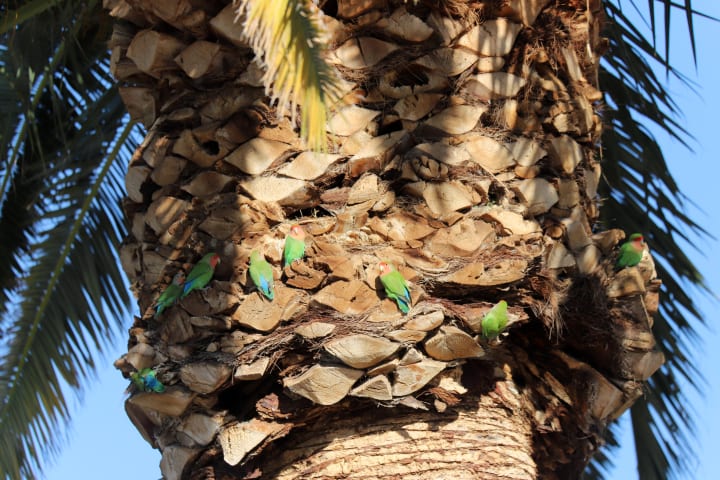
Feral colonies of birds form when domesticated or captive birds escape or are released into the wild and successfully establish breeding populations. This process happens in several stages:
- Escape or Release – Birds may escape from aviaries, farms, or pet owners, or be deliberately released. For example, feral pigeons (rock doves) originated from domesticated birds that were kept for food or as messengers.
- Survival in the Wild – The birds must be able to find food, shelter, and avoid predators in their new environment. Some species, like pigeons and parakeets, adapt well to urban environments where food is plentiful.
- Reproduction and Establishment – If the birds can successfully breed and raise offspring, a stable population can form. This is easier for species that are naturally social and breed quickly.
- Expansion and Adaptation – Over time, these birds may adapt to local conditions, sometimes developing distinct behaviors or physical traits. They may also outcompete native species or integrate into local ecosystems.
Perhaps the most well-known species to establish feral bird colonies is the rock pigeon. Originally native to Europe, North Africa, and parts of Asia, rock pigeons were among the first birds kept by humans for food, messengers, and religious significance. Ancient civilizations housed them in dovecotes and selectively bred them for their homing ability, making them an integral part of human history.
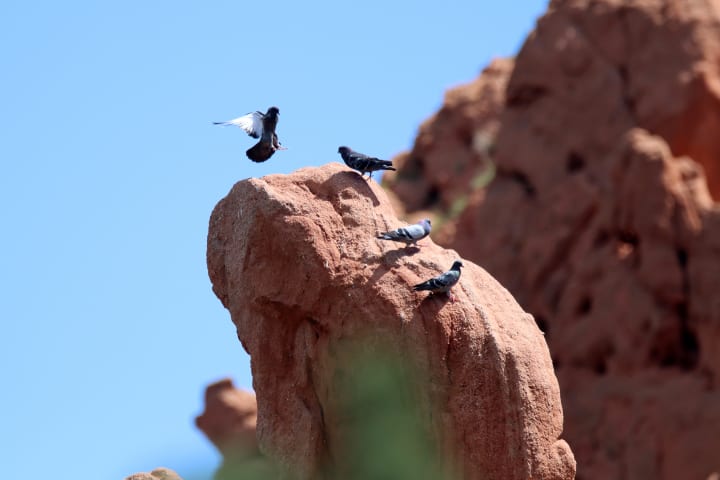
As trade and exploration expanded, people carried pigeons to new lands, introducing them to regions far beyond their original range. Many escaped or were deliberately released, gradually forming wild populations. Cities provided an ideal environment for these birds, as tall buildings resembled the cliffs they naturally nested on, and human activity ensured a steady supply of food. By the 19th and 20th centuries, rock pigeons had become a common sight in urban centers worldwide, from New York to London to Mumbai.
“I have been feeding pigeons, thousands of them, for years. But there was one pigeon, a beautiful bird, pure white with light gray tips on its wings... I would know that pigeon anywhere. No matter where I was that pigeon would find me... She understood me and I understood her. I loved that pigeon.”
—Nikola Tesla
Over time, these pigeons adapted to their new environments, thriving in cities, farms, and even semi-wild landscapes. Their ability to live alongside humans allowed them to flourish, leading to a wide range of feather colors and patterns influenced by their domestic ancestry. Despite being seen as pests in some places due to their droppings and competition with native birds, they remain a significant part of urban ecosystems. In some cultures, their intelligence and navigational skills are still admired, particularly in pigeon racing. Today, feral rock pigeons are one of the most successful bird species in the world, deeply intertwined with human life.
Some other species that have established feral colonies include:
- Monk parakeets in North America and Europe. Their presence outside their native range is largely due to the pet trade. Unlike many parrot species, monk parakeets are uniquely suited for survival in cooler climates. They build large, communal stick nests rather than relying on tree cavities, which helps them withstand cold winters in places like New York, Chicago, Madrid, and London.
- Feral chickens in places like Hawaii. These birds are descendants of domestic chickens that either escaped or were released. In Hawaii, many are believed to have descended from Polynesian chickens brought by early settlers, later interbreeding with European domestic breeds introduced by explorers and settlers.
- Feral peafowl in some suburban and rural areas. Peafowl, particularly Indian peafowl, have also formed feral colonies in suburban and rural areas, particularly in warm climates like California, Florida, and parts of Australia. Originally imported as ornamental birds for estates, gardens, and zoos, some escaped or were intentionally released, leading to wild populations.
Feral bird colonies are a fascinating testament to nature’s resilience and adaptability. These birds have carved out a niche in human-altered landscapes. Their presence raises important questions about conservation, invasive species, and the ever-evolving relationship between wildlife and urban environments.
While some view them as nuisances and others as beloved local characters, one thing is certain—feral birds are here to stay. Understanding their history, behaviors, and ecological impact allows us to appreciate their role in our shared spaces. As we continue to shape the world around us, these birds serve as a reminder that nature, even when it takes an unexpected path, will always find a way to adapt and thrive.
About the Creator
Erica J.
Chronic-pain sufferer just trying to be healthy and enjoy life while bird lurking and photographing nature. Purchase photo prints and read birding blogs: https://linktr.ee/erica80hd
Himalayas Bare and Rocky After Reduced Winter Snowfall, Scientists Warn
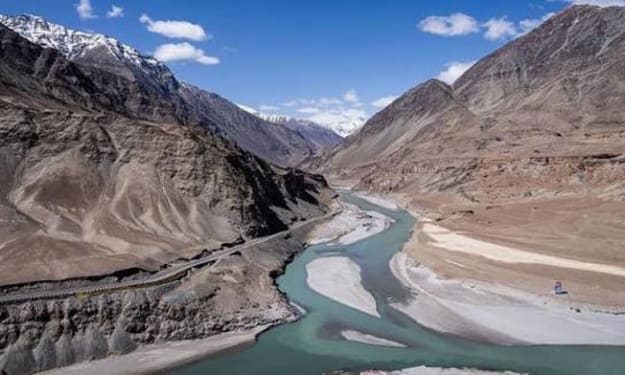
The Himalayas, often described as the world’s “Third Pole,” are facing a dramatic and worrying transformation. Scientists are warning that reduced winter snowfall is leaving vast stretches of the mountain range bare, rocky, and increasingly vulnerable to long-term environmental damage. Once known for their thick snow blankets and powerful glaciers, parts of the Himalayas are now showing exposed rock earlier than ever before—an alarming sign of climate stress in one of Earth’s most critical ecosystems. A Visible Change in the World’s Highest Mountains Winter snowfall plays a vital role in the Himalayan climate system. Snow acts as a protective layer, insulating glaciers and regulating the slow release of meltwater into rivers during warmer months. However, researchers monitoring satellite data and ground stations report that recent winters have brought significantly less snowfall across large areas of the range. As a result, snowlines are rising higher up the slopes, leaving lower and mid-altitude regions exposed. This has turned once-white mountain landscapes into expanses of dark rock, which absorb more heat from the sun, accelerating warming in a dangerous feedback loop. Why Reduced Snowfall Matters Snow is more than a scenic feature—it is essential to the health of Himalayan glaciers. When snowfall declines, glaciers lose their main source of replenishment. At the same time, exposed ice and rock melt faster under direct sunlight. Scientists warn that this imbalance is speeding up glacier retreat across the Himalayas. Many glaciers are now shrinking at rates not previously recorded, threatening the long-term stability of water systems that support nearly two billion people across South and Southeast Asia. Impact on Asia’s Major Rivers The Himalayas feed some of the world’s most important rivers, including the Indus, Ganges, Brahmaputra, Yangtze, and Mekong. These rivers depend on seasonal snow and ice melt to maintain consistent flow throughout the year. Reduced snowfall means less stored water for the dry season. In the short term, faster melting can cause floods and landslides. In the long term, however, shrinking glaciers could lead to water shortages, affecting agriculture, hydropower, and drinking supplies across multiple countries. A Growing Risk of Disasters Bare, rocky slopes are far more unstable than snow-covered ones. Snow helps bind loose material together, while exposed rock and soil increase the likelihood of landslides and avalanches. Scientists have already observed a rise in slope failures and glacial lake outburst floods in the region. As glaciers retreat, meltwater often accumulates in fragile lakes dammed by loose rock and ice. These lakes can burst suddenly, releasing destructive floods that threaten mountain communities and downstream infrastructure. Climate Change at the Core Researchers agree that climate change is the primary driver behind the declining snowfall. Rising global temperatures are altering weather patterns, causing more winter precipitation to fall as rain rather than snow. Even small temperature increases at high altitudes can drastically change how moisture behaves. Additionally, warming oceans and shifting atmospheric circulation are affecting the timing and intensity of winter storms that traditionally brought snow to the Himalayas. Effects on Local Communities and Wildlife Mountain communities that rely on predictable snowfall for farming, tourism, and water storage are already feeling the effects. Farmers report changes in planting cycles, while winter tourism has declined in some regions due to unreliable snow conditions. Wildlife is also under pressure. Species adapted to cold environments are losing habitat as snow cover shrinks. Plants that depend on snowmelt are struggling to survive in drier, warmer conditions, disrupting fragile alpine ecosystems. Scientists Call for Urgent Monitoring and Action Experts stress the importance of improved monitoring of snowfall, glacier health, and water flows across the Himalayan region. Better data can help governments plan for future water management challenges and disaster risks. At the same time, scientists emphasize that local adaptation alone is not enough. Reducing global greenhouse gas emissions remains critical to slowing temperature rise and preserving what remains of the Himalayan snow and ice. What the Future Holds If current trends continue, large parts of the Himalayas could see permanent changes within decades. Reduced snowfall and accelerating glacier loss may reshape landscapes, ecosystems, and human livelihoods on an unprecedented scale. The sight of bare, rocky Himalayan slopes is more than a visual change—it is a warning signal. The world’s highest mountains are responding rapidly to a warming planet, and the consequences will extend far beyond the peaks themselves.
By Fiaz Ahmed Brohi7 days ago in Earth
Nature’s Hidden Gems: Discovering the Rarest Flowers on Earth
Introduction: When Beauty Meets Rarity Nature is filled with wonders, but few are as captivating—and as elusive—as the rarest flowers on Earth. From enormous parasitic blooms to delicate orchids that appear only under precise conditions, these plants challenge our understanding of survival, evolution, and beauty.
By Ahmed aldeabella4 days ago in Earth


Comments (1)
I really appreciate how you delve into the idea of transformation, showing that while the concept of freedom may seem like an escape from the cage, it often leads to a new set of challenges that require resilience and adaptation. The transition from one state to another is never linear, and your writing beautifully captures that reality. The themes of community and the balance between independence and interdependence really stood out to me, making this piece even more impactful. It’s a reminder that no matter where we start, the journey toward growth and change is always multi-faceted and filled with lessons. Thank you for sharing such a thought-provoking narrative that made me reflect on both nature and society in a new light!