
South Asia on Edge
India and Pakistan’s current standoff is more than a regional issue—it’s a global concern.

India and Pakistan’s current standoff is more than a regional issue—it’s a global concern
In the churning cauldron of global geopolitics, few rivalries are as enduring—and as dangerously complex—as the one between India and Pakistan. From the smoldering valleys of Kashmir to the sterile corridors of international diplomacy, the tension between these two nuclear-armed neighbors continues to ripple outward, affecting regional stability and global peace.
In 2025, the stakes are higher than ever.
A History Etched in Partition
To understand the current climate, one must first grasp the weight of history. When British colonial rule ended in 1947, the subcontinent was carved into two nations based largely on religious identity—Hindu-majority India and Muslim-majority Pakistan. The Partition was not just a political act; it was a human tragedy, displacing over 15 million people and leaving more than a million dead in communal violence.
Since then, India and Pakistan have fought three major wars and endured countless skirmishes, especially over the disputed region of Jammu and Kashmir. Each decade has brought new flashpoints, new grievances, and new missed opportunities for peace.
2025: The Current Flashpoints
In the first quarter of 2025, tensions flared once again, ignited by a combination of military posturing, internal political pressure, and international provocations.
India’s recent push for border fortification projects in Kashmir, combined with heightened drone surveillance, has raised alarms in Islamabad. In response, Pakistan has escalated troop deployments near the Line of Control (LoC) and intensified rhetoric accusing New Delhi of aggression and human rights abuses in the valley.
Meanwhile, cyber-attacks—suspected to originate from both sides—have targeted infrastructure and media outlets, fueling a digital war that bleeds into the public consciousness. The narratives are polarizing, the rhetoric is heating up, and the common citizen is once again left fearing the consequences.
Why It’s No Longer Just a “Regional” Issue
In decades past, the India-Pakistan conflict was viewed primarily as a South Asian matter. But that narrative has shifted significantly.
Here’s why:
1. Both Nations Are Nuclear Powers
The specter of nuclear war looms in every escalation. While full-scale war remains unlikely due to mutually assured destruction (MAD), the mere presence of nuclear weapons turns every border skirmish into a potential global crisis. A miscalculation, an accidental strike, or even false intelligence could set off a chain reaction.
2. International Alliances Are in Flux
India’s strengthening ties with the United States and its allies—especially in the QUAD alliance (with Japan, Australia, and the US)—shift the balance of influence. Meanwhile, Pakistan’s growing reliance on China’s economic and military support, particularly under the China-Pakistan Economic Corridor (CPEC), draws Beijing into the equation.
This rivalry is no longer just about national pride—it’s a proxy stage for broader superpower competition.
3. The Role of Global Terror Networks
Terrorism remains a flashpoint. Militant groups operating from within Pakistan’s borders—some of which have historical links to intelligence agencies—have been implicated in attacks on Indian soil. These groups complicate diplomatic dialogue, as India demands accountability, while Pakistan pleads a lack of control.
The international community, especially the United Nations and FATF (Financial Action Task Force), is increasingly involved in pressuring both nations to contain such threats.
4. Diaspora Influence and Digital Amplification
With tens of millions of South Asians living abroad, particularly in the UK, US, Canada, and the Middle East, the conflict has emotional and political resonance globally. Social media amplifies every incident, often fueling misinformation and fanning nationalistic flames across borders.
This global digital community has become a double-edged sword—raising awareness but also creating echo chambers of outrage.
The Human Cost
While governments exchange blame and analysts draw maps, the people on the ground pay the price.
In Kashmir, daily life remains a cycle of lockdowns, curfews, and fear. Journalists face censorship, students face military checkpoints, and families live under the shadow of stray bullets and sudden raids.
In both countries, cross-border shelling has displaced entire villages. Schools are shut. Lives are disrupted. Dreams are deferred.
Beyond Kashmir, ordinary citizens on both sides are fatigued by the constant tension. They want trade, travel, and cultural exchange—not another generation born into animosity.
Opportunities Missed (and Made)
It would be unfair to claim that efforts toward peace haven’t been made. From the Agra Summit (2001) to the Lahore Declaration (1999), there have been moments of optimism. In recent years, track II diplomacy—unofficial dialogues between academics, journalists, and retired officials—has attempted to build bridges where official talks fail.
There have also been cultural overtures: cricket diplomacy, cross-border films, and people-to-people programs. Yet these are often short-lived, crushed by the next border incident or political shift.
As of 2025, formal dialogue remains on ice, with both sides accusing the other of bad faith.
The Domestic Angle: Nationalism on the Rise
One of the most significant roadblocks to peace is internal politics. In both India and Pakistan, nationalist sentiment is on the rise, often wielded as a tool by ruling parties to consolidate power.
In India, the current government has adopted a hardline stance on national security, particularly after the revocation of Jammu and Kashmir’s special status in 2019. Any move perceived as “soft” on Pakistan is quickly politicized.
In Pakistan, the military continues to wield immense influence. Civilian governments walk a tightrope, needing to appeal to domestic pride while avoiding economic collapse. With inflation surging and international loans looming, the temptation to distract the public with external threats is high.
The result? A vicious cycle. Each side’s rhetoric strengthens the other’s resolve, leaving diplomacy gasping for breath.
What Can Break the Cycle?
It’s not hopeless. But it is hard.
1. Third-Party Mediation
While both countries are often resistant to external mediation, neutral actors like Norway, Switzerland, or the UAE could help facilitate backchannel talks, especially on trade, water-sharing, or military de-escalation.
2. Crisis Communication Protocols
Creating robust, real-time communication channels between military commands could prevent accidental escalations—especially during border incidents.
3. Youth and Cultural Exchanges
Investing in long-term people-to-people programs—particularly among youth—can slowly chip away at entrenched hostility. It’s harder to demonize someone whose story you’ve heard.
4. Regional Economic Integration
The South Asian economy is full of untapped potential. If India and Pakistan could move toward limited economic cooperation, even in areas like climate change and public health, it might soften political positions over time.
5. Responsible Media and Tech Regulation
Encouraging cross-border journalism, curbing hate speech, and pressuring platforms like Facebook, YouTube, and Twitter to flag misinformation can stop social media from becoming a digital warzone.
The World Can’t Afford Indifference
It’s easy for the global community to view the India-Pakistan rivalry as a longstanding, local feud—something tragic, but contained.
But in an age where wars don’t stay on maps, ignoring South Asia’s simmering tension is a dangerous mistake.
What happens in Kashmir echoes in Kabul. What starts as a border standoff can crash stock markets in Tokyo. What gets said in one parliament becomes propaganda in another.
And behind every missile test, every drone strike, every diplomatic snub—there are people. Millions of them. Wanting peace. Deserving peace.
Final Thoughts: A Choice Between Fear and Future
The road ahead is uncertain, but the choice remains clear: escalate or engage. Fear or future.
India and Pakistan—two nations born from the same soil—still have the opportunity to shape a different legacy. One not defined by conflict, but by cooperation. One where the children of Lahore and Lucknow grow up curious about each other, not cautious. One where borders exist on maps, but not in hearts.
But that future can’t be wished into existence. It must be willed—with courage, compromise, and an unflinching commitment to peace.
Because the world is watching. And this time, silence is not an option.
About the Creator
Umar zeb
Hi, I'm U zeb, a passionate writer and lifelong learner with a love for exploring new topics and sharing knowledge. On Vocal Media, I write about [topics you're interested in, e.g., personal development, technology, etc
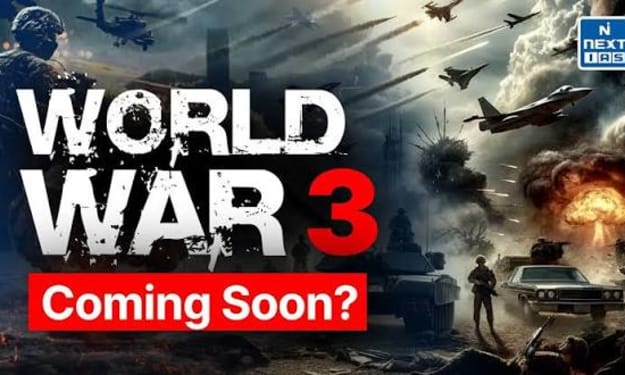
Could World War III Be Coming Soon?
The idea of World War III often appears in news discussions, political debates, and public imagination. After the devastating impact of World War I and World War II, humanity has become deeply aware of the catastrophic consequences of global war. Today, when international tensions rise, many people wonder whether the world could again face a conflict on such a massive scale. While no one can predict the future with certainty, understanding the current global situation can help us evaluate whether a third world war is truly likely.
By shaoor afridia day ago in Earth
REEEEEEEEE!
I'm on a low road right now. There are a literal million things to do and not one of them worth my time. I would rather sit in place and burn but the orbit takes me on its inevitable route 'round the center; and I a center in my own right, around which others orbit, and so on and so forth, ad infinitum, ad nauseum.
By C. Rommial Butler5 days ago in Poets



Comments
There are no comments for this story
Be the first to respond and start the conversation.