
Seven Colors of the Rainbow
The Science, Symbolism, and Splendor Behind Nature’s Most Colorful Wonder
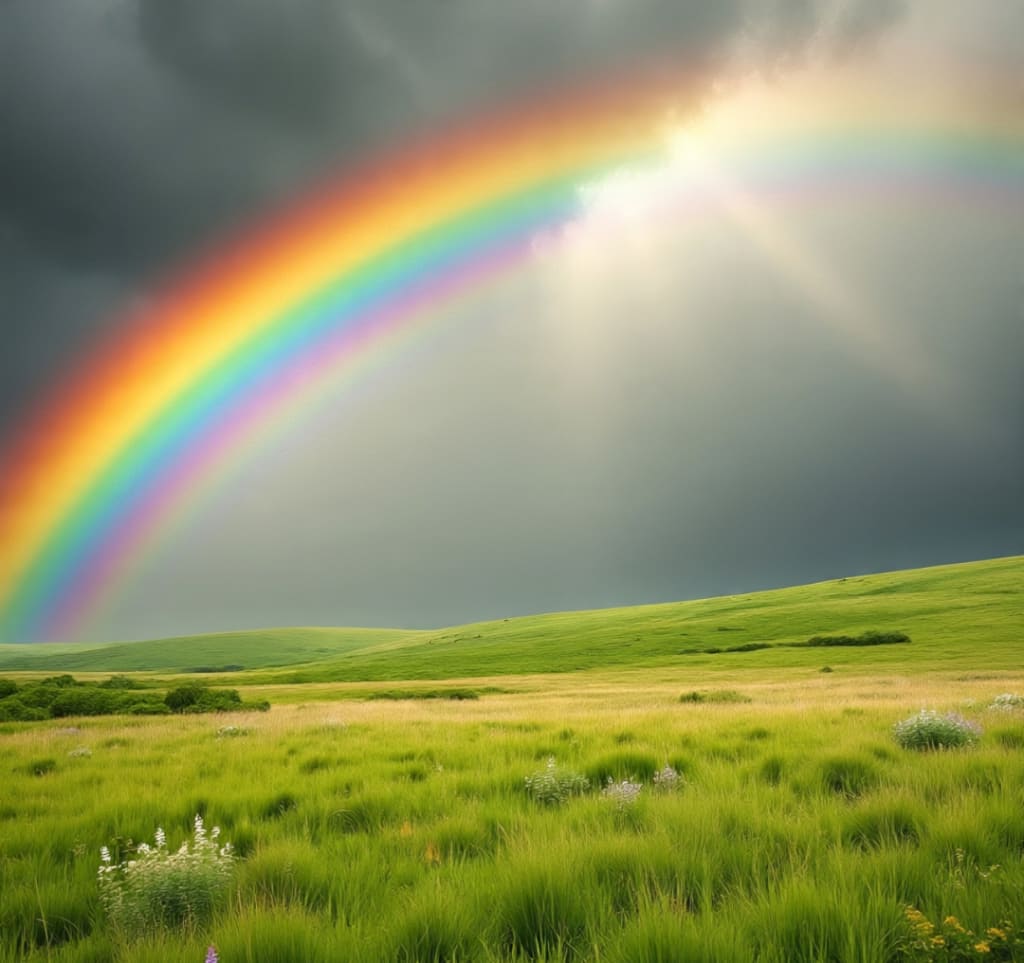
The world of colors is one of nature’s most beautiful gifts, and among all its wonders, few sights inspire awe quite like the rainbow. Appearing as a luminous arc painted across the sky, the rainbow captures the hearts of dreamers, scientists, and poets alike. Its seven radiant hues — red, orange, yellow, green, blue, indigo, and violet — are more than just a stunning spectacle; they represent science, symbolism, and the timeless beauty of the natural world.
The Science Behind the Spectrum
Rainbows are not magic, though they certainly look like it. They are, in fact, the result of light, water, and a touch of perfect timing. When sunlight passes through raindrops in the atmosphere, the drops act as tiny prisms. The light bends (refracts), bounces (reflects), and spreads (disperses) into its different color components. Each color bends at a slightly different angle — red at about 42 degrees and violet at about 40 — creating the curved, multi-colored arc we see from the ground.
This process, first explained scientifically by Sir Isaac Newton, reveals the hidden spectrum of sunlight. What we perceive as “white light” is actually a blend of many colors, waiting to be released through nature’s prism — the raindrop.
The Seven Colors and Their Meanings
Every color of the rainbow carries its own charm and symbolism:
Red stands for energy, strength, and passion — the first and boldest hue that catches our eye.
Orange radiates creativity and enthusiasm, blending the warmth of red with the cheerfulness of yellow.
Yellow glows with happiness and optimism, symbolizing the brilliance of sunlight itself.
Green represents balance, nature, and growth — a color of life and renewal.
Blue brings calm, peace, and trust, like the sky and the sea.
Indigo embodies wisdom and intuition, a deep, thoughtful color that connects the mind and spirit.
Violet shines with imagination and spirituality, closing the rainbow with a sense of mystery and beauty.
Together, these seven colors reflect the harmony of nature and the diversity of life.
A Symbol Across Cultures
Throughout history, the rainbow has carried deep meaning across different cultures. In Greek mythology, it was believed to be a path connecting the Earth to the heavens, created by Iris, the messenger goddess. In the Bible, it is a symbol of peace and promise — the sign of God’s covenant after the great flood.
For many Indigenous cultures, rainbows represent harmony between people and nature. In modern times, the rainbow has also become a symbol of hope, unity, and diversity — a reminder that beauty often appears after the storm.
Rainbows in Art and Imagination
Beyond science and symbolism, rainbows have inspired countless works of art, poetry, and music. From the famous song “Somewhere Over the Rainbow” to children’s drawings that fill classrooms with color, the image of the rainbow always brings joy and positivity. It reminds us that light can return even after the darkest of clouds.
Artists use the seven colors to represent emotions and ideas, while scientists continue to explore the nature of light and color in even greater depth. Yet, despite all our knowledge, the sight of a rainbow still feels magical — a moment where science meets wonder.
A Lesson from the Rainbow
Perhaps the greatest lesson the rainbow teaches us is that beauty often comes from contrast. Without rain, there can be no rainbow. The blending of sunlight and storm mirrors life itself — full of challenges and bright moments that coexist to create something extraordinary.
So, the next time a rainbow arches across the sky, take a moment to pause and look up. Behind its seven dazzling colors lies the story of light, nature, and hope — a story as old as time and as fresh as the rain that made it.
About the Creator
Keep reading
More stories from Muhammad Saad and writers in Earth and other communities.
Towards an Unknown Destination
The morning sun rose gently over the distant hills, casting golden rays on the narrow dirt path that wound its way through the valley. The air was crisp and alive with the scent of wet earth and blooming wildflowers. Arman stood at the edge of the road, a small backpack on his shoulder and determination in his eyes. He didn’t know where the road would lead — only that it led somewhere. And for the first time in years, that was enough. For too long, Arman had lived a life of predictable patterns — same job, same town, same thoughts replaying in his head like a song stuck on repeat. One evening, as he sat by his window watching the rain fall, he felt a strange emptiness creep in. His life was safe but stagnant, full but unfulfilled. The next morning, without overthinking, he packed a few clothes, a journal, and his old camera, and left home — walking towards an unknown destination. The first few days were difficult. The road was long and uneven, and the silence often too loud. He missed familiar voices, warm meals, and the comfort of his bed. Yet every step carried a strange peace — as if with each mile, he was shedding the weight of everything that once held him back. On the third day, he reached a small village nestled between green hills. The villagers greeted him with smiles and offered him water and bread. He sat with an old farmer who was fixing a broken fence. “Where are you going, son?” the farmer asked. Arman smiled faintly and said, “I don’t know yet.” The farmer laughed, “Sometimes not knowing is the best way to find out.” That night, Arman stayed in the village. He helped the children gather firewood and listened to stories around the bonfire. He realized how content these people were with their simple lives — no rush, no noise, just gratitude. It made him question everything he had once chased. As the days turned into weeks, Arman’s journey took him through forests, rivers, and small towns. He began to notice things he had once ignored — the way sunlight danced on the water, how the wind carried whispers through the trees, how silence could be more healing than words. Every stranger he met taught him something new. A potter showed him patience, a traveler spoke of courage, a monk shared wisdom about letting go. In one quiet mountain village, Arman met a young boy named Rafi who dreamed of becoming a teacher but had no books or school nearby. Arman spent a few days with him, teaching him letters and numbers using sticks and stones. When he finally left, Rafi hugged him tightly and said, “One day, I’ll build a school here, and I’ll remember you.” Arman walked away smiling — for the first time, he felt that his journey had meaning beyond himself. But the path was not always easy. There were moments of doubt and loneliness, especially when the road stretched endlessly through barren plains. One stormy night, drenched and exhausted, Arman took shelter under a tree. The darkness around him mirrored the uncertainty in his heart. He questioned why he had left home, what he was truly looking for. Yet, as thunder echoed across the sky, he realized something profound — maybe the journey wasn’t about reaching a place at all, but about becoming a different person along the way. Months later, Arman reached the edge of a vast sea. The setting sun painted the sky in hues of orange and purple. He sat by the shore, listening to the rhythm of the waves. His reflection shimmered in the water — he looked the same, yet felt entirely new. The road behind him had changed him in ways he couldn’t put into words. He had learned that destinations don’t always exist on maps — sometimes, they exist within us. The unknown he had once feared had become his greatest teacher. As stars began to appear one by one, Arman took out his journal and wrote, “I set out to find a place, but I found myself instead.” He smiled, stood up, and looked once more at the endless horizon. The journey wasn’t over — it was simply beginning again, in a new direction. With calm confidence, he took a deep breath, tightened his backpack, and began walking once more — towards another unknown destination.
By Muhammad Saad 4 months ago in Earth
Amid European Energy Fears, Coal Creeps Back Into Favour
Europe’s energy landscape is shifting as fears over supply security and rising costs drive some countries back toward coal, a fossil fuel many had hoped to phase out entirely. The resurgence comes amid heightened tensions over energy imports, particularly natural gas, as the war in Ukraine and geopolitical friction with Russia have exposed vulnerabilities in the continent’s energy systems. Germany, long seen as a leader in renewable energy adoption, recently announced plans to keep several coal-fired power plants online longer than initially scheduled. Officials cited winter energy demands and the need to maintain a reliable baseload while natural gas supplies remain constrained. Similar considerations are emerging in Poland, the Czech Republic, and other nations that rely heavily on imported energy. “The energy crisis has forced governments to make difficult choices,” said Dr. Klaus Weber, an energy policy analyst at European Energy Institute. “While the climate goals remain important, ensuring citizens have access to electricity and heat this winter has become a more immediate priority.” The return to coal is not simply a response to price spikes. Energy security has become a pressing concern after European reliance on Russian gas pipelines was disrupted, prompting countries to diversify sources and store reserves. Coal, abundant in Europe and globally traded at competitive prices, provides a short-term buffer against shortages. At the same time, rising electricity costs have placed enormous pressure on households and industries. According to recent statistics from the International Energy Agency, European electricity prices surged by nearly 40% in the past year, prompting governments to subsidize energy bills and rethink fuel strategies. Coal-fired generation, though more polluting, offers predictable output and can be ramped up quickly to stabilize grids. Renewable energy advocates have expressed concern that this shift could undermine Europe’s climate leadership. Coal emits roughly twice the CO₂ per unit of energy compared to natural gas, posing challenges to achieving net-zero targets. Critics warn that extending coal use—even temporarily—risks locking in infrastructure that is inconsistent with long-term decarbonization goals. “Every megawatt-hour produced from coal is a step backward for Europe’s climate ambitions,” said Maria López, senior campaigner at Greenpeace Europe. “Governments need to pair any temporary measures with accelerated renewable deployment to avoid backsliding on emissions reductions.” Some nations are attempting to balance these pressures by deploying cleaner coal technologies. Advanced coal plants with carbon capture and storage (CCS) can reduce emissions by capturing a significant portion of CO₂ before it enters the atmosphere. Germany and the Netherlands are investing in pilot projects to integrate CCS into existing power plants, though critics note that large-scale implementation remains costly and complex. Analysts suggest that Europe’s return to coal is likely to be temporary. Once gas supplies stabilize and renewable infrastructure expands, reliance on coal is expected to decline. Yet the episode has highlighted the fragility of energy systems in the face of geopolitical shocks and the tension between short-term energy security and long-term climate goals. Meanwhile, citizens and businesses are feeling the immediate impact. Many households in Eastern and Central Europe face sharply higher heating costs this winter, and industrial manufacturers are warning that energy-intensive production could be scaled back if prices remain high. Policymakers are caught between the urgent need to maintain supply and the imperative to meet climate commitments. The European Union is working on strategies to mitigate these challenges. Measures include expanding LNG import terminals, investing in cross-border electricity interconnectors, and boosting renewable energy capacity. However, the gap between energy supply and demand, exacerbated by geopolitical tensions, means coal may remain a stopgap solution for months to come. Europe’s cautious return to coal underscores a broader reality: energy transitions are never linear. Even as governments and citizens push toward a greener future, external shocks—conflict, supply disruptions, and price volatility—can temporarily alter priorities. The key challenge for policymakers will be ensuring that short-term reliance on fossil fuels does not derail long-term climate ambitions.
By Fiaz Ahmed 5 days ago in Earth
The Politics of Playing Dress-Up
Well, to start off I'd like to say a happy world book day to all who celebrate. I know I haven't really posted anything on my socials about it but I'm not a jubilant kind of person. I lay low most of the time. Let's start off with a popular anecdote from the vaults...
By Annie Kapur7 days ago in Geeks



Comments
There are no comments for this story
Be the first to respond and start the conversation.