
Russia assumes UN Security Council presidency despite Ukrainian anger
The Controversial Leadership: Russia Takes Charge of the UN Security Council Amid Accusations of War Crimes and Violations of International Law
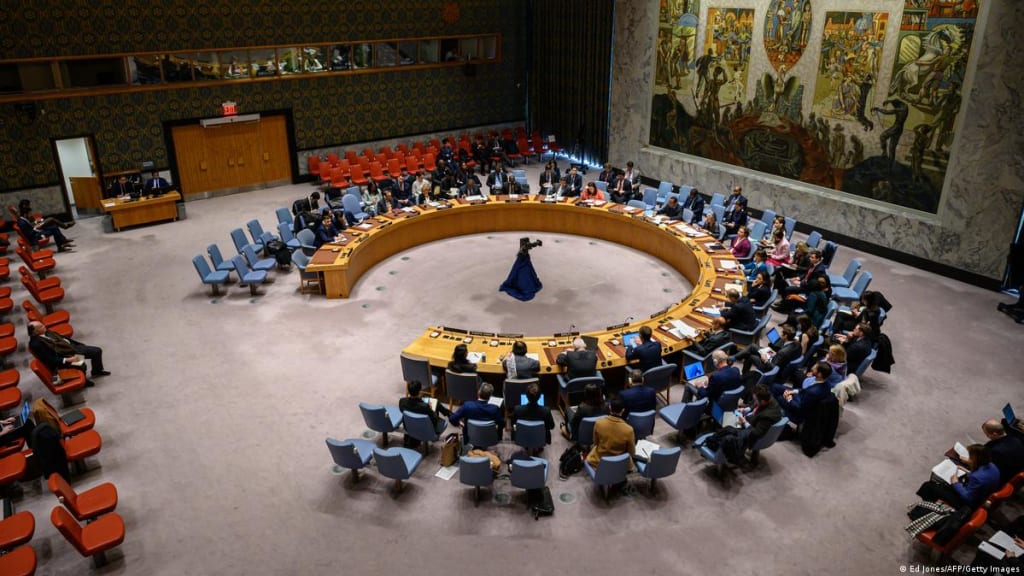
The world is currently facing one of the most significant environmental crises in history, with climate change, deforestation, and pollution affecting every corner of the globe. But the latest development to hit the international stage is the fact that Russia, a country accused of war crimes and subject to an international arrest warrant for its president, Vladimir Putin, has taken over the presidency of the UN Security Council, despite strong objections from Ukraine.
The UN Security Council is an international body responsible for maintaining peace, with each of its 15 members taking up the presidency for a month on a rotating pattern. However, this latest move by Russia to take over the presidency of the Security Council has raised concerns about the institution's effectiveness in maintaining world peace.
Russia's last presidency in February 2022 was marked by a full-scale invasion of Ukraine, leaving the country in shambles. Yet, the United States, citing the UN charter, has refused to block Russia, a permanent member of the council, from assuming the presidency, leaving the international community with limited options to hold Russia accountable for its actions.
As Russia assumes its role as the leader of the Security Council, the world is left wondering what kind of "new world order" its ambassador to the UN, Vasily Nebenzia, plans to discuss. Nebenzia has stated that he plans to oversee several debates, including one on arms control, and discuss the "new world order" that is coming to replace the unipolar one. With the power to veto any resolution, Russia's presidency raises concerns about its intentions and its ability to spread disinformation to justify its actions in Ukraine.
This move has sparked outrage among the international community, with Ukraine's Foreign Minister Dmytro Kuleba calling Russia's presidency "the worst joke ever for April Fool's Day" and a "stark reminder that something is wrong with the way international security architecture is functioning." Kuleba also called it "a slap in the face to the international community."
Ukrainian presidential adviser Mykhaylo Podolyak went further, calling the move "another rape of international law... an entity that wages an aggressive war, violates the norms of humanitarian and criminal law, destroys the UN Charter, neglects nuclear safety, can't head the world's key security body." President Volodymyr Zelensky has also called for Russia to be removed from its member status, citing Russia's invasion of Ukraine and the annexation of Crimea.
The situation is dire, and urgent action is needed to prevent further devastation. The UN Security Council was formed to maintain peace, yet its structure no longer reflects the current global power dynamics. It is time for the international community to come together and demand reforms to this crucial institution. The Security Council must be equipped to address modern challenges, including climate change, cybersecurity threats, and humanitarian crises.
However, the UN charter does not allow for the removal of a permanent member, leaving the international community with few options to hold Russia accountable for its actions. The US has said its hands were tied in this matter, and it expects Moscow "to continue to use its seat on the council to spread disinformation" and justify its actions in Ukraine. This decision leaves the international community with limited options to hold Russia accountable for its actions.
The world cannot afford to sit idly by as Russia assumes the presidency of the UN Security Council. It is time for the international community to demand accountability, justice, and reforms to protect the world from further harm. The Security Council must be reformed to better reflect the current global power dynamics and
About the Creator
Keep reading
More stories from Ellis Hayes and writers in Earth and other communities.
Tech Trends: Exploring the Latest Gadgets and Industry News
Drink to Tech Trends, your ultimate companion to the latest gadgets, industry news, and emerging technologies. Our mission is to provide you with the most engaging and informative content about the world of technology.
By Ellis Hayes3 years ago in 01
US Balks as UK and France Pledge Troops to Postwar Ukraine
As the war in Ukraine grinds on with no clear end in sight, the debate over what comes after the fighting has taken a sharper turn. The United States has signalled reluctance about committing troops to Ukraine once the war ends, even as the United Kingdom and France openly pledge to consider deploying forces in a postwar security role. The divergence has exposed differing strategic priorities among Western allies and raised new questions about how Ukraine’s future security will be guaranteed. While all three nations remain united in their support for Kyiv during the war, the emerging split over postwar troop commitments highlights the complexity of planning for peace in a conflict that continues to reshape Europe’s security landscape. What the UK and France Are Proposing British and French leaders have increasingly spoken about the need for long-term security arrangements for Ukraine once active hostilities end. Their position reflects a growing concern that any ceasefire or peace agreement could be fragile, leaving Ukraine vulnerable to renewed aggression. The idea under discussion is not a combat deployment in an active war zone, but rather a stabilisation or reassurance force. Such troops could help train Ukrainian forces, protect critical infrastructure, and serve as a visible deterrent against future attacks. Supporters argue that a limited but credible international presence would help ensure that any peace settlement is respected. For London and Paris, this approach fits within a broader European push to take more responsibility for continental security. Both governments see Ukraine not only as a partner but as a frontline state whose stability directly affects Europe as a whole. Why Washington Is Hesitant The United States, while remaining Ukraine’s most significant military backer during the war, has taken a more cautious stance on postwar troop deployments. American officials have stressed that there are no plans to send US forces into Ukraine, even after a potential peace agreement. This hesitation is rooted in several factors. First, Washington remains wary of any move that could risk a direct confrontation with Russia. Even in a postwar scenario, the presence of US troops on Ukrainian soil could be portrayed by Moscow as a provocation, escalating tensions rather than reducing them. Second, domestic considerations play a major role. After years of overseas military engagements, there is limited appetite among the American public and political class for new long-term deployments abroad, particularly in a region where risks remain high and outcomes uncertain. Finally, US strategy has increasingly emphasised supporting allies through funding, training, and equipment rather than large-scale troop commitments. From Washington’s perspective, enabling Ukraine to defend itself may be preferable to stationing American forces on the ground. A Question of Deterrence At the heart of the debate lies a fundamental question: what will actually deter future aggression against Ukraine? The UK and France appear to believe that a physical presence, however limited, would send a powerful signal of commitment. Troops on the ground would demonstrate that Ukraine’s security is directly tied to that of major European powers, raising the cost of any future attack. The US, by contrast, seems to place greater faith in alternative mechanisms such as long-term military aid, security guarantees, and sanctions frameworks. American officials argue that deterrence does not necessarily require boots on the ground, especially if Ukraine emerges from the war better armed and more integrated with Western institutions. This difference reflects broader strategic cultures. European powers, facing the immediate proximity of the conflict, may feel a stronger need for visible reassurance measures, while the US assesses risks from a more global perspective. Implications for NATO Unity Although Ukraine is not a NATO member, the discussion has clear implications for the alliance. Any deployment of UK or French troops would be closely scrutinised for what it means for NATO’s role and credibility. NATO operates on consensus, and the absence of US support for a postwar troop presence could complicate coordination. Even if London and Paris act independently or as part of a smaller coalition, questions would remain about command structures, rules of engagement, and the political backing required for such a mission. At the same time, the situation underscores a broader shift within NATO, with European members increasingly expected to shoulder more responsibility. If the UK and France proceed with their plans, it could mark a significant step toward a more autonomous European security posture. Ukraine’s Perspective For Kyiv, the debate is both encouraging and frustrating. On one hand, the willingness of major European powers to consider troop deployments signals long-term commitment and recognition of Ukraine’s security concerns. On the other hand, uncertainty from the US—Ukraine’s most powerful ally—adds another layer of unpredictability. Ukrainian leaders have consistently argued that security guarantees must be concrete, not symbolic. From their perspective, any postwar arrangement must ensure that Russia cannot simply regroup and strike again. Whether this is achieved through foreign troops, binding treaties, or accelerated integration with Western institutions remains an open question. What is clear is that Ukraine wants assurances that go beyond promises and declarations. The Risk of Mixed Signals One potential danger of the current divergence is the message it sends to Moscow. Differing positions among Western allies could be interpreted as hesitation or lack of unity, potentially weakening deterrence rather than strengthening it. At the same time, open debate is not necessarily a sign of weakness. Allies often disagree on tactics while remaining aligned on broader goals. The challenge will be ensuring that these differences do not undermine the core objective of securing a stable and sovereign Ukraine. Diplomats on both sides of the Atlantic are likely to continue working behind the scenes to narrow the gap, even if public statements suggest a clear divide. Looking Ahead The question of postwar Ukraine remains largely theoretical while fighting continues. Yet the discussion itself reveals how seriously Western governments are taking the long-term consequences of the conflict. The UK and France’s willingness to pledge troops reflects a belief that peace must be actively protected. The US reluctance highlights concerns about escalation, sustainability, and domestic support. Reconciling these approaches will be one of the most important diplomatic challenges once the guns eventually fall silent. For now, the disagreement does not signal a breakdown in alliance unity, but it does expose the difficult choices ahead. As the war continues, planning for peace is proving almost as complex—and politically sensitive—as managing the conflict itself.
By Muhammad Hassan7 days ago in Earth



Comments
There are no comments for this story
Be the first to respond and start the conversation.