
Rice Market Size & Forecast 2025–2033: Global Demand, Growth Drivers & Regional Outlook
How the World’s Most Essential Staple Food Is Powering Steady Market Growth

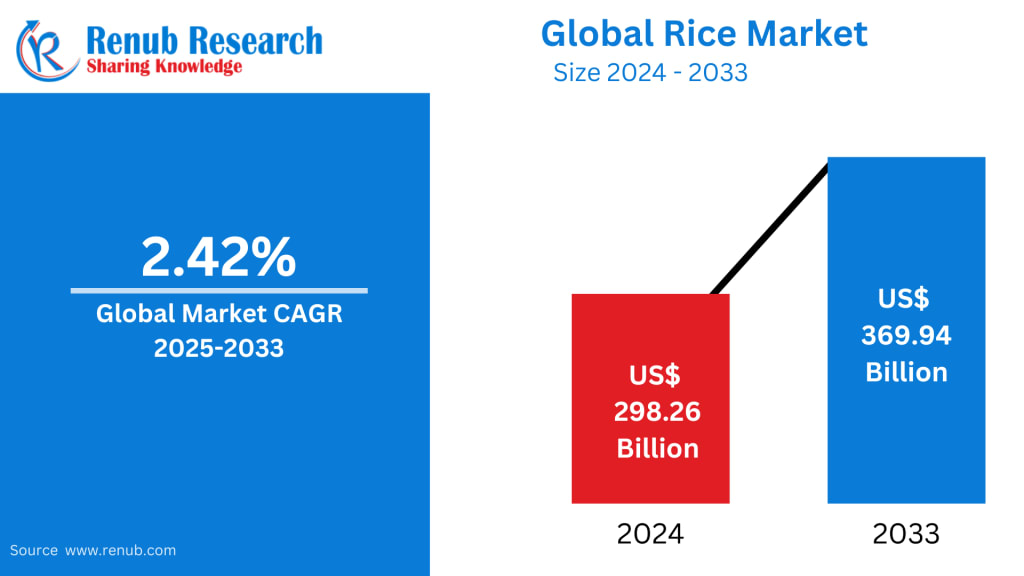
Global Rice Market Summary
The global rice market continues to maintain its position as one of the world’s most crucial and stable agri-commodity sectors. According to Renub Research, the rice market is poised to reach USD 378.41 billion by 2033, rising from USD 305.14 billion in 2024, at a CAGR of 2.42% during 2025–2033. This steady long-term expansion reflects population growth, evolving food habits, supportive government policies, and rising trade activities.
The Global Rice Market Report analyzes the industry by Product Type (Regular, Aromatic), Type (Red, Black, Brown, Parboiled, Sushi, Arborio, etc.), Grain Size (Long, Medium, Short), Distribution Channel (Offline, Online), and Application (Food, Feed, Others) across 25 major countries. It also covers competitive analysis of key global companies.
Rice remains the most consumed staple food for over half the world’s population. Asia alone accounts for 90% of production and consumption, with China and India jointly producing nearly half of total global output. As per FAOSTAT, over 165 million hectares were planted with rice in 2022—underscoring the crop’s unmatched global footprint.
With rising incomes, rapid urbanization, and an expanding demand for processed and convenience food items, rice continues to hold its dominant position in the global food system.
Global Rice Market Overview
Rice is not only a staple food—it's the lifeline of food security for billions. Over 120 countries cultivate rice today, and it ranks third globally in agricultural production after maize and sugarcane. As global population trends accelerate, demand for rice continues to mirror demographic expansion.
In nations like India, the world’s largest rice harvester with over 48 million hectares of annual production, rice is deeply embedded in culinary, cultural, and economic activities. At the same time, globally rising incomes—especially in developing regions—are spurring greater consumption of higher-quality and specialty rice varieties.
Key forces driving market momentum include:
Urbanization & population rise, strengthening long-term demand
Enhanced farming technologies, lifting productivity
Government support programs, ensuring pricing and supply stability
Growing global trade, driven by food security concerns and diversified consumption
Surging consumption of processed rice products, including ready-to-eat and flavored rice meals
Climate-resilient rice innovations, mitigating climate-linked risks
As a versatile grain used in food, beverages, snacks, baby foods, and even non-food applications, rice’s relevance will continue to expand over the coming decade.
Growth Drivers in the Global Rice Market
1. Government Programs & Agricultural Regulations
Government policy remains a crucial pillar in supporting rice farmers and stabilizing global supply. Many rice-producing nations maintain subsidies, minimum support prices, or export regulations to maintain affordability and protect domestic security.
These interventions shield farmers from market volatility and encourage investment in advanced farming solutions such as mechanization, irrigation management, hybrid rice seeds, and climate-smart agricultural practices.
Countries also invest in R&D, focusing on:
High-yield varieties
Drought and flood-resistant strains
Pest-resistant seeds
Nutrient-rich biofortified rice
Example Policy Action:
📌 In February 2024, India’s food ministry launched “Bharat Rice” at Rs 29/kg to control retail prices, providing a buffer against market inflation.
Such policies influence trade flows and global price formation, making them essential to overall rice market stability.
2. Rising Demand for Convenience Rice-Based Foods
A major consumer trend shaping the rice sector is the dramatic rise in demand for quick, ready-to-eat, and portable rice foods—especially in urban markets.
Popular categories include:
Frozen ready rice bowls
Instant rice noodles
Microwaveable rice pouches
Heat-and-eat biryani and rice meals
Rice cakes and chips
Gluten-free, plant-based rice snacks
Health-conscious consumers, especially Millennials and Gen-Z, are increasingly seeking:
Low-fat options
Gluten-free alternatives
Easy-to-cook formats
Flavor-infused and premium varieties
This shift has created new opportunities for food manufacturers, boosting demand for specialty and processed rice varieties globally.
3. Expanding Global Export Opportunities
Globalization and evolving trade agreements have strengthened rice trade routes between Asia, the Middle East, Africa, and Europe. Exporters benefit from:
Reduced trade barriers
Higher demand from import-dependent countries
Increasing preference for high-quality varieties (Basmati, Jasmine, parboiled)
Rising consumption in ethnic cuisine across Europe & North America
Stringent quality certifications also assure food safety, enabling exporters to position their offerings in premium global markets.
As population and income levels rise, particularly in Africa and the Middle East, the demand for imported rice is projected to grow significantly through 2033.
Market Challenges
Despite strong long-term outlook, the rice market faces several structural pressures.
1. Supply–Demand Imbalances
Weather shocks, pest outbreaks, and production deficits can trigger tight supplies and price surges. Conversely, overproduction can depress farmer income. These cyclical imbalances remain a core risk factor.
2. Price Volatility
Rice prices remain sensitive to:
Climate events (floods, droughts, El Niño)
Government trade actions (export bans, quotas, minimum prices)
Currency fluctuations
Inflationary pressures & global recessionary cycles
Market speculation
This volatility impacts farmers, traders, food processors, and consumers alike, posing a persistent challenge to market stability.
Regional Market Analysis
United States Rice Market
The U.S. has seen a sharp increase in rice production due to improved agricultural technology and favorable weather.
Key highlights:
9.89 million metric tons produced in 2023 (36% rise over 2022)
Harvested area grew 32%, reaching 1.15 million hectares
Growth supported by USDA programs, irrigation infrastructure, and hybrid seed varieties
Consumer trends show rising demand for:
Brown rice
Wild rice
Organic and natural rice products
Specialty international rice varieties
The booming food service sector (Asian cuisine, fast-casual restaurants, meal kits) further drives rice consumption.
India Rice Market
India remains not only the world’s largest rice producer—but also a major exporter.
Drivers of growth:
Rapid population expansion (expected to reach 152.2 Crore by 2036)
Growing domestic consumption in both urban & rural regions
Rising exports of Basmati and non-Basmati variants
Increasing demand for processed rice-based products
Industry Developments (2024):
LT Foods launched DAAWAT® Jasmine Thai Rice, tapping into the rising trend of Asian cuisine in India.
Diageo India, with CSA support, launched a regenerative agriculture project for sustainable rice farming covering 500+ hectares, promoting water-saving and low-carbon practices.
These initiatives illustrate India’s transition toward sustainable, high-value rice production.
Germany Rice Market
Germany relies almost entirely on imports due to its unsuitable climate for rice cultivation. Consumer preferences lean toward:
Long-grain rice
Aromatic varieties
Ready-to-cook packaged rice
Premium Basmati, Jasmine, and organic options
Ethnic cuisines, especially Asian and Mediterranean, continue to boost rice consumption.
United Arab Emirates Rice Market
The UAE’s rice market is shaped by:
Heavy dependence on imports (India, Pakistan, Thailand)
Expat-driven high consumption
Strong preference for Basmati and premium varieties
Growing demand for ready-to-eat and convenience rice products
Trade policies, logistics networks, and global supply fluctuations directly influence the market.
Global Rice Market Segmentation
Product Type
Regular
Aromatic
Type
Red Rice
Arborio Rice
Black Rice
Grain Fragrance Rice
Brown Rice
Rosematta Rice
Parboiled Rice
Sushi Rice
Others
Grain Size
Long Grain
Medium Grain
Short Grain
Distribution Channel
Offline
Online
Application
Food
Feed
Others
Country Coverage (25 Market Viewpoints)
United States, Canada, France, Germany, Italy, Spain, United Kingdom, Belgium, Netherlands, Turkey, China, Japan, India, Australia, South Korea, Thailand, Malaysia, Indonesia, New Zealand, Brazil, Mexico, Argentina, South Africa, Saudi Arabia, United Arab Emirates.
Company Analysis (4 Key Viewpoints):
Company Overview
Key Persons
Recent Developments & Strategies
Sales Analysis
Major Companies Covered
KRBL Limited
LT Foods Ltd
Kohinoor Foods
Thai Wah
Archer Daniels Midland
Tate & Lyle
General Mills
MGP Limited
Final Thoughts
The global rice market is entering a period of sustained stability, supported by demographic expansion, rising processed-food consumption, and active government support. As trade flows widen and sustainability practices strengthen, rice is set to remain the cornerstone of global food security through 2033 and beyond.
With growing investments in high-yield varieties, digital agriculture, and processed rice foods, the next decade will bring new opportunities for producers, exporters, and food manufacturers worldwide.
About the Creator
Sushant. Renub Research
I’m Sushanta Halder, Digital Marketing Manager at Renub Research with 15+ years in SEO, content, PPC & lead generation. Passionate about data-driven growth strategies.
Keep reading
More stories from Sushant. Renub Research and writers in Earth and other communities.
Global Wheat Market Size and Forecast 2025–2033: Rising Demand, Changing Trade Flows & the Future of the World’s Most Important Grain
The Global Wheat Market, valued at USD 47.70 billion in 2024, is expected to climb to USD 71.48 billion by 2033, expanding at a CAGR of 4.60% from 2025–2033. Supported by evolving consumption patterns, population growth, improving agricultural technologies, and rising industrial usage, wheat continues to be the backbone of global food security.
By Sushant. Renub Research2 months ago in Earth
Stanislav Kondrashov on the Future of Work in the Age of the Energy Transition
As the world steadily moves away from fossil fuels, the shift toward sustainable energy is reshaping not only infrastructure but the very fabric of the global workforce. According to industry analyst and sustainability advocate Stanislav Kondrashov, the years ahead will bring seismic changes to employment—disrupting traditional sectors while giving rise to a new class of critical roles.
By Stanislav Kondrashov5 days ago in Earth
Britain’s PM Calls Trump on Greenland: Defending Sovereignty in a Shifting Arctic
When you think of New Year’s conversations between world leaders, Greenland probably isn’t the first thing that comes to mind. Yet on January 7, 2026, British Prime Minister Keir Starmer and former U.S. President Donald Trump discussed the icy island over a phone call — and it made headlines worldwide. Why? Because Greenland, a massive, ice-covered territory in the Arctic, is suddenly at the center of global geopolitics, and Britain is making sure its voice is heard. Greenland Isn’t Just Ice At first glance, Greenland seems remote and quiet — a land of snow, glaciers, and polar bears. But this island is strategically critical. It sits between North America and Europe, holds valuable natural resources, and commands control over emerging Arctic shipping routes as ice melts due to climate change. In recent years, Greenland has captured the attention of global powers, especially the United States. Trump has repeatedly suggested that the island is crucial to U.S. national security and even hinted at the possibility of acquiring it. These ideas, though unlikely, raised eyebrows in Europe and among NATO allies. For Denmark, Greenland’s governing country, and its residents, this rhetoric was a reminder that sovereignty matters — and outsiders shouldn’t dictate their future. Starmer’s Clear Message During the phone call, Starmer made Britain’s position unmistakable: Greenland’s future must be decided by its people and Denmark, not by external powers. This wasn’t just diplomacy for the sake of headlines. It’s about principles that Britain has long defended: respect for sovereignty, international law, and the rules-based global order. Starmer’s message sends a signal not only to Trump but also to other countries that might think about exerting undue influence over smaller, strategic territories. The call also touched on other global concerns, including NATO security matters, Arctic maritime operations, and broader geopolitical tensions. But it’s Greenland that grabbed the spotlight — because it’s a flashpoint for sovereignty, alliance dynamics, and Arctic strategy. Why the UK Cares You might wonder: why is Britain involved in a discussion about Greenland? After all, it’s part of Denmark. The answer lies in NATO and European security. Greenland is strategically vital for the alliance. Any unilateral action by the U.S. to control or influence Greenland could threaten NATO cohesion. Britain, as a leading NATO member, has a stake in ensuring that all alliance decisions respect sovereignty and the rules of international cooperation. In other words, Britain isn’t stepping into Greenland’s affairs to take control — it’s defending the principle that territorial decisions should belong to the rightful authorities, in this case, Denmark and Greenland’s residents. Alliances and Principles Starmer’s call also highlights a delicate balancing act. The UK maintains a close relationship with the U.S., but that doesn’t mean it agrees with every idea, especially when sovereignty is at stake. This is the reality of modern diplomacy: even trusted allies can have differences of opinion, and leaders must navigate these differences carefully. Starmer’s message to Trump reflects a wider approach — maintain strong alliances while standing firm on core values. Some politicians have acknowledged that disagreements are normal and even healthy in long-standing partnerships. The key is open communication and respect for international norms, which Starmer aimed to demonstrate during the call. Greenland as a Symbol Beyond geopolitics, Greenland has become a symbol of a new era in global relations. Arctic resources, strategic positions, and climate change are making previously quiet regions hotspots for diplomacy. Greenland reminds the world that territory, sovereignty, and self-determination are still central issues, even in the 21st century. For Britain, standing with Denmark and affirming Greenland’s autonomy sends a clear message: the UK supports international law and the idea that small regions should not be pawns in great-power games. What This Means Going Forward So what can we expect after this phone call? Greenland remains firmly under Danish control, with its future in the hands of its residents. NATO cohesion is reinforced, as European leaders see Britain advocating for rules-based governance. The Arctic region continues to be a strategic focal point, with countries carefully watching each other’s moves. In short, Starmer’s call is a reminder that even in a world of powerful nations, diplomacy, respect, and legal principles still matter. Takeaways Sovereignty Matters: Greenland’s future is a matter for its people, not outside powers. Allies Can Disagree: Britain’s defense of principles shows that disagreements with allies don’t have to break partnerships. Strategic Regions Are Hotspots: Arctic regions like Greenland are increasingly important in global security, economics, and diplomacy. Principles Over Power: Upholding international law is as critical as maintaining military or economic influence. Greenland may be far from the streets of London or Washington, but the stakes are high. Starmer’s phone call with Trump demonstrates that the UK is ready to defend sovereignty, international norms, and alliance cohesion, even when the conversation turns icy.
By Muhammad Hassan4 days ago in Earth
A Failed Artist, A Disillusioned Poet, An Underpaid Game Show Host
I took my son and niece to Gori, a small town in Georgia where Joseph Stalin was born. They talked me into visiting the Stalin's Museum, the largest in the post-Soviet space. I had resisted going there because I just can't stand the monster and know enough about him, or so I thought.
By Lana V Lynx6 days ago in FYI




Comments
There are no comments for this story
Be the first to respond and start the conversation.