
Global Wheat Market Size and Forecast 2025–2033: Rising Demand, Changing Trade Flows & the Future of the World’s Most Important Grain
How Growing Populations, Food Processing, Technological Advances & Trade Shifts Are Reshaping the Global Wheat Economy

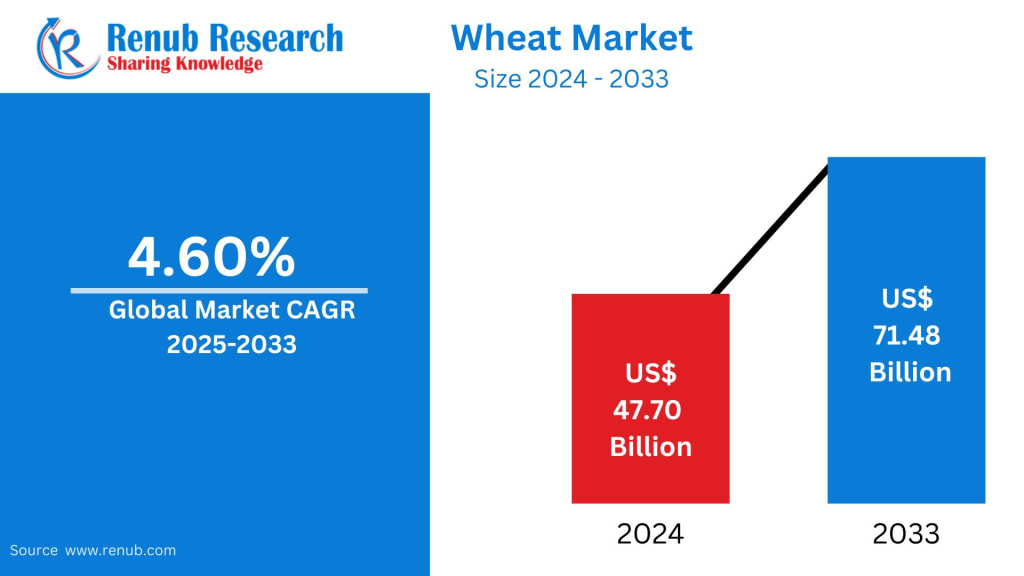
The Global Wheat Market, valued at USD 47.70 billion in 2024, is expected to climb to USD 71.48 billion by 2033, expanding at a CAGR of 4.60% from 2025–2033. Supported by evolving consumption patterns, population growth, improving agricultural technologies, and rising industrial usage, wheat continues to be the backbone of global food security.
Across baked foods, beverages, animal feed, and industrial applications, wheat remains indispensable. Its adaptability to different climates, its high nutritional value, and the growing demand for processed and convenience foods make it one of the most resilient commodity markets worldwide.
This report offers a comprehensive overview of the global wheat industry—covering growth drivers, challenges, segment analysis, regional insights, and key company developments—crafted in a crisp, engaging editorial format ready for Vocal publication.
Global Wheat Market Overview
Wheat (Triticum spp.) is the world’s second most-produced cereal and a staple food for billions of people. Grown predominantly in China, India, Russia, the U.S., and Canada, it remains essential in the production of bread, noodles, pasta, breakfast cereals, cakes, biscuits, semolina, beer, whiskey, animal feed, and industrial products such as starch and gluten.
Wheat's versatility, nutritional value, and compatibility with different climatic zones have secured its position as a global staple. With rising demand for ready-to-eat foods, plant-based alternatives, and fortified wheat products, the wheat market continues to play a vital role in sustaining economies and supporting global food security.
Key Growth Drivers of the Global Wheat Market
1. Rising Global Population & Surging Food Demand
With the global population projected to reach 10.3 billion by the mid-2080s, demand for wheat-based foods is surging. Nearly 783 million people already face food insecurity (Nov 2023), making wheat’s role in global nutrition more crucial than ever.
Wheat is widely consumed in developing regions where rising incomes and rapid urbanization are reshaping dietary habits. Governments and agricultural bodies are investing heavily in crop improvement programs to ensure sustainable wheat availability.
By 2050, food consumption is projected to increase by 50–70%, positioning wheat as an indispensable crop in global food chains.
2. Expansion of the Global Food Processing Industry
Wheat consumption is deeply linked to the explosive growth of the baking, snacks, beverages, and instant food industries.
Rising demand for convenient and packaged foods in North America, Europe, and Asia-Pacific significantly boosts the consumption of wheat-based products.
Fortified, functional, and clean-label wheat products—such as high-fiber bread, protein-enriched pasta, and organic semolina—are witnessing strong adoption.
A notable industry development includes:
May 2022: Lavie Bio Ltd. (Evogene’s subsidiary) reported successful commercial sales of result™, a bio-inoculant for spring wheat in the U.S., signalling the rise of biotechnology in wheat farming.
3. Technological Advancements in Wheat Farming
Modern agricultural technologies, including:
Precision farming
Genetically improved seed varieties
Efficient irrigation techniques
Crop monitoring via drones and IoT
High-yielding, drought-resistant wheat hybrids
…are transforming global wheat productivity.
One major innovation:
Nov 2024: Corteva introduced a breakthrough non-GMO hybrid wheat technology, mirroring the hybrid revolution seen in corn. This technology is expected to significantly increase wheat yields worldwide.
Such advancements help farmers mitigate climate risks, optimize input costs, and ensure consistent production.
Key Challenges Impacting the Wheat Market
1. Climate Change & Extreme Weather Conditions
Wheat production is significantly affected by:
Drought
Heatwaves
Floods
Pest outbreaks
Unpredictable rainfall
The growing frequency of extreme weather events poses risks to supply stability. Countries are increasingly investing in resilient crop varieties and sustainable farming techniques to reduce vulnerability.
2. Trade Restrictions & Geopolitical Pressures
Wheat trade is highly sensitive to:
Export bans
Tariffs
Sanctions
Border conflicts
Policy shifts
The Russia-Ukraine conflict, for instance, has disrupted nearly 30% of global wheat exports, forcing import-dependent countries to seek alternative suppliers and diversify procurement strategies.
Such geopolitical uncertainties influence global wheat prices and availability.
Market Segmentation Analysis
By Nature
Organic Wheat
Growing consumer focus on health, sustainability, and clean labeling is boosting organic wheat demand. The rise of organic flour, pasta, bakery goods, and cereals has pushed food companies to scale organic sourcing and comply with certification standards.
Conventional Wheat
Conventional wheat dominates the market due to its high productivity and cost efficiency. It remains central to mass food production, livestock feed, and industrial processing. Emerging nations especially rely on conventional wheat to meet large-scale demand.
By End User
1. Food & Beverages
Wheat is a core ingredient in bread, noodles, pasta, bakery snacks, and breakfast cereals. Wheat-based alcoholic beverages (beer and whiskey) also contribute significantly to demand. The growing gluten-free movement poses a challenge, pushing manufacturers toward innovative wheat formulations.
2. Animal Feed
Used extensively for poultry and hog feed, wheat offers high starch content and digestibility. However, competition from alternative feed grains like corn and soy impacts market share.
3. Industrial Use
Wheat is crucial in:
Starch production
Gluten extraction
Bio-based polymers
Ethanol manufacturing
Demand from industrial applications continues to grow steadily.
B2C: Online vs. Offline Markets
Online Wheat Market
E-commerce platforms, agritech marketplaces, and digital cooperatives have revolutionized wheat trading. Benefits include:
Transparent pricing
Direct farmer-to-buyer transactions
Reduced middlemen costs
Wider accessibility
Digital adoption is especially rapid in India, the U.S., and Brazil.
Offline Market
Traditional wholesale markets, grain mandis, supermarkets, and agro-retailers still dominate B2C wheat distribution, especially in rural regions.
Regional Market Insights
United States
One of the world’s top producers and exporters, the U.S. benefits from:
High-yield seed varieties
Advanced farming technologies
Strong global trade partnerships
2024 wheat production: 1.97 billion bushels
Yield: 51.2 bushels per acre
Key export destinations include Japan, Mexico, the Philippines, and Latin America.
France
A major European wheat powerhouse, known for:
High-quality soft wheat
Strong R&D infrastructure
Established export networks
March 2024: Episens launched GOURMANCE, a premium global bakery ingredient brand.
India
The world’s second-largest wheat producer, driven by:
High domestic consumption
Government procurement (MSP)
Expanding export capacity
2025 wheat output estimate: 115.4 million metric tons—a record.
India’s organic and fortified wheat markets are also rising rapidly.
Brazil
Despite strong consumption, Brazil is heavily import-dependent.
The country is pushing for wheat self-sufficiency by 2030.
Annual consumption: 12+ million tonnes
Projected 2024-25 production: 9.5 million tonnes
80% of imports come from Argentina
As food processing grows, Brazil’s dependence on wheat will continue, but local production initiatives are gaining momentum.
Countries Covered in the Market Forecast
North America: United States, Canada
Europe: France, Germany, Italy, Spain, United Kingdom, Belgium, Netherlands, Turkey
Asia-Pacific: China, Japan, India, Australia, South Korea, Thailand, Malaysia, Indonesia, New Zealand
Latin America: Brazil, Mexico, Argentina
Middle East & Africa: South Africa, Saudi Arabia, UAE
Key Players (Company Profiles Covered)
Cargill Inc.
CHS Inc.
Bunge
Glencore
Louis Dreyfus Company
Ardent Mills
The Scoular Company
Syngenta
The Soufflet Group
Adani Wilmar
Each company is analyzed through:
Overview, Key Person, Recent Developments, Product Portfolio, and Revenue.
Final Thoughts
The global wheat market is undergoing significant transformation. With rising food demand, evolving consumer preferences, and rapid advancements in agricultural technologies, wheat will remain a cornerstone of global nutrition and commerce.
However, the industry must navigate climate challenges, trade uncertainties, and the need for sustainable farming practices.
As countries strengthen food security strategies and companies invest in high-yield varieties, digital supply chains, and biotechnology, the future of the wheat market looks promising.
Between 2025 and 2033, the wheat industry will not only expand in size but also evolve in intelligence, sustainability, and global interconnectivity.
About the Creator
Sushant. Renub Research
I’m Sushanta Halder, Digital Marketing Manager at Renub Research with 15+ years in SEO, content, PPC & lead generation. Passionate about data-driven growth strategies.
Keep reading
More stories from Sushant. Renub Research and writers in Earth and other communities.
Agricultural Tractors Market Size and Forecast 2025–2033
The global agricultural tractors market continues to rise as countries worldwide ramp up mechanization, upgrade aging fleets, and integrate digital farming tools into everyday agricultural processes. According to Renub Research, the market for agricultural tractors is projected to reach USD 68.87 billion in 2024, expanding at a CAGR of 5.47% from 2025 to 2033, ultimately totaling USD 111.22 billion by 2033. This growth reflects not only rising food demand but also global strategies to modernize farms, reduce labor pressures, and strengthen food security.
By Sushant. Renub Research2 months ago in Earth
How Dangerous Is Chernobyl Radiation Today
many people still ask the same question: how dangerous is chernobyl radiation today? The short answer is that the danger still exists, but it is very different from what it was in 1986. Radiation levels have dropped a lot, some areas are safer than others, and strict rules remain in place to protect people and the environment. To understand the real risk today, it is important to look at what happened, what has changed, and what dangers still remain.
By Horizon Dwellers3 days ago in Earth
Stanislav Kondrashov Explores the Hidden Power of Geothermal Energy
In a world racing to find cleaner, more reliable sources of energy, one solution has remained quite literally beneath our feet: geothermal energy. Often overlooked in favour of flashier alternatives, geothermal power quietly harnesses the Earth’s own heat to produce electricity and heating for homes, businesses, and even entire communities. It’s not new, it’s not loud, and according to energy expert and researcher Stanislav Kondrashov, it might just be one of the most stable paths forward.
By Stanislav Kondrashov 4 days ago in Earth




Comments
There are no comments for this story
Be the first to respond and start the conversation.