
"Radiant Genius: The Curies' Relentless Pursuit of Science's Mysteries"
"Marie Curie's Nobel Odyssey, Radium's Legacy, and the Price of Perpetual Discovery"

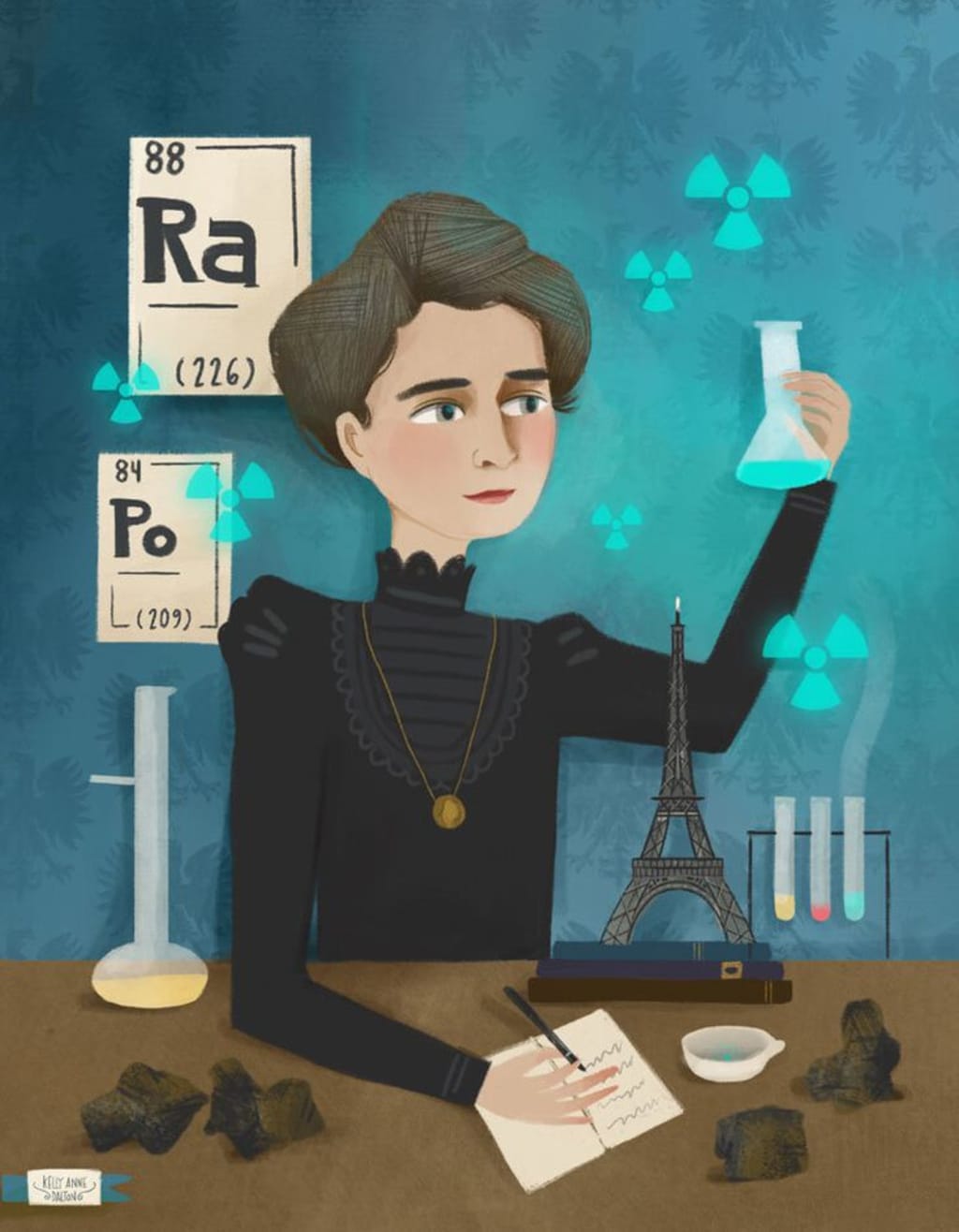
If you wish to catch a glimpse of Marie Curie's invaluable manuscripts, prepare to don protective gear and sign a radiation waiver. Madame Curie's legacy, and even her remains, were safeguarded within a lead-lined coffin, preserving the radiation that played a central role in her groundbreaking research and, sadly, likely contributed to her untimely demise.
Marie Curie, born Maria Sklodowska, spent her early years in Russian-occupied Poland. A brilliant student, she faced formidable obstacles due to her gender, as women were denied access to higher education. In an act of defiance, Marie enrolled in the clandestine Floating University, an underground institution offering education to Polish youth. Through sheer determination, frugality, and employment as a governess and tutor, she eventually made her way to Paris to study at the prestigious Sorbonne.
In Paris, Marie faced extreme hardships, often subsisting on meager rations of bread and tea, at times even fainting from near-starvation. Yet, her resolve remained unyielding. It was in the bustling streets of Paris that she encountered the physicist Pierre Curie, who not only opened the doors of his laboratory but also his heart to her. However, Marie's longing for her homeland remained strong, and upon her return to Warsaw, she encountered the same resistance in her quest for an academic position.
Fortune smiled upon her in the form of Pierre, and the two quickly married, forming a remarkable scientific partnership. Another physicist's discovery, Henri Becquerel's revelation in 1896 that uranium emitted a mysterious radiation akin to X-rays, ignited Marie's curiosity. She soon discerned that thorium exhibited a similar phenomenon. Most significantly, the intensity of this radiation depended solely on the quantity of the element, irrespective of physical or chemical alterations. This led her to conclude that this radiation originated from a fundamental aspect within the atoms of these elements, challenging the prevailing notion that atoms were indivisible.
Determined to explore further, the Curies turned their attention to pitchblende, an exceptionally radioactive ore. Through relentless work, they unveiled not one, but two new elements – polonium, a tribute to Marie's Polish roots, and radium, derived from the Latin word for ray. In the process, they introduced the term "radioactivity."
By 1902, the Curies had successfully extracted a significant amount of pure radium chloride salt from several tons of pitchblende, a remarkable achievement of the time. The accolades began to roll in, and in 1903, Pierre Curie and Henri Becquerel received Nobel Prize nominations in physics. However, Marie was inexplicably overlooked. In a noble gesture, Pierre advocated for his wife's recognition, and eventually, all three – the Curies and Becquerel – jointly received the Nobel Prize in physics. Marie Curie thus became the first female Nobel Laureate.
In 1906, tragedy struck when Pierre was tragically killed in a street accident. Devastated by the loss of her husband and scientific partner, Marie immersed herself in her research and assumed Pierre's teaching position at the Sorbonne, becoming the institution's first female professor. Her independent work bore fruit, and in 1911, she earned another Nobel Prize, this time in chemistry, for her pioneering work on radium and polonium, and her analysis of pure radium and its compounds. This remarkable achievement solidified her as the only person to ever receive Nobel Prizes in two distinct scientific disciplines.
As Professor Curie, she harnessed her discoveries to transform the landscape of medical research and treatments. During World War I, she established mobile radiology units, advancing our understanding of radiation's effects on tumors. However, it's possible that these immense contributions to humanity came at a personal cost, as she tragically succumbed to a bone marrow disease in 1934, a condition believed by many to be the result of her prolonged radiation exposure.
Marie Curie's revolutionary research laid the cornerstone for our comprehension of physics and chemistry. Her pioneering work spanned a multitude of fields, leaving indelible imprints on oncology, technology, medicine, and nuclear physics, among others. Whether for better or worse, her revelations in the realm of radiation opened doors to a new era, unveiling some of science's most profound mysteries.
About the Creator
Keep reading
More stories from Alisa İnnokate and writers in Earth and other communities.
"The Infinite Hotel Paradox: Unraveling Infinity's Mind-Bending Mysteries"
In the 1920s, the ingenious mathematician David Hilbert conceived a renowned mental experiment to illustrate the bewildering nature of infinity. Picture an Infinite Hotel, a place with an unending array of rooms, along with an exceptionally industrious night manager. One fateful night, the Infinite Hotel found itself entirely occupied, filled to the brim with an infinite number of guests. However, an unexpected traveler arrives, seeking a room. Instead of turning him away, the resourceful night manager devises a solution.
By Alisa İnnokate2 years ago in Earth


Comments (3)
Very informative article. Thank you for sharing
The love story between Marie and Pierre Curie is truly heartwarming.
Did you like the story? Which scientists would you like to see featured articles on?