
QUEEN OF THE NIGHT
The flower that only blooms in night

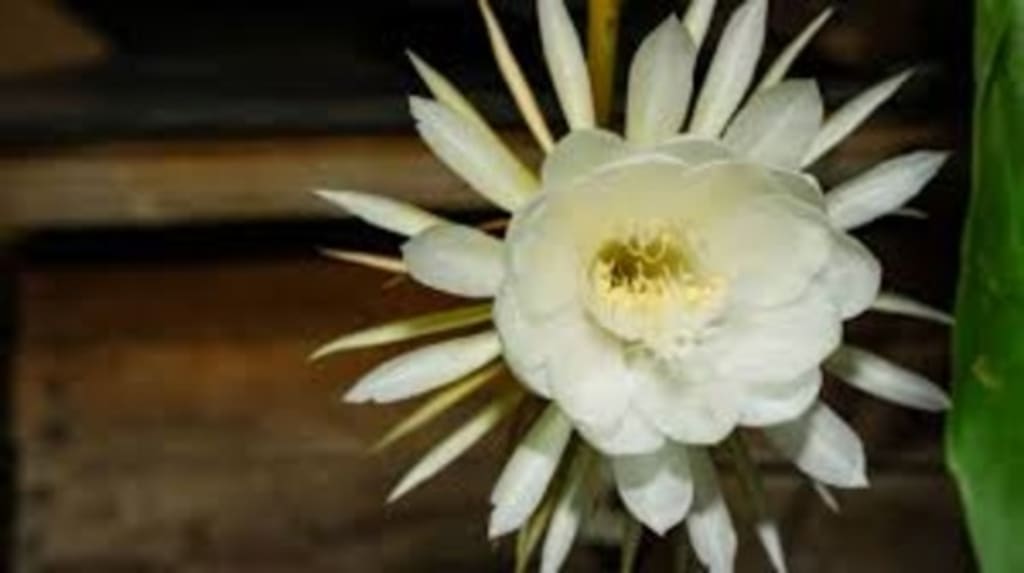
She blooms in full, and her beauty is only witnessed by the night sky. By dawn, she wilts even before the sun’s first kiss, with only her fragrant scent left as the ghost of her evening arrival. Known by many names, such as the Princess of the Night or the Queen of the Night, the Cereus cactus is a species of cactus whose flower only blooms at night, typically between the months of July and October. However, one class of Cereus—possibly coming from the species Epiphyllum oxypetalum—blooms one night a year, and enthusiasts of this species make it a point not to miss it. The blossom it produces on the night it blooms is described as being the size of a newborn infant’s head. By dawn, its pristine white petals wilt, and the flower dies, leaving only its strong, fragrant scent that is equally anticipated by many.
This night-bloomer has trumpet-shaped flowers with creamy-white, waxy petals. In full bloom, the flower can measure up to 4 inches wide and as much as 8 inches long. Depending on how they are grown and cultivated, these cacti can stand erect or be trained to sprawl on a trellis. Unfortunately for most of us, this Queen of the Night is only found in deserts, the subtropics of the Southwestern United States, Central and South America, and the Antilles. However, at least one species of Cereus has been successfully grown from clippings and is now a popular houseplant. Without their sought-after blooms, these cacti typically look fairly common, with gnarled, dry nests or a strange cactus-orchid hybrid with leaves—not really something that will turn heads and make a jaw-dropping impression.
According to Marc Hachadourian of the New York Botanical Garden’s Nolen Greenhouses, the plant is “kind of big and gangly and awkward,” as he describes the cactus species. He continues by saying that the “lure of those blooms is worth it,” referring to the plant’s extraordinary behavior when its buds begin to blossom. These night-blooming flowers will not actually begin to blossom until they are about four or five years old; and by then, they will only produce a few flowers. With a little patience and time, though, the incidence of blooming flowers will increase as the plant ages. Some breeders speed up the flowers’ blooming process by keeping their plants in dark environments all day to mimic nighttime conditions during the blooming season. But regardless of the methods used to make the buds blossom, the Cereus will only open its buds at night and will wither and wilt by dawn.
You might think that with this peculiar behavior, the plants would have died out by now, but these night-bloomers are pollinated by a species of moth called the Hawk Moth, which is drawn to its fragrance. Several other species of nocturnal insects and animals, like bats, also contribute to pollination. The occurrence of the bloom is quite a rarity, so many enthusiasts and hobbyists make it an annual event where they gather with like-minded friends, family members, and even passersby to witness the Queen of the Night awaken from her slumber in an explosion of intoxicating fragrance. A Facebook page called The Queen of the Night Society has even turned into a small community in their neighborhood of Hudson, NY. The members of the group have their own plants and are more than happy to exchange tips and tricks in caring for their little night-blooming plants.
At the Tohono Chul Botanical Garden in Arizona, staff closely monitor all 300 of their native, night-blooming Cereus to ensure they are in peak health and to know when they are due to bloom. On the night that the flowers are expected to bloom, Tohono Chul operates late into the night and sets up a small event serving food and drinks to both loyal guests and curious visitors. According to Jo Falls, an educator at Tohono Chul, “…it’s really just an excuse to be out in the desert after dark to see what many people see as this absolutely magical flower.” Because the flowers bloom according to specific weather and environmental conditions such as rainfall, humidity, and temperature, most species go full bloom during rainy periods in the summer. Some plants even seem to follow a lunar cycle, with buds opening up around a full moon. Blooming typically happens between sunset and midnight, and it takes at least one to three hours for all the petals to unfold. Once they do, a wave of fragrance resembling magnolia or gardenia floods the area and the senses of those around it, beckoning them like pheromones to marvel at its beauty. Unlike the character in Mozart’s Magic Flute, this Queen of the Night is a lady of wonderment and beauty; and like a fickle lover, she will quickly slip away from your grasp once you take your eyes off her when dawn breaks.
Thank you so much for reading!
About the Creator
Richchik Bardhan
A MBBS student,Love to read and write about science facts and sometimes sci-fic too because Some sci-fic can later be proven into facts someday.....
Keep reading
More stories from Richchik Bardhan and writers in Earth and other communities.
Telescope Made for Sea
Telescopes Built At Bottom Of The Sea Across the world, telescopes are the best way for us to see what's out there in space. But did you know that there's actually one being built with a completely different purpose? It's a telescope at the bottom of the sea. [Music] The KM3NeT is a next-generation deep-sea research facility that's being built between 1.5 and 3 miles deep in the waters of the Mediterranean Sea. This research infrastructure will house telescopes that aren't designed to look at light, like the ones we're more familiar with, but instead will be looking through the water at neutrinos. There will be two telescopes: one known as ARCA, which will allow scientists to search for neutrinos that have been produced by distant astrophysical sources, such as gamma-ray bursts, colliding stars, and supernovae; and the other telescope, called ORCA, which is focused on learning more about the properties of neutrinos that have been formed in the Earth's atmosphere.
By Richchik Bardhanabout a year ago in Earth
Malted Wheat Flour Market Size and Forecast 2025
Malted Wheat Flour Market Overview Malted wheat flour is produced by germinating wheat grains, drying them, and grinding them into flour. This natural malting process activates enzymes—particularly amylase—that convert starch into fermentable sugars during baking. The result is improved dough fermentation, enhanced texture, increased loaf volume, and a richer, more consistent flavor profile in baked goods.
By Aaina Oberoi3 days ago in Earth
Neutraceutical Packaging Market Size and Forecast 2025–2033
Neutraceutical Packaging Market at a Glance The Neutraceutical Packaging Market is projected to expand from US$ 4.92 billion in 2024 to US$ 7.63 billion by 2033, growing at a CAGR of 4.99% from 2025 to 2033. This steady growth reflects the accelerating global demand for dietary supplements, functional foods, herbal products, and wellness beverages. Rising health awareness, aging populations, sustainability expectations, the rapid growth of e-commerce, and evolving regulatory frameworks are reshaping how nutraceutical products are packaged, protected, and presented.
By jaiklin Fanandish4 days ago in Earth
Wild Card Weekend Recap: What Happens Now?
I think I figured out why I love Wild Card Weekend so much. It's because it's the first playoff anything of the calendar year. The NFL season starts in the fall, and once upon a time, the champion was crowned either on or slightly before New Year's. The evolution of the NFL schedule has resulted in the playoffs starting just into the New Year, and currently, the final week of the season falls on the first weekend of the New Year, with Wild Card Weekend coming a week after that. So yes, chronologically, the NFL's Wild Card Weekend serves as the first playoff anything of the calendar year.
By Clyde E. Dawkins7 days ago in Unbalanced




Comments
There are no comments for this story
Be the first to respond and start the conversation.