

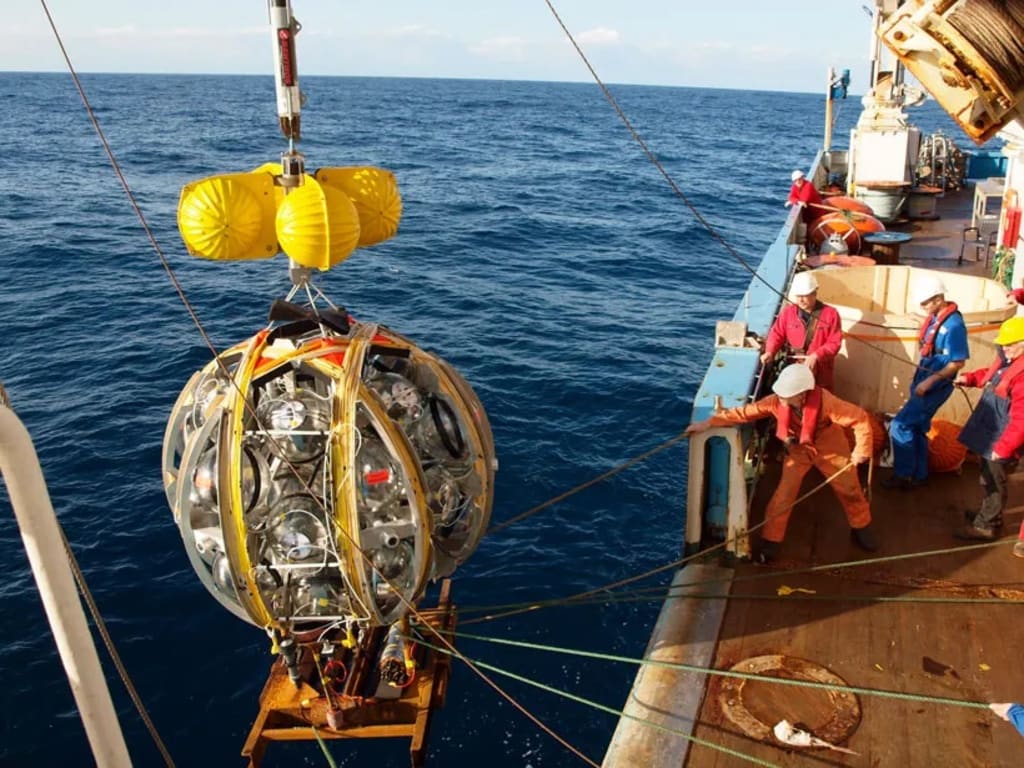
Telescopes Built At Bottom Of The Sea
Across the world, telescopes are the best way for us to see what's out there in space. But did you know that there's actually one being built with a completely different purpose? It's a telescope at the bottom of the sea. [Music] The KM3NeT is a next-generation deep-sea research facility that's being built between 1.5 and 3 miles deep in the waters of the Mediterranean Sea. This research infrastructure will house telescopes that aren't designed to look at light, like the ones we're more familiar with, but instead will be looking through the water at neutrinos. There will be two telescopes: one known as ARCA, which will allow scientists to search for neutrinos that have been produced by distant astrophysical sources, such as gamma-ray bursts, colliding stars, and supernovae; and the other telescope, called ORCA, which is focused on learning more about the properties of neutrinos that have been formed in the Earth's atmosphere.
First of all, what are neutrinos? While you may have heard of basic particles such as electrons, neutrinos are probably less familiar. They too are one of the fundamental particles that make up the universe, but very little is known about them. They were first theorized in 1931 and were given their name by Enrico Fermi in 1934 when he developed his theories on radioactive decay. It had been a mystery why energy and momentum weren't conserved in some radioactive decays, and he accurately explained an unseen neutral particle that carried energy away from the process and named it the little neutral one, or neutrino. It would be another 25 years until the first confirmed detection of a neutrino took place, and they were found to be partners of electrons. Electrons carry an electric charge, but neutrinos are electrically neutral, which means that they are not affected by electromagnetic forces. As far as we know, they are only affected by weak subatomic forces, which have a much shorter range than electromagnetism. So, unlike electrons, which can only pass a limited amount through matter, neutrinos can pass huge distances through objects. This means that they are incredibly difficult to detect.
There are three different types or flavors of neutrinos, each of which is related to a type of electron. The simplest is the electron neutrino, which is associated with electrons, while the other two, the muon and the tau neutrinos, are associated with heavier versions of electrons.
So how does the KM3NeT ARCA and ORCA work? They are not your ordinary telescopes and have been designed to increase the chances of observing neutrinos. As the particles are neutral, they don't interact with matter very often. In fact, about one neutrino passes through a fingernail every second. However, when they do, on that rare occasion, interact with matter, they produce an electrically charged secondary particle. These secondary particles travel through water faster than light, which produces an optical light called Cherenkov radiation, similar to a sonic boom, that can be detected. This is what the telescopes are looking for. By measuring the arrival time of the light, the path of the secondary particle traveling through a detector can be reconstructed, and so can the path of the original neutrino. To do so, KM3NeT will eventually be made up of 10,000 optical modules that are photomultiplier tubes contained within pressure-resistant glass spheres. They will be positioned across 600 detection units that are 700 meters in length and spaced 100 meters apart. This array will, as a result, be able to closely monitor a cubic kilometer of water. The sensors are installed at depths of many miles because this eliminates any interference from other light sources. The Mediterranean is perfect because of the optical properties of the water and its proximity to shore, which allows for the huge data transfer to land as needed. Crucially, only neutrinos can pass through the center of the Earth, so all the sensors are pointed down instead of up to eliminate any other interference.
So, with all this work and setup, what exactly are researchers trying to find? This will be the second purposefully built neutrino telescope, along with the Ice Cube in Antarctica, and the results from the two are expected to provide further insight into these particles. The difficulty in detecting them, because they rarely interact with anything, is also what makes them particularly special. They can be very old and provide information that was created billions of years ago. They are the only particles that can provide data on the universe's earliest moments and from within the cores of astrophysical objects. Scientists hope that studying neutrinos can quickly illuminate our understanding of the universe, our origins, and go some way towards explaining processes that remain a mystery to us. So, the new underwater telescope is very different from what you'd normally think of, and even though it will be facing the direction of the Earth's core, it is the cutting edge of experimental design for looking out into the universe.
Thank you all so much for reading.
……….
About the Creator
Richchik Bardhan
A MBBS student,Love to read and write about science facts and sometimes sci-fic too because Some sci-fic can later be proven into facts someday.....
Keep reading
More stories from Richchik Bardhan and writers in Earth and other communities.
QUEEN OF THE NIGHT
She blooms in full, and her beauty is only witnessed by the night sky. By dawn, she wilts even before the sun’s first kiss, with only her fragrant scent left as the ghost of her evening arrival. Known by many names, such as the Princess of the Night or the Queen of the Night, the Cereus cactus is a species of cactus whose flower only blooms at night, typically between the months of July and October. However, one class of Cereus—possibly coming from the species Epiphyllum oxypetalum—blooms one night a year, and enthusiasts of this species make it a point not to miss it. The blossom it produces on the night it blooms is described as being the size of a newborn infant’s head. By dawn, its pristine white petals wilt, and the flower dies, leaving only its strong, fragrant scent that is equally anticipated by many.
By Richchik Bardhanabout a year ago in Earth
The New Gold Rush is Happening at Wastewater Treatment Plants
I never thought much about where wastewater goes after it leaves my house until I read a study from Arizona State University. Researchers tested sewage sludge from cities across America and found something remarkable.
By Marcus Briggsabout 12 hours ago in Earth
Inflation Remained at 2.7% in December: High Prices Continue to Weigh on Many Americans
As Americans rang in the new year, many were relieved to see that inflation in December held steady at 2.7%, according to the latest reports. On the surface, this might seem like good news — a signal that runaway price growth is slowing. But for countless households across the country, the reality is more complicated: high prices continue to strain budgets, affecting everything from groceries to gas, rent, and beyond. The Numbers Behind the Headlines December’s 2.7% inflation rate, measured year-over-year, shows no significant change from November. This is a continuation of the trend economists have watched closely throughout 2025: after a period of intense price spikes, inflation appears to be moderating but remaining stubbornly above pre-pandemic norms. Key areas contributing to this steady inflation include: Food prices, particularly meat, dairy, and fresh produce, which have remained elevated due to supply chain challenges and global agricultural pressures. Housing costs, including rents and home prices, which continue to rise in many urban and suburban markets. Energy prices, especially gasoline and home heating, which fluctuate seasonally but have not dropped enough to ease household pressure. While 2.7% may seem manageable compared to the double-digit spikes of 2021–2022, it still outpaces wage growth for millions of Americans, meaning that in real terms, many are experiencing reduced purchasing power. How Inflation Affects Everyday Americans For many families, the impact of steady inflation is tangible. Consider this: a household spending $500 a month on groceries in 2025 might now be paying over $535 for the same items. Gasoline, which has seen seasonal swings, can quickly add dozens of dollars to monthly commuting costs. Rent, historically the largest expense for most households, has grown faster than wages in many cities. A steady 2.7% inflation rate means renters face incremental increases in living costs every month, often outpacing salary adjustments. Even seemingly small price increases ripple across budgets. Families may delay purchases, cut discretionary spending, or tap savings, which in turn affects broader consumer demand — a key driver of economic growth. The Role of the Federal Reserve and Economic Policy Inflation is not just about prices at the grocery store — it’s also shaped by monetary policy, interest rates, and government action. Throughout 2025, the Federal Reserve maintained a cautious approach, keeping interest rates relatively high to control inflation without triggering a recession. The Fed’s actions aim to balance: Slowing price growth to protect consumers’ purchasing power Avoiding a sharp economic downturn that could result from overly aggressive rate hikes Despite these efforts, economists warn that inflation’s persistence at 2.7% suggests structural pressures in the economy. Global supply chain disruptions, rising energy costs, and ongoing demand for goods and services continue to exert upward pressure on prices, making it harder for policy alone to bring relief. Inflation and Wage Growth: A Delicate Balance One of the most concerning aspects of steady inflation is its relationship with wages. For workers whose salaries haven’t kept pace with rising costs, inflation effectively reduces real income. Some sectors, like technology and healthcare, have seen modest wage gains, but many service industries — retail, hospitality, and small businesses — continue to struggle. Employees in these fields often find that even small price increases can significantly affect their quality of life, from grocery shopping to transportation and childcare expenses. What This Means for the Economy Steady inflation at 2.7% has several implications for the broader economy: Consumer Spending: When households feel the pinch, discretionary spending declines, which can slow economic growth. Investment Decisions: Businesses facing higher input costs may delay expansion or hiring, affecting job markets. Housing Market Dynamics: Rising rent and home prices continue to challenge affordability, influencing both buyers and renters. Financial Planning: Americans are increasingly turning to budgeting strategies, high-yield savings, or side income to offset higher costs. Economists stress that while inflation at this level is not catastrophic, it remains a long-term concern, especially if wages fail to keep up with price growth. Strategies for Coping with Persistent Inflation For households navigating these pressures, there are several approaches: Budget adjustments: Tracking expenses and prioritizing essential costs can help manage monthly finances. Smart shopping: Using discounts, bulk purchasing, and price comparison can reduce grocery and household costs. Energy efficiency: Lowering utility bills through energy-saving practices mitigates rising energy prices. Financial literacy: Investments, savings, and debt management become even more crucial in times of persistent inflation. While these steps cannot eliminate inflation’s impact, they provide tangible ways for Americans to protect their finances. Looking Ahead Economists predict that inflation in 2026 may continue to hover around 2–3%, barring unexpected shocks such as global conflicts, energy crises, or supply chain disruptions. While not extreme, this range continues to influence household budgets, corporate planning, and government policy decisions. For many Americans, the lesson is clear: even modest inflation can weigh heavily on day-to-day life. Staying informed, adjusting financial habits, and understanding the economic landscape remain essential for navigating a world where prices are higher than before. Steady inflation at 2.7% is a reminder that economic stability is fragile. While the numbers suggest moderation, the lived experience of millions of Americans shows that high prices are far from over, influencing decisions from grocery shopping to career planning. As the new year unfolds, households, businesses, and policymakers alike must grapple with the realities of an economy where every percentage point matters.
By Muhammad Hassan7 days ago in Earth



Comments (3)
Great article Richchik.
Excellent written
Nice article