
Plate Tectonics
The Role of Plate Tectonics in Shaping Continents and Mountains

The Role of Plate Tectonics in Shaping Continents and Mountains
Have you ever wondered how the giant mountains like the Himalayas were formed, or why continents like Africa and South America look like puzzle pieces that could fit together? The answer to both questions comes from a powerful force beneath our feet—plate tectonics.
Plate tectonics is one of the most important processes shaping the surface of the Earth. It explains how continents move, how mountains rise, and even how earthquakes and volcanoes happen. In this article, we’ll explore what plate tectonics is, how it works, and how it has helped shape the continents and mountains we see today.
What Are Tectonic Plates?
To understand plate tectonics, let’s start with the structure of the Earth. Earth is made up of several layers:
- Crust – the thin outer layer where we live.
- Mantle – a thick layer of hot, flowing rock beneath the crust.
- Outer Core – a layer of liquid metal.
- Inner Core – a solid ball made mostly of iron.
The crust and the upper part of the mantle form a layer called the lithosphere. This layer isn’t one solid piece—it’s broken into large sections called tectonic plates. These plates float on the softer, more flexible part of the mantle below called the asthenosphere.
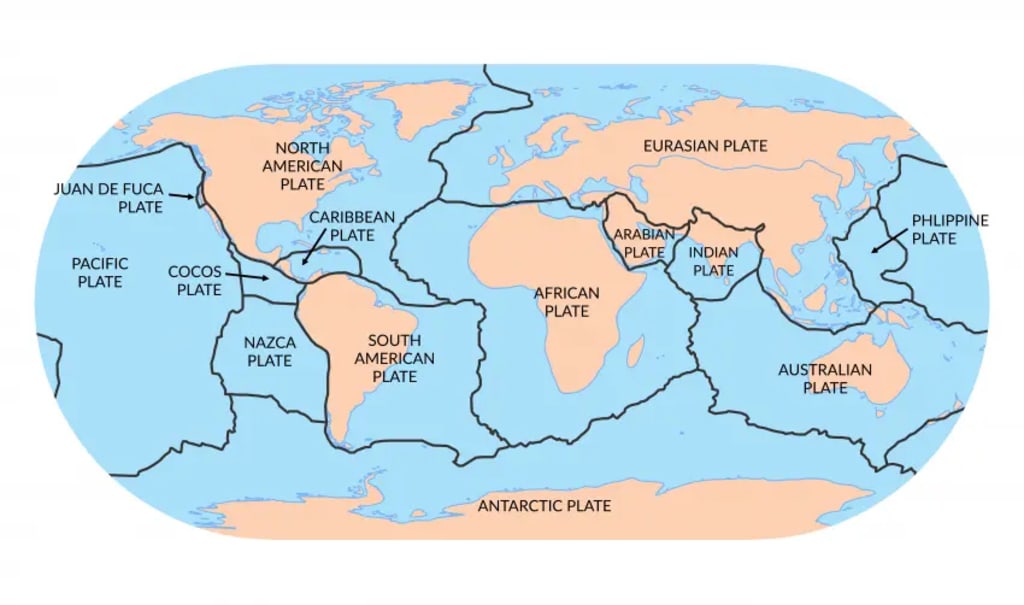
There are about a dozen major tectonic plates, including the North American Plate, the Eurasian Plate, the African Plate, and the Pacific Plate. These plates are always moving, but very slowly—usually just a few centimeters a year, about as fast as your fingernails grow!
How Do Tectonic Plates Move?
Tectonic plates move because of heat deep inside the Earth. The mantle is constantly flowing, like thick soup being heated from below. This creates convection currents—circles of moving rock that slowly drag the plates above them.
There are three main ways plates can move:
- Divergent Boundaries – Plates move apart from each other.
- Convergent Boundaries – Plates move toward each other.
- Transform Boundaries – Plates slide past each other.
Let’s look at how each of these movements helps shape continents and mountains.
Divergent Boundaries: Making New Land
When plates move apart at divergent boundaries, new crust is formed. This usually happens at the bottom of the ocean. Magma (hot melted rock) rises up from the mantle and cools when it reaches the surface, forming new rock.
This process is called seafloor spreading. One example is the Mid-Atlantic Ridge, a giant underwater mountain range where the Atlantic Ocean is slowly getting wider. As the plates move apart, magma rises to fill the gap and hardens into new rock, slowly pushing the continents on either side away from each other.
Sometimes, divergent boundaries can also occur on land. In eastern Africa, the East African Rift is a place where the continent is slowly splitting apart. Over millions of years, it could form a new ocean.
Convergent Boundaries: Building Mountains
When plates collide at convergent boundaries, something amazing happens—mountains can be formed.
There are two main types of collisions:
1. Continent-Continent Collision
When two continental plates crash into each other, neither one wants to sink because they are both light and thick. Instead, they push upward, crumpling like paper and forming huge mountain ranges.
The Himalayas are a perfect example. They were formed when the Indian Plate slammed into the Eurasian Plate. The collision started about 50 million years ago and is still happening today, which is why the Himalayas continue to grow.
2. Ocean-Continent Collision
When an oceanic plate (which is heavier) collides with a continental plate, the oceanic plate slides underneath in a process called subduction. This pushes the continental crust upward, forming mountain ranges and sometimes volcanoes.
The Andes Mountains in South America were formed this way, as the oceanic Nazca Plate is being pushed under the South American Plate.
Transform Boundaries: Shaking Things Up
At transform boundaries, plates slide past each other sideways. They don’t make mountains, but they do cause earthquakes.
One of the most famous transform boundaries is the San Andreas Fault in California. The Pacific Plate and the North American Plate are sliding past each other here. When they get stuck, pressure builds up until it suddenly releases, causing the ground to shake.
Plate Tectonics and Continents
Now that you know how plates move and interact, let’s see how that has shaped the continents.
Millions of years ago, Earth’s continents weren’t where they are today. In fact, all the continents were once joined together in a giant supercontinent called Pangaea. Over time, plate movements slowly pulled them apart.
As the plates moved, the land broke into smaller continents that drifted to their current positions. This is why the coastlines of continents like South America and Africa seem to fit together—they were once connected.
Scientists can also find matching rock layers and fossils on continents that are now far apart, proving they were once joined.
Plate Tectonics and the Rock Cycle
Plate tectonics also plays a big role in the rock cycle, which is how rocks change from one type to another over time.
- When mountains are formed, rocks are pushed up and exposed to weathering and erosion.
- When volcanoes erupt, they release molten rock that cools into igneous rock.
- When rocks are buried deep underground by plate movements, heat and pressure can change them into metamorphic rock.
- And when sediment from erosion gets packed together, it forms sedimentary rock.
Without plate tectonics, the rock cycle would slow down, and Earth’s surface would be very different.
Real-Life Examples of Plate Tectonics at Work
Let’s look at a few places on Earth where we can see plate tectonics in action:
- Iceland sits on the Mid-Atlantic Ridge, where new crust is forming as the Eurasian and North American plates move apart. You can actually walk between the plates there!
- Mount Everest, the tallest mountain on Earth, is still rising because of the ongoing collision between India and Asia.
- Japan is located near several converging plates, which is why it has so many volcanoes and earthquakes.
- California experiences frequent earthquakes because of the sliding plates at the San Andreas Fault.
Why Plate Tectonics Matter
Understanding plate tectonics is important for many reasons:
- Safety – Knowing where earthquakes and volcanoes are likely to happen helps us prepare and save lives.
- Resources – Plate boundaries are often rich in minerals, oil, and gas.
- Climate and Life – The movement of continents affects ocean currents and climate, which in turn affect life on Earth.
Plate tectonics is one of the main reasons Earth is such a dynamic and changing planet.
A World Still in Motion
Even though tectonic plates move very slowly, their effects are huge. Over millions of years, they have shaped the continents, built massive mountain ranges, and created the land we live on.
And the movement hasn’t stopped. The continents are still drifting, the mountains are still rising, and new land is still being made. So the next time you see a mountain or feel a small earthquake, remember that it’s part of a much bigger story—the story of Earth’s moving plates.
Key Vocabulary
- Tectonic Plate – A large piece of the Earth’s crust that moves over the mantle.
- Mantle – The layer of hot rock beneath Earth’s crust.
- Convergent Boundary – A place where two plates come together.
- Divergent Boundary – A place where two plates move apart.
- Transform Boundary – A place where two plates slide past each other.
- Subduction – When one plate slides under another.
- Pangaea – A supercontinent that existed millions of years ago.
- Convection Current – A circular movement of heat in the mantle that moves plates.
Plate tectonics is like Earth’s slow but powerful engine. It’s always working, even if we don’t feel it every day. Over time, it has created the continents we live on and the mountains that rise into the sky. It has made our world what it is—and it will keep changing our planet for millions of years to come.
So next time you look at a map or hike up a hill, remember: you’re standing on a moving piece of Earth’s puzzle.
About the Creator
Jeno Treshan
Story writer Jeno Treshan creates captivating tales filled with adventure, emotion, and imagination. A true lover of words, Jeno weaves unforgettable stories that transport readers to far-off lands.
Keep reading
More stories from Jeno Treshan and writers in Earth and other communities.
Earth's Twin?
Earth's Twin? Comparing Earth to Exoplanets in the Habitable Zone For centuries, humanity has looked up at the stars and wondered: Are we alone? Beyond the poetry of curiosity, there’s a scientific underpinning to the quest — if life exists elsewhere, it most likely thrives on planets that resemble Earth. But how similar must another world be for us to call it an "Earth twin"?
By Jeno Treshan 5 months ago in Earth



Comments
There are no comments for this story
Be the first to respond and start the conversation.