
Pakistan as a Superpower in World War 3
How Pakistan’s geography, military strength, and alliances could reshape global power during a third world war.

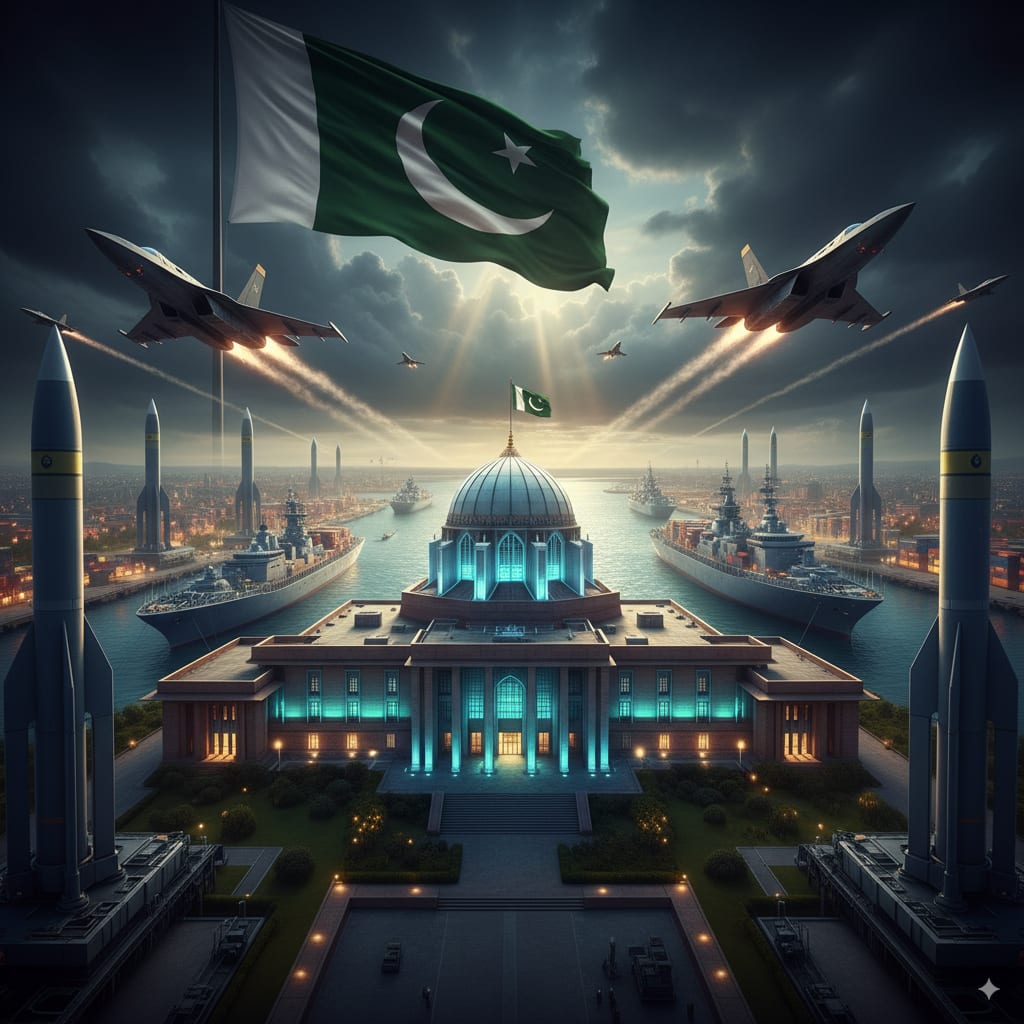
Pakistan as a Superpower in World War 3: A Strategic Imagination
The idea of Pakistan becoming a superpower in the context of a possible World War 3 may sound ambitious, even unrealistic at first. Yet, in geopolitics, wars often transform nations in unpredictable ways. Countries that were once considered secondary players can rise to global dominance if they combine geography, military strength, alliances, and national resilience at the right historical moment. If World War 3 erupts, Pakistan—situated at the crossroads of South Asia, Central Asia, and the Middle East—could emerge as a decisive global power.
1. Pakistan’s Strategic Geography
Pakistan’s most valuable asset is its location. It borders China, India, Afghanistan, Iran, and the Arabian Sea, making it a gateway between Asia, the Middle East, and Europe. In times of global conflict, control of vital trade routes and military chokepoints becomes essential.
The Gwadar Port in Balochistan, part of the China-Pakistan Economic Corridor (CPEC), gives direct access to the Arabian Sea and could serve as a hub for global trade and naval dominance. If World War 3 disrupts traditional shipping lanes, Gwadar could become the “lifeline” for both Asian and Middle Eastern economies, boosting Pakistan’s geopolitical significance.
2. Military and Nuclear Power
Pakistan already ranks among the top ten military powers in the world. Its army is highly experienced, having fought multiple wars with India and engaged in long-term counterterrorism campaigns. The Pakistan Air Force is recognized for its skill, while the Pakistan Navy secures crucial sea routes in the Arabian Sea.
Most importantly, Pakistan is a nuclear power. With an estimated 170–180 nuclear warheads and advanced missile delivery systems, Pakistan possesses one of the world’s most credible deterrent arsenals. In a World War 3 scenario, nuclear capability would make Pakistan not just a regional actor but a global-level power—forcing major nations to engage with it as a key stakeholder.
3. Alliances and Partnerships
Superpower status is not achieved alone. Pakistan’s alliances would define its role in World War 3. Its “all-weather” friendship with China provides military, economic, and diplomatic backing. Pakistan is also deeply connected to the Muslim world, with Saudi Arabia, Turkey, Qatar, and other nations likely to align with it in case of global conflict.
If NATO and the West lean heavily toward India, Pakistan could solidify a new Asian military bloc with China, Russia, and Islamic states—potentially challenging U.S.-led alliances. This would put Pakistan at the center of a massive geopolitical shift.
4. Economic Transformation Under War Conditions
Pakistan’s economy currently struggles with debt, inflation, and weak industrial growth. However, history shows that global wars often transform economies overnight. World War 2 turned the U.S. from a struggling depression-era nation into the world’s economic superpower.
In World War 3, Pakistan’s control of trade corridors, access to energy routes, and defense industry could fuel a wartime economic boom. Strategic investments in technology, agriculture, and manufacturing could accelerate its rise, provided corruption and mismanagement are kept in check.
5. Ideological and Cultural Power
Beyond weapons and trade, Pakistan has an ideological card. As the only Muslim-majority nuclear power, it holds symbolic influence over nearly 1.8 billion Muslims worldwide. In a conflict framed partly along civilizational or religious lines, Pakistan could emerge as the voice of the Muslim world, uniting diverse nations under its leadership.
This cultural and religious influence, combined with military strength, could elevate Pakistan to a unique kind of superpower—both hard power (military) and soft power (identity and ideology).
6. Risks and Challenges
Of course, the path to superpower status is not without danger. Pakistan faces internal challenges: political instability, economic dependency, terrorism, and energy shortages. In a world war, these weaknesses could also expose Pakistan to collapse if not properly managed.
Moreover, rivalry with India—a nuclear power and a potential U.S. ally in World War 3—would be a constant threat. A direct Indo-Pak conflict could devastate South Asia, but if Pakistan maintains discipline and global alliances, it could shift the balance of power in its favor.
Conclusion: A New World Order?
If World War 3 erupts, the world order will not remain the same. Powers like the U.S., Russia, and China may dominate initially, but emerging states like Pakistan could leverage geography, alliances, and nuclear deterrence to rise dramatically.
Pakistan’s potential superpower status lies not just in its weapons, but in its position as a bridge between East and West, Islam and modernity, South Asia and the Middle East. In a fractured, war-torn world, that role could make Pakistan one of the most influential players in shaping the future global order.
Whether this vision becomes reality depends on leadership, unity, and the ability to turn crisis into opportunity. World War 3 may be catastrophic for humanity—but for Pakistan, it could be the moment of transformation.
About the Creator
Wings of Time
I'm Wings of Time—a storyteller from Swat, Pakistan. I write immersive, researched tales of war, aviation, and history that bring the past roaring back to life
Keep reading
More stories from Wings of Time and writers in Earth and other communities.
Pakistan vs India: Secret Israel-India Military Alliance Exposed
Pakistan vs India: Secret Israel-India Military Alliance Exposed India vs China: The Silent War for Global Dominance In the shifting sands of global geopolitics, one of the most significant but less openly discussed developments is the growing defense and intelligence partnership between India and Israel. For decades, Pakistan and India have been locked in rivalry, with both nations seeking allies to strengthen their positions. Now, Israel’s increasing role in India’s military growth raises serious questions for Pakistan, its national security, and the balance of power in South Asia.
By Wings of Time 4 months ago in Earth
Tea of Silence
The snow had covered the hills for days, turning the land into a quiet white world where sound seemed afraid to exist. On the highest of these hills, beneath a dry, leafless tree, a young man sat alone. The tree had long ago lost its strength, its branches thin and broken, but it still stood, as if refusing to disappear. The young man chose this place often, not because it was comfortable, but because it was honest.
By Bilal Mohammadi6 days ago in Earth
Microbiota, microbiome or microflora: how to speak correctly and why it is for health.
You've probably heard the phrase, "We are what we eat." But modern science says more precisely: we are also those who live in us. Until 2016, it was believed that there are many times more bacteria in our body than our own cells. The latest calculations by mathematicians show that we divide the body with our microorganisms by about 50/50: about 30 trillion of our cells versus 38 trillion bacterial ones.
By Yaroslav Gorohov2 days ago in Earth



Comments
There are no comments for this story
Be the first to respond and start the conversation.