
Our power station on the roof
It's early days, but we think we have done the right thing by installing solar panels


We have made a decisive move to do our bit to combat global warming and save the oceans by installing solar panels on the roof of our house. At the time of writing, they have been in place for less than a week (and the scaffolding has yet to be removed), so we cannot as yet tell just how big a contribution we will make over time, but we certainly expect it to be worthwhile.
The process of getting the panels installed was fairly straightforward, but we did experience a major hiccup along the way.
Our house is more than 100 years old and is in a village on the former Leicestershire (UK) coalfield. Like many houses of the same age in this area it has a slate roof, as opposed to a tiled one, and the slates – which would have come from a Welsh quarry – will also be around a century old. This was the problem, because when the guys who were installing the solar panels started to drill into them to fit the fixing brackets, they found that many of the slates were too thin and brittle to avoid cracking right across.
We were therefore faced with a choice – abandon the whole idea or have the roof re-slated? We decided on the latter, because we were really keen to press ahead with the solar panel project, despite the extra cost involved (about 50% extra as it turned out).
The next problem was finding a firm that could do the job without too much delay. Here we got lucky, because I mentioned this problem to one of the guys who was working on our garden at the time, and he passed the word on to “a mate of his” who was able to do the re-slating the following week, using new Spanish slates that were perfectly capable of being drilled. We therefore acquired a brand new roof that we will never see again due to it now being covered by twelve solar panels!
When the solar panel people came back they were able to complete the installation in a day, which was fortunately a dry and sunny one, following several that had definitely not been so. Putting the panels on the roof was only part of the job, because they also needed to fix two box units on to the front of our house (the panels are on the other side). These are the system’s control box and the battery unit that can store excess electricity coming from the panels and then feed it back to our domestic supply when it is needed. The boxes are not all that attractive, but they have got the neighbours talking!
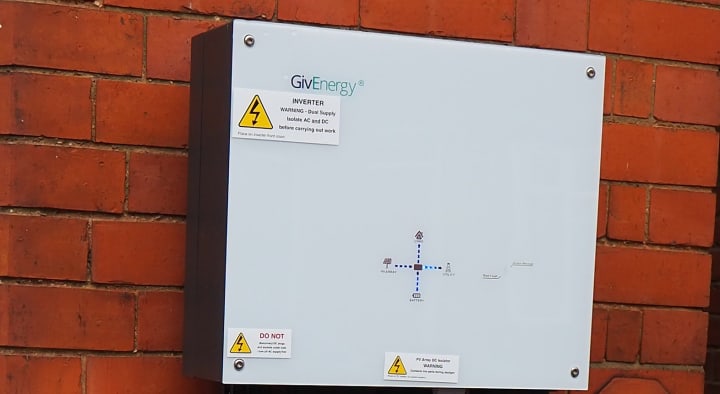
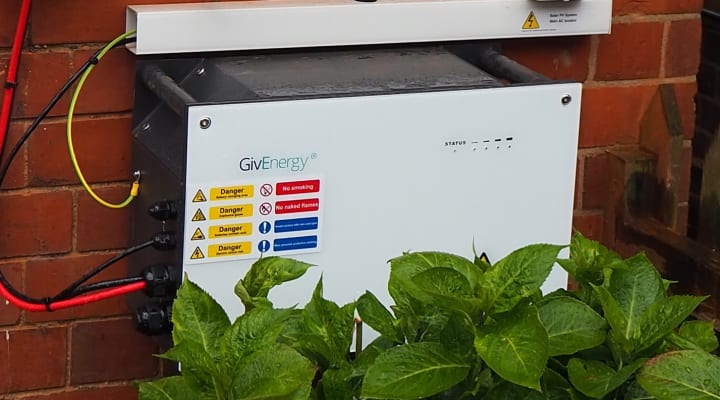
Connections had to be made to link the panels to the boxes on the outside wall, and our existing meter and fuse-box on the inside of the house. This meant passing cables from the panels through part of our attic (loft) space – which is fortunately quite easy to get at – then along a conduit down the outside wall and round the corner to the boxes. It also meant drilling a hole through the wall next to our internal units so that cables could be threaded through and connected to the new outside boxes. This latter job took quite some time (and a lot of noise!) due to the fact our exterior walls consist of a double thickness of solid Leicestershire bricks with no cavity – that’s how these houses were built before World War I!
The End Result
So what have we got? A system that is designed to capture energy directly from the Sun and translate it into part of our domestic power supply, thus using less of that supplied by an electricity company. This should benefit us two-fold – by cutting our bills and also giving us the opportunity to export power to the grid at times when our generation of electricity exceeds our immediate needs. We will be paid directly by the power company when this happens.
It is not true to say that solar panels only work when the sun is shining, because there is still current produced under cloudy skies, although nothing like as much. Our panels are on a roof that faces south-east, so the best times for direct sunshine are during the morning and early afternoon. Later on, the sun moves out of direct range of the panels, but that does not matter too much because there is a building not far away that has a solid white-painted wall which catches any direct evening sunshine and bounces it straight back to the panels on our roof – very convenient!
The electricity company – who, I should have mentioned before, are also the suppliers and installers of the whole system – have given us access to an app that shows us exactly how much work the panels are doing at all times of the day, and how much of their electricity we are saving as a result. The graphics are excellent, showing just where the current is flowing – from the panels to the control system and thence to our domestic supply, to and from the battery box, and from the latter to both our supply and the external grid. It also shows how our power demands fluctuate and how much we are using at all times.
As I write, the system has only had four complete days of operation, and all of them have been overcast and rainy, with only brief glimpses of sunshine! Could all this bad weather be our fault? Some of our neighbours have dropping hints that this might be so! It is therefore not possible to say just how much benefit we might expect to gain, based on our experience to date. However, it is already clear that at least some savings are being made – yesterday, for example, the panels provided 14 kwH during a day when we consumed 40.6 kwH of electricity, which means that about one-third of our consumption was provided by our power station on the roof during a day that did not have a huge amount of sunshine.
I am looking forward to days later on in the summer when – with any luck – we should get unbroken sunshine and one of our major power consumers – our electric-powered Aga cooker, which normally stays on all the time because it provides a general heat source as well as cooking our food and boiling the kettle – is turned off for its summer break and we rely on a separate electric cooker and an electric kettle. I can foresee days when the panels will supply more power than we consume.
Our carbon footprint
There is another very interesting statistic displayed on the app mentioned above. This is “CO2 emissions saved”, calculated as fractions of a tonne in terms of current use and a cumulative total. Today’s total so far, for example, is 0.011 tonnes and the “total emissions saved” (i.e. since the panels were installed) figure is 0.051 tonnes. 51 kilos is the same as 112 pounds.
Given that the UK emits around 350 million tons of CO2 in a year (the figure for the United States is more than 5 billion tons), 112 pounds in five days does not sound like much, and of course it is not (until you imagine yourself picking up 56 bags of sugar or 129 cans of coke!). However, if that figure is extrapolated to cover a whole year, we are looking at more than 8,000 pounds (or 3.6 metric tonnes). Given that there are many roofs in the country that are also saving carbon, and vastly more that could be doing so, the conclusion has to be that this could be a very important route towards emissions saving and thus a valuable weapon in the fight against global warming.
A poem to end with
My recent experience led me to leap headlong into poetry! Based on the idea that we were doing our tiny bit to save CO2 emissions by generating our own electricity rather than allowing fossil fuels to do so on our behalf, these were the thoughts that came to mind:
*
The panels are on the roof, generating.
They’re supposed to turn sunlight into watts,
Cutting our bills, saving the planet.
Only one problem – since the guys who put them there went home
(In brilliant sunshine I might add)
The clouds have come and gathered ever since,
Not so much as a peep or a shard
Of the big yellow ball in the sky.
But all is not completely lost.
These panel things work – a bit, so the man said –
Just from normal daylight.
After Day One, the meter reading said – clear as sunshine –
That we had now saved Planet Earth
To the tune of ten kilos of CO2.
Wow!
That’s twenty-two pounds in English!
Ten bags of sugar!
Three decent-sized new-born babies!
A CO2 counterbalance (maybe) to:
A ranch cow having a couple of burps?
A plane flying half a millimetre?
A sapling being felled in a rainforest?
A fat arse trumping on a manicured green?
(But that must be more than 10 kilos, surely?)
And when the sun comes out,
How much planet-saving then?
Half an hour of beefy burps?
A whole metre of flight?
A tree and the ape that lived in it?
(Don’t know about the arseing golfer, though).
But it’s not just us -
If a million roofs bask in the sun
And make billions of watts,
Surely it must do Planet Earth
A power of good?
About the Creator
John Welford
John was a retired librarian, having spent most of his career in academic and industrial libraries.
He wrote on a number of subjects and also wrote stories as a member of the "Hinckley Scribblers".
Unfortunately John died in early July.
Keep reading
More stories from John Welford and writers in Earth and other communities.
The distance from Earth to the Moon
The distance between the Earth and the Moon is not constant, but varies over the course of the Moon’s orbit around the Earth, which is not a perfect circle but an ellipse. The point at which the Moon is furthest from Earth is called the apogee, and the nearest point is called the perigee. These points do not coincide with the phases of the Moon (i.e. when there is a full moon, or crescent moon, etc), and they vary from year to year.
By John Welford5 years ago in Earth
Seven Earth-Sized Planets Discovered Beyond Our Solar System
In one of the most exciting breakthroughs in modern astronomy, scientists have discovered a system of seven Earth-sized planets orbiting a distant star. This extraordinary finding has captured global attention because several of these planets exist in the “habitable zone,” where conditions may allow liquid water to exist. The discovery not only expands our understanding of planetary systems but also strengthens the possibility that life might exist beyond our solar system.
By Irshad Abbasi 4 days ago in Earth


Comments
There are no comments for this story
Be the first to respond and start the conversation.