
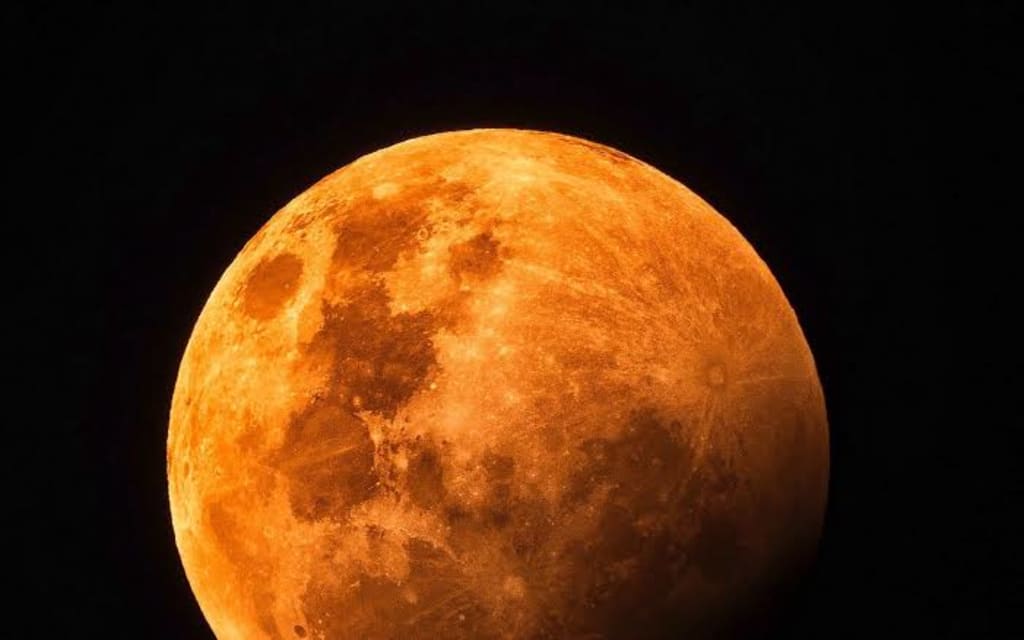
An orange moon is a stunning and rare sight that occurs when the moon is low on the horizon and appears to take on an orange or reddish hue. This phenomenon is caused by the way that light is scattered and filtered through the Earth's atmosphere, particularly during times of atmospheric disturbance or pollution.
When the moon is low on the horizon, its light must travel through more of the Earth's atmosphere to reach our eyes, compared to when it is higher in the sky. This causes the shorter, blue wavelengths of light to be scattered and filtered out, leaving only the longer, reddish wavelengths to reach our eyes. This gives the moon its distinctive orange or reddish color.
There are many factors that can contribute to the appearance of an orange moon, including the presence of dust or pollution in the atmosphere, as well as atmospheric disturbances such as wildfires or volcanic eruptions. These events can create a haze or a layer of particles in the atmosphere that scatter and filter the moon's light, causing it to take on a vivid orange or red color.
The appearance of an orange moon can also be affected by the position of the moon in relation to the Earth and the Sun. During a lunar eclipse, for example, the moon passes through the Earth's shadow and takes on a deep red color. This is known as a blood moon and is a rare and spectacular event that is highly prized by astronomers and stargazers alike.
In many cultures and traditions, the moon is a symbol of mystery, romance, and spirituality. The appearance of an orange moon is often seen as a special and meaningful event, with many people believing that it signifies a time of change, transformation, or spiritual awakening. Some people even believe that the orange moon has magical or mystical properties, and use its energy for spells and rituals.
In conclusion, an orange moon is a rare and beautiful sight that is caused by the way that light is scattered and filtered through the Earth's atmosphere. Whether viewed as a natural phenomenon or as a symbol of mystery and spirituality, an orange moon is a unique and unforgettable experience that reminds us of the wonders and mysteries of the natural world.
Remember our atmosphere on Earth acts much like a filter on a camera taking out or adjusting the balance of colors and wavelengths as we see them. In outer space there is no atmosphere and the Moon's true gray colors appear without any filters applied. White light is the combination of all colors in the visible light spectrum. As the white light from the Sun is reflected off the Moon it enters our atmosphere. The atmosphere scatters the different wavelengths so that we see different colors representing the Sun and Moon based on a variety of factors.
We have learned that the Moon when viewed from outside the Earth's atmosphere is gray. Yet from inside the atmosphere it ranges from orange to yellow to white depending on where it is in the sky, the amount of light surrounding it (day vs night), and the dust or pollution in the atmosphere. During a lunar eclipse the Moon can even appear red and is sometimes called a Blood Moon.
When the Moon is orange it is because the atmosphere is filtering out the shorter wavelengths. This can be due to being low in the sky, particles in the air such as dust, or even smoke from wildfires can diffuse the wavelengths and make the Moon appear orange. When the Moon rises into the sky it often looks yellow, for the same reasons the Sun looks yellow as it is higher in the sky. The light waves go through a small amount of atmosphere, but most of the light arrives at our eyes as it is reflected. However, during the day the Moon high in the sky often looks white. This is because during the day it is competing with the light from the Sun. The Sun is much brighter, being the source of the light, and thus the Moon seems less colorful and white as it reflects light through our atmosphere.
About the Creator
Forecasters Warn of ‘Potentially Catastrophic’ Storm Threatening Texas to the Carolinas
A massive storm system is on the horizon, and forecasters are raising the alarm for communities stretching from Texas to the Carolinas. Officials are warning that this could be a “potentially catastrophic” weather event, with heavy rainfall, hurricane-force winds, and dangerous flooding expected across multiple states. As residents prepare for what could be a historic storm, experts are urging vigilance and proactive measures to minimize risk. A Storm Unlike Any in Recent Memory Meteorologists describe this storm as unusually powerful, with characteristics of both a tropical system and a winter storm. The National Weather Service (NWS) has issued alerts across a wide swath of the southern and eastern United States, highlighting the potential for flash flooding, tornadoes, and prolonged power outages. According to Dr. Karen Whitfield, a senior meteorologist with the NWS, “The size and intensity of this system are alarming. The combination of warm Gulf moisture and high-pressure systems in the north is creating conditions that could make this one of the most destructive storms in recent history.” Rainfall totals could reach 10 to 15 inches in some areas, particularly in low-lying regions along the Gulf Coast and parts of the Carolinas. Rivers already swollen from recent precipitation could overflow, putting communities at immediate risk. States on High Alert From Houston to Charlotte, emergency management teams are mobilizing resources. Texas officials have activated disaster response units and are advising residents in flood-prone areas to consider evacuation plans. In Louisiana, emergency shelters are being readied for potentially thousands of displaced residents. The Carolinas, which were hit by flooding last year, are preparing for similar challenges. Local governments are emphasizing the importance of early warning systems, urging citizens to monitor weather updates and heed evacuation notices promptly. Governor Laura Jenkins of North Carolina stated, “We cannot stress enough the importance of taking these warnings seriously. This storm has the potential to cause catastrophic damage, and the safety of our residents is our top priority.” The Human and Economic Toll Beyond the immediate threat to life and property, experts predict that the storm could have significant economic consequences. Power outages could disrupt businesses, transportation, and supply chains. Schools and public services may face closures, further complicating recovery efforts. Insurance companies are already warning of increased claims due to property damage. According to industry analysts, this storm could rival some of the costliest weather events in U.S. history if rainfall and wind speeds reach projected levels. Preparing for the Worst Meteorologists emphasize that preparation is key. Residents in affected areas are advised to: Secure property: Bring outdoor furniture, garbage bins, and other loose objects indoors to prevent them from becoming projectiles. Stock up on essentials: Water, non-perishable food, medications, and batteries should be readily available. Plan evacuation routes: Know multiple routes out of flood-prone areas and identify local shelters. Stay informed: Monitor official channels for updates from the NWS, FEMA, and local authorities. Emergency management teams are also using social media and local news outlets to reach residents quickly, providing real-time information on evacuation orders, shelter openings, and weather updates. The Role of Climate Change While no single storm can be directly attributed to climate change, scientists note that warming ocean temperatures and shifting weather patterns increase the likelihood of extreme storms. The Gulf of Mexico, for instance, has been experiencing above-average sea surface temperatures, fueling the energy of storms forming over its waters. Dr. Whitfield explains, “Warmer waters mean more moisture and stronger winds in storms. This doesn’t happen in isolation — it’s part of a larger trend where extreme weather events are becoming more frequent and more severe.” Looking Ahead Forecasters say that the storm’s trajectory could shift as it moves inland, and residents should remain alert for updates. While initial predictions suggest the greatest impact will be felt along the Gulf Coast and southeastern states, heavy rain and gusty winds could affect areas as far north as Virginia and Tennessee. Meteorologists stress that preparation now can save lives later. “It’s better to be over-prepared than under-prepared,” said Whitfield. “Even if the storm shifts slightly, the risks remain very real.” Communities across Texas, Louisiana, Mississippi, Georgia, and the Carolinas are bracing for what could be a defining weather event of the year. Authorities, residents, and businesses are mobilizing to minimize damage and ensure safety, hoping that early action will prevent loss of life and property. As the storm approaches, officials urge calm but firm action. From evacuations to emergency supplies, the steps taken in the coming hours could make all the difference.
By Muhammad Hassan6 days ago in Earth
The New Gold Rush is Happening at Wastewater Treatment Plants
I never thought much about where wastewater goes after it leaves my house until I read a study from Arizona State University. Researchers tested sewage sludge from cities across America and found something remarkable.
By Marcus Briggs7 days ago in Earth
Affection and Healing for Yourself
During the night of the last quarter moon, I gathered my ritual supplies. I carefully handled the chunk of black tourmaline that would protect me from your overall negative and narcissistic energy. I carefully walked the house with my stick of selenite in hand, asking the universe to cleanse our working space.
By Alisha Wilkins ✒️🦋🖋️7 days ago in Fiction



Comments
There are no comments for this story
Be the first to respond and start the conversation.