
Only 36.5 light-years away from Earth, there may be alien life
A 'super-Earth' has been discovered


There are countless stars in the vast universe, and the sun is just one of them. Since this realization, people have begun to speculate that other stars in the universe also have their planets like the sun.
While this is plausible, because the planets themselves do not emit light and are very small in mass and size (relative to stars), this speculation has not been verified for a long time in the past.
It wasn't until 1995 that astronomers discovered the first exoplanet orbiting a main-sequence star, "51 Pegasus b" (51 Pegasus b). Hot field, so far, astronomers have discovered and confirmed more than 4,000 exoplanets, many of which are rocky planets larger in size and mass than Earth, also known as "Super-Earths".
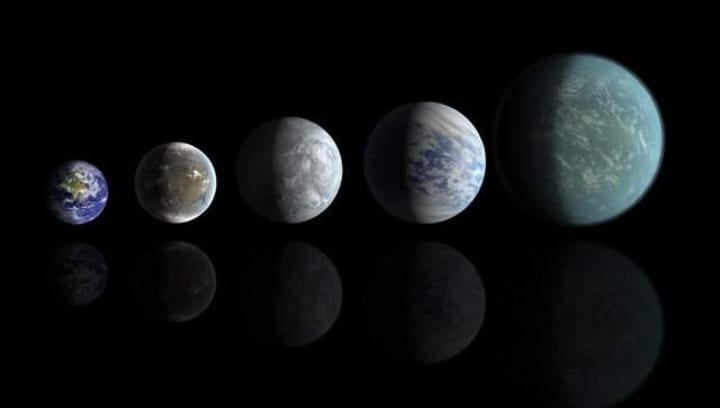
Recently, a research team composed of several astronomers published a paper [1] saying that another "super-Earth" was discovered only 36.5 light-years away from the earth, and the astronomers named it "Ross 508 b". ” (Ross 508b).
"Ross 508 b" orbits a star named "Ross 508" in the sky in the constellation Serpens, a red dwarf of spectral type M4.5 with a mass It is about 18% of the sun, the radius is about 21% of the sun, and the effective temperature is about 3071K (Kelvin).
Observational data show that the mass of "Ross 508 b" is about 4 times that of the Earth, and the average distance between its orbit and the host star is only 0.053 AU (equivalent to 5.3% of the distance between the Sun and the Earth), and it orbits its host about every 10.75 days. A star revolves once.
Since "Ross 508" is a faint red dwarf, its habitable zone is further inward than the sun, so this distance just puts "Ross 508 b" in the habitable zone of its host star. In this case, the surface temperature of "Ross 508 b" can allow liquid water to exist, which means that there may be alien life on this "super-Earth".
It should be noted that this is only a hypothesis that cannot be verified for the time being. To take a step back, even if there is extraterrestrial life in "Ross 508 b", they will live a lot harder than life on Earth. There are two main reasons. reason.
The first reason is that because "Ross 508 b" is so close to its host star, it is likely to have been tidally locked, which would cause "Ross 508 b" to always face its star on the same side The host star, in this case, its "sunny side" will always be roasted by the host star, and its surface temperature will be very high, while the "backward side" will become a star because it cannot be illuminated by the host star. A "dark world" with very low temperatures.
If this is the case, then the natural environment of the "sunny side" and "backward side" of "Ross 508 b" is very unfriendly to life, and it is only possible in the narrow area where the "sunny side" and "backward side" meet. Conditions suitable for life exist.
Another reason is that, compared with yellow dwarfs like the sun, red dwarfs are much more grumpy, and huge flares often appear on the surface of such stars.
The reason for this is actually because the mass of the red dwarf is relatively small so it cannot form a "radiation layer" like the sun that can prevent the outer material from entering its core, which will cause the outer and core of the red dwarf. The material can directly form convection, which makes its surface very unstable.
When a flare appears on the surface of a red dwarf star, it releases much higher energy than usual through electromagnetic radiation (mainly concentrated in X-rays, ultraviolet light, and radio bands). For this, we can look at a specific example: the closest to the sun star - Proximal Centaur.
Proximal Centaur is a red dwarf star slightly smaller than "Ross 508". In the past few days, astronomers have often observed huge flares of Proximal Centaur, especially in May 2019, when Proximal Centaur appeared An astonishing super flare, whose brightness in the ultraviolet band increased by about 14,000 times in 7 seconds, compared with the largest known solar flare, only this super flare of about 1%.
As mentioned earlier, "Ross 508 b" is only 0.053 AU away from the main star, so it is not difficult to imagine that if there exists life on this "super-Earth", they may also just live Simple creatures underground or in the depths of the ocean because life (at least life as we know it) can hardly survive and thrive for long on the surface of a planet that is "hit" by flare events at close range from time to time.
About the Creator
Baudamolova
Science is the graveyard of buried faded the various ideas。
Keep reading
More stories from Baudamolova and writers in Earth and other communities.
Nuclear fusion ends at iron
An atom is made up of a nucleus and electrons, while the nucleus is made up of neutrons and protons. For an atom, the number of protons in its nucleus determines the type of element it is. For example, the element hydrogen with atomic number 1 has only one proton in its nucleus, helium with atomic number 2 has two protons in its nucleus, and so on for other elements.
By Baudamolova3 years ago in Earth
O-Ring Seals Market Size and Forecast 2025–2033
Introduction In an era defined by advanced engineering, sustainability goals, and performance efficiency, the smallest components often play the biggest roles. Among these unsung heroes of modern manufacturing are O-ring seals—simple, circular devices that quietly prevent leaks, ensure safety, and keep critical systems functioning under extreme conditions.
By Aaina Oberoi3 days ago in Earth
The Refrigerant Transition
Cooling seldom features in climate headlines, yet it is one of the quietest success stories of the last decade. Under the Kigali Amendment to the Montreal Protocol, countries are phasing down hydrofluorocarbons (HFCs)—super-pollutant refrigerants—while retailers and manufacturers rapidly switch to ultra-low-GWP “natural” refrigerants such as carbon dioxide (R744) and propane (R290). Fully implemented, Kigali alone can avert roughly 0.4–0.5°C of warming by 2100; paired with efficiency improvements, the avoided warming can be closer to ~1°C—an enormous contribution from a single policy family [1–2].
By Futoshi Tachino5 days ago in Earth
Wild Card Weekend Recap: What Happens Now?
I think I figured out why I love Wild Card Weekend so much. It's because it's the first playoff anything of the calendar year. The NFL season starts in the fall, and once upon a time, the champion was crowned either on or slightly before New Year's. The evolution of the NFL schedule has resulted in the playoffs starting just into the New Year, and currently, the final week of the season falls on the first weekend of the New Year, with Wild Card Weekend coming a week after that. So yes, chronologically, the NFL's Wild Card Weekend serves as the first playoff anything of the calendar year.
By Clyde E. Dawkins4 days ago in Unbalanced




Comments
There are no comments for this story
Be the first to respond and start the conversation.